
Private equity · 6 min read
Raise prices before an exit without putting your customer base at risk

Key points
- A price increase before a software company's exit starts about two years before the sale. Buyers discount increases that only appear in the business plan.
- When a software company raises prices before an exit, it protects its customers with a reason they can follow, steps for large customers and outreach from familiar faces.
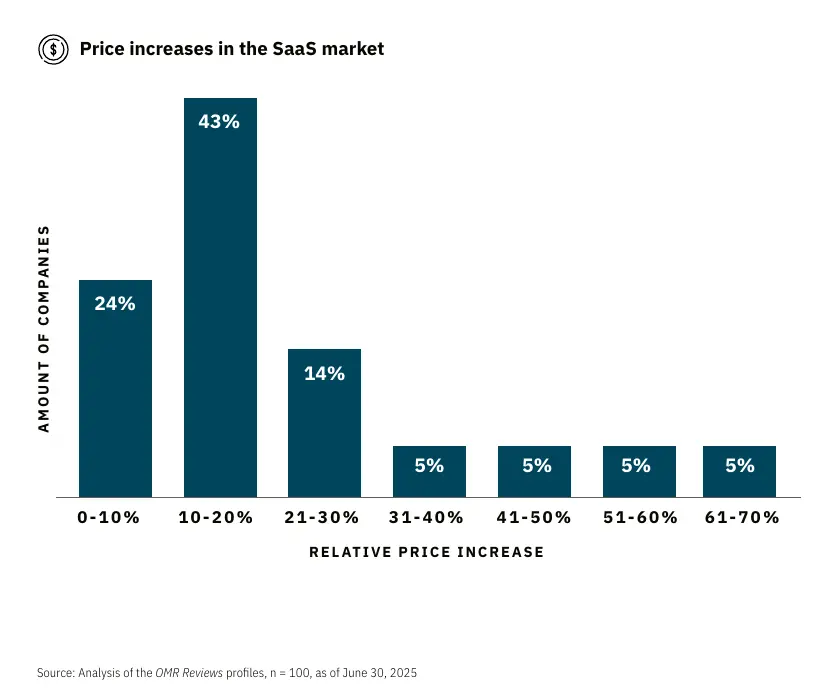
- Two out of three price increases by software vendors on the German software review platform OMR Reviews were between 0 and 20%. A software company closes larger gaps before an exit in two steps.
- Changing a software company's pricing model shortly before an exit is risky. New revenue models take two to four years before customers fully adopt them.
If you want to raise a software company's prices before an exit, start about two years before the sale, so buyers can already see the effect in revenue, EBITDA and retention. You protect the customer base with three things: a reason the customer can follow, steps for large customers and outreach from the people the customer knows. This article is for shareholders, operating partners and managing directors of a software company that's set to be sold in the next two to three years.
Buyers pay for what they see in the numbers
Mark Miller, founder and managing partner of the M&A advisory firm Carlsquare, gave sellers clear advice: “It’s better, of course, to raise the prices yourself before you sell.” His reasoning fits into three words: “seeing is believing.” When the time is right, he would “rather wait another two years and raise the prices.”
The reason lies in how valuations work. Felicitas May, investment director and head of value creation at Beyond Capital Partners, describes the buyer's view like this: At exit, you pay “for the quality of revenue, not for a potential chance at revenue.” A price increase that has been in revenue for twelve months and hasn't hurt retention is revenue quality. A price increase in the business plan is a chance, and the buyer discounts it.
If time runs short, there's a middle path. Miller described a sale in which the pandemic made a planned price increase impossible before closing. The parties agreed on gradual increases after the sale and made them part of the earn-out. So the buyer pays the premium only once the increase has worked.
Why prices often sit untouched before a sale
Many software companies go into a sale with prices that haven't changed in years. Often the worry behind it is that an increase could cost customers. For the company's owners, a lot rides on that. The fear is understandable. But data rarely backs it up.
Our project experience says otherwise. In software models, we often see retention above 90 to 95% after price increases. Dr. Stephan Schmid of BU Bregal Unternehmerkapital said of the pricing projects in his portfolio that they “never reached the point where the relationship between the company and its customers was lastingly strained.” When someone once worried that all customers would run away after a price increase, I answered: “No, not gonna happen.” Price is rarely the number one criterion in software selection. In our studies, it often ranks third or fourth.
How much and how fast
The market mostly moves in moderate steps. For our SaaS & AI Pricing Report 2026, we analyzed 100 software profiles on the German software review platform OMR Reviews. In 67% of the price increases there, the increase was between 0 and 20%. Larger jumps happen mainly where existing customers haven't had an adjustment in a long time. If you want to close the gap to the current price list in one step, you need a very good reason. If you have two years, you can close it in two steps and show both in the numbers before the sale.
You can calculate in advance how much churn a price increase can absorb against its EBITDA effect.
Five rules that protect the customer base
- Segment. Split customers by their distance from the current price list, by size and by depth of integration. Deeply integrated customers switch less often. Customers who only use a product superficially need more justification for the increase.
- Give a reason. No pricing move without a reason the customer can follow. Good reasons are new features, higher costs or a product roadmap you're investing in. Microsoft justified its increase for Office 365 and Microsoft 365, by its own account the first substantial one since Office 365 launched ten years earlier, in exactly this way: with 24 additional apps in the plans and more than 1,400 new features.
- Steps for large customers. Large customers often can't push an increase through internally in a single step. A step plan over one to two years takes that pressure off them.
- The familiar face speaks. The founder or the customer's existing contact communicates the increase. If the founder distances himself when a customer calls, the increase has failed.
- Measure monthly. Track gross revenue retention, downgrades and the price actually enforced every month during the transition. For that, you need a fixed set of pricing KPIs.
The announcement itself follows its own rules on wording and lead time.
Timeline to signing
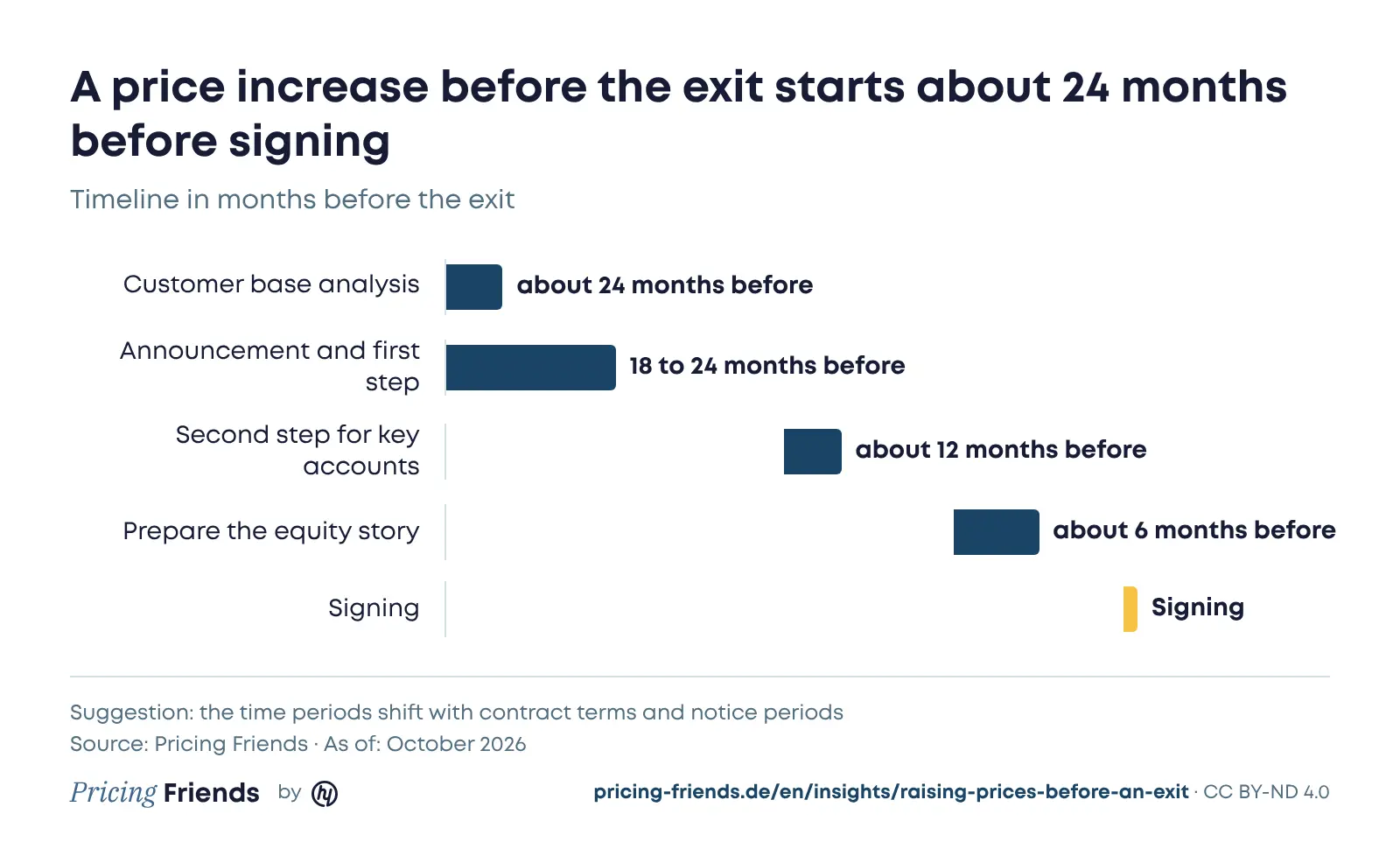
The time frames are our suggestion. They depend on contract terms and notice periods.
| Time before exit | Step | What a buyer sees later |
|---|---|---|
| About 24 months | Baseline analysis: prices per customer against the current list, segments, contract clauses | Clean data in the data room |
| 18 to 24 months | Announcement and first step for all segments | Twelve months of revenue at the new price |
| 12 months | Second step for large customers, evaluate retention | Stable gross revenue retention after the increase |
| 6 months | Prepare KPIs and rationale for the equity story | Proven pricing power |
| Signing | Remaining potential as an evidence-backed plan, possibly in the earn-out | Upside with proof |
What to leave alone before an exit
Switching the entire pricing model shortly before a sale is risky. In Felicitas May's experience, new revenue models take two to four years before customers fully adopt them. If you cut off recurring revenue shortly before the exit to introduce a new model, you show the buyer exactly the revenue slump they are valuing. When you switch from licenses to subscriptions, license sales disappear in the first year and revenue collapses. A change like that belongs at the start of the holding period, in the value creation plan after the deal.
Being well prepared also means anticipating buyers' questions. Miller advises preparing topics like the pricing strategy before due diligence, because that makes it easier for the buyer to build their own business case. Preparing solid evidence for buyers is a task a specialized pricing consultancy like hy can help with.
Miller reports that AI strategy now belongs in every due diligence and every equity story. We expect buyers to ask next how that strategy makes money. A company that has priced an AI feature before the exit and can show its adoption in numbers answers both questions at once.
Bottom line: Raise early, in steps, for a good reason
Raise prices about two years before an exit, so the effect on revenue and retention is proven. You keep the customer base with a reason customers can follow, steps for large customers and the face the customer knows. Whatever can't take effect in time goes into the process as an evidence-backed plan, through an earn-out if needed.
The portfolio check shows how your portfolio companies look from the outside before a sale: Enter up to ten domains and get a score from 0 to 100 for each company, its pricing model in one line and the most important finding. The overview arrives by email.
Sources
- SaaS & AI Pricing Report 2027 by hy, p. 13
- SaaS & AI Pricing Report 2026 by hy, p. 41
- Pricing Friends, episode 5: Private Equity und Pricing mit Andreas Spiegel: Wie revolutioniert effektives Pricing den Wert von Softwareunternehmen?
- Pricing Friends, episode 99: Sonderfolge: SaaS-Pricing, AI und die Zukunft der Preismodelle, Dr. Sebastian Voigt bei Julius Göllner
- Pricing Friends, episode 123: Software-M&A und Pricing mit Mark Miller: Was entscheidet über den Preis einer SaaS-Company beim Exit?
- Pricing Friends, episode 129: Private Equity und Pricing mit Dr. Stephan Schmid
- Pricing Friends, episode 147: AI Value Creation im Private Equity: Wie wird aus KI-Effizienz echter Umsatz?
- Microsoft: New pricing for Microsoft 365, August 19, 2021
Quotes are translated from German. The podcast episodes are in German.