
Price increases · 7 min read
How to get sales discounts under control: Rules that hold

Key points
- Every discount in software sales needs something in return, an expiration date and an approval level. A discount with nothing in return only shows procurement that there's more to get.
- Before setting new discount rules, a software vendor measures where its discounts land: the average, the spread between reps and the clustering at quarter end.
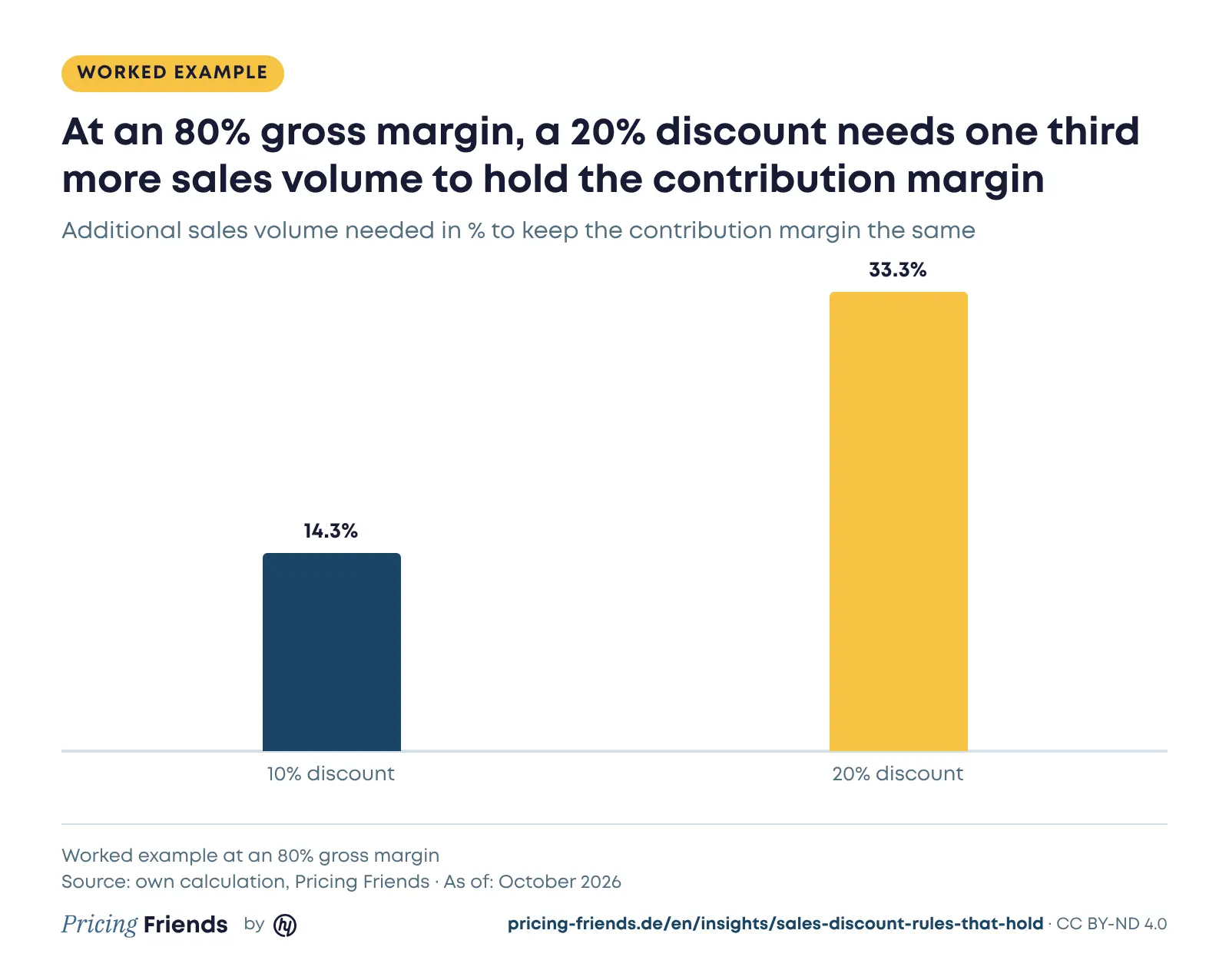
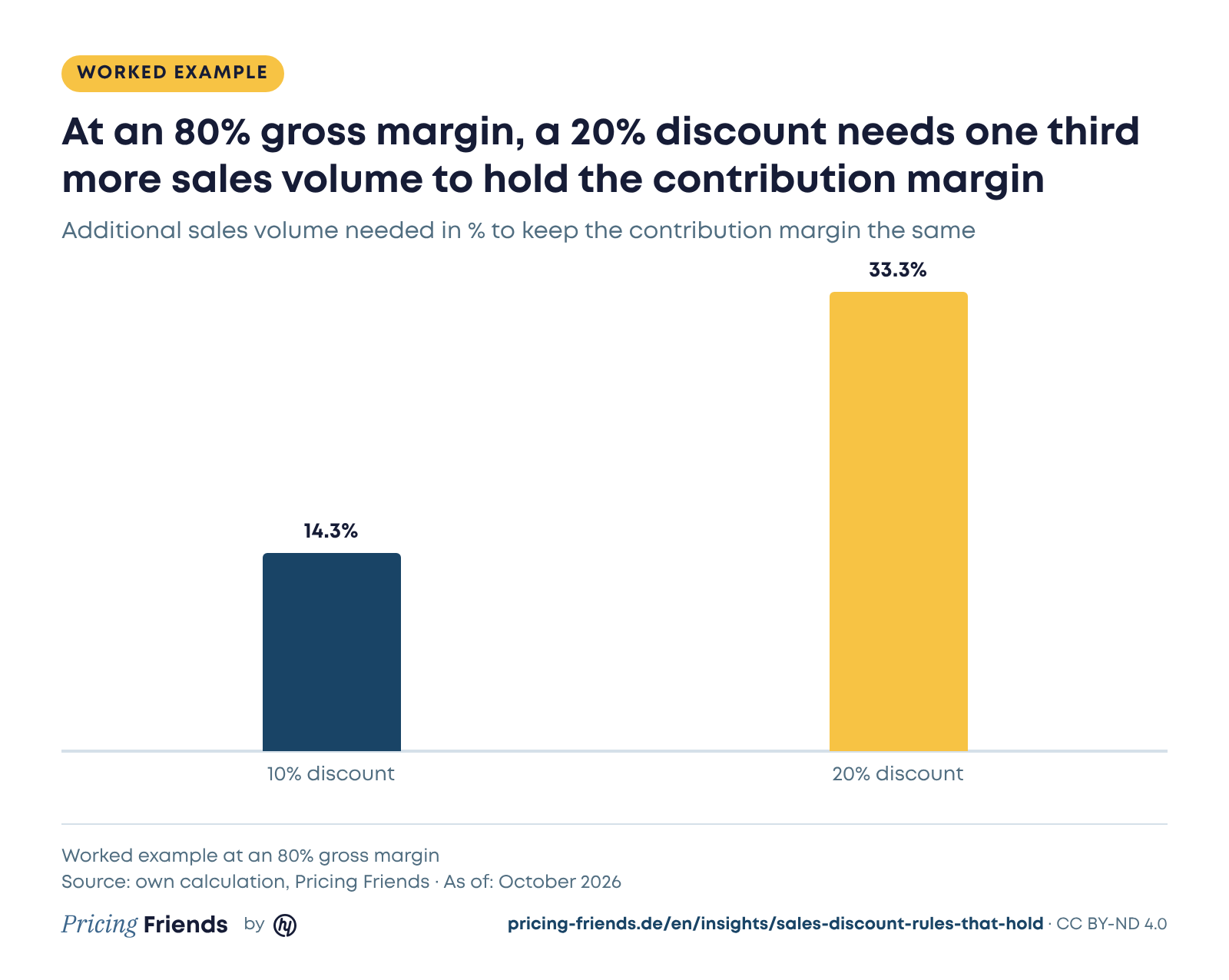
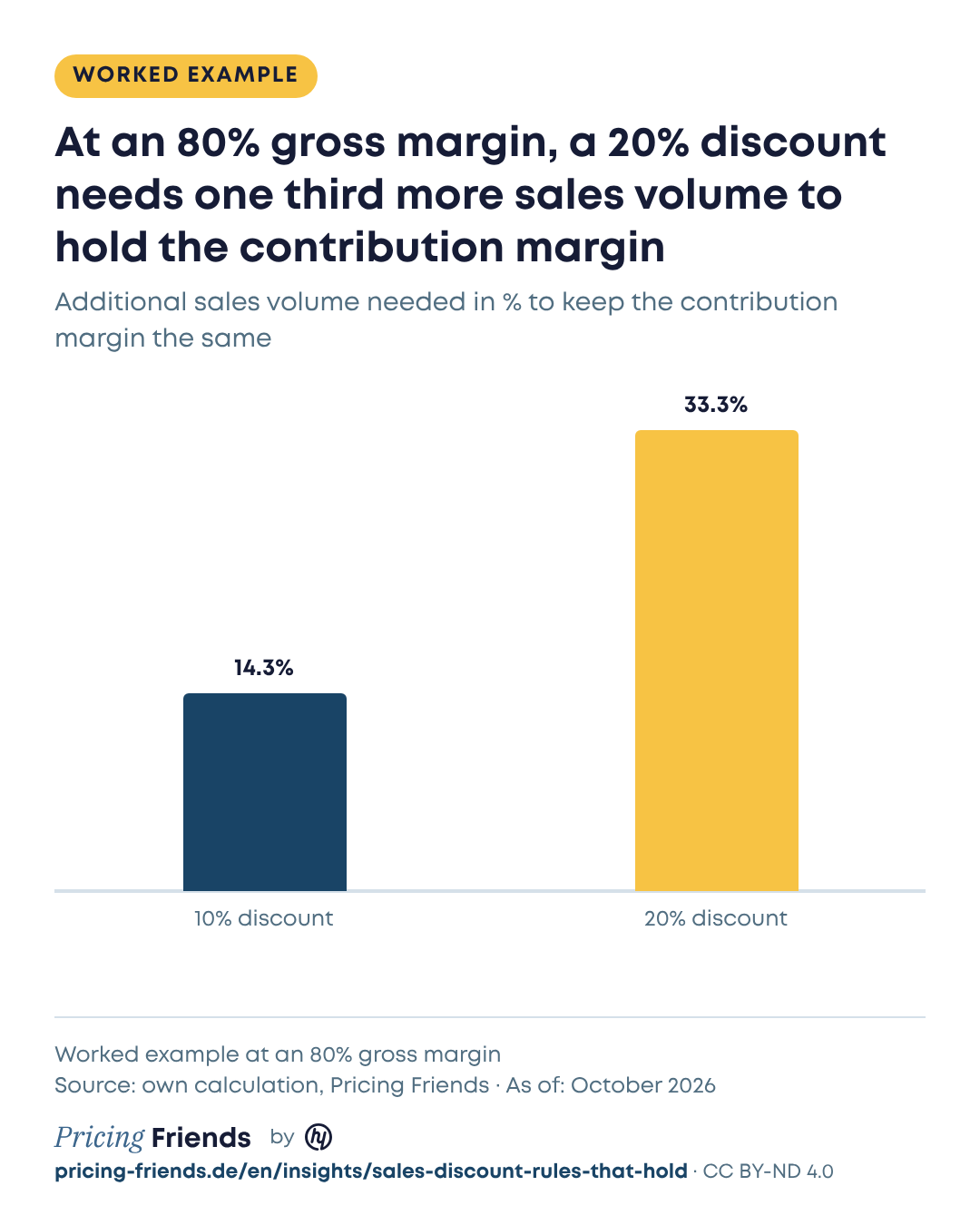
- At an 80% gross margin, a software vendor needs one third more volume after a 20% discount to earn the same contribution margin.
- If software sales commission is based on the net price, it doesn't reward discounts. Three plans shift the sales conversation from the discount to the scope of what the customer gets.
If you sell software to businesses and every deal closes at a different discount, you're most likely missing a set of rules. You get discounts under control when every concession has three things: something in return from the customer, an expiration date and an approval level. You also need an analysis that shows where your discounts actually land today.
This article is for executives and sales leaders at software companies whose list price and actual price keep drifting further apart.
Why discounts get out of hand
The patterns are almost always the same. Anyone who has worked at a software company knows the first one. On the podcast I once put it this way: “at the end of the quarter there's an 80% discount after all, because the sales rep still needs to hit their quota.” The second is quieter. Robert Kaiser, managing director at Tacto, observes in episode 137 “that sales reps find it hard, especially when they're still relatively inexperienced, to actually show high prices in the six-figure range.” The discount then comes before the customer has even asked for it.
A study by Ian Larkin of Harvard Business School shows that the first pattern is more than an anecdote. It was published in 2014 in the Journal of Labor Economics. Larkin analyzed the sales data of a large enterprise software vendor. There, the commission rate rose with a rep's quarterly revenue. So reps moved deals into the quarters where it paid off for them, and in those quarters they gave significantly lower prices. That cost the vendor 6 to 8% of revenue.
Kaiser's verdict on these discounts is clear: “But if I'm throwing discounts around from the start, then yes, that undermines the value of the software, undermines credibility, and in the end it doesn't benefit anyone.”
First measure where the discounts land
Before you write rules, you need a picture of where you stand. A table from your CRM with all deals from the last 12 months is enough: list price, net price, discount in percent, rep, customer segment, date. From it you can read four things. How high is the average discount? How widely does it vary between reps? Do high discounts cluster at quarter end? Do large customers get bigger discounts than small ones, or is it random?
Then calculate what a discount costs.
Worked example: Your software has a gross margin of 80%. Out of €100 in revenue, €80 is contribution margin. At a 10% discount, that's €90 in revenue and €70 in contribution margin. To get back to €80 in contribution margin, you have to sell 14.3% more. At a 20% discount, it's already 33.3% more. So a discount has to bring in far more volume than its percentage suggests.
Every discount needs something in return
The most important rule comes from negotiation theory. Matthias Schranner explained it with an example in episode 31: If a customer extends a contract from three to four years, they get a smaller markup, because the vendor gains more predictability. “So, one more year, and in return I go down 3%. And that's called reciprocal.” A discount with nothing in return, by contrast, only signals to procurement that there's even more to get next time.
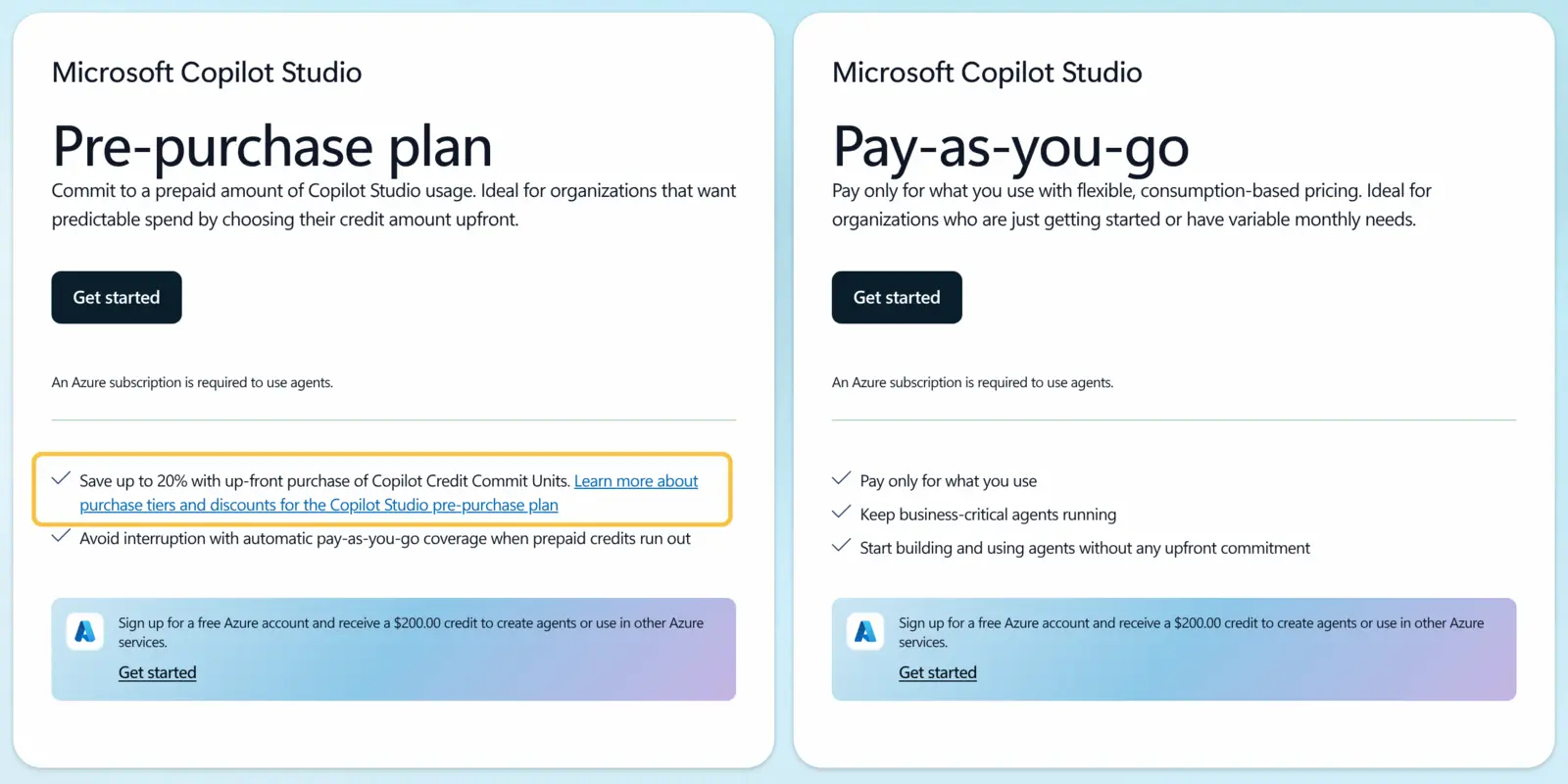
I recommend this all the time for credits and usage-based models too. On the podcast I put it this way: If you buy credits one at a time, you pay full price; if you commit to a volume, you get the discount, “or you commit to 1,000 and only then do you get the discount.” Microsoft does the same with Copilot Studio: Discounts of up to 20% are only available with a pre-purchase.
Typical things in return that can justify a discount:
| What the customer gives | What you get from it |
|---|---|
| Longer contract term | predictable revenue, fewer negotiations |
| Prepayment or volume commitment | cash flow, secured usage |
| More users, locations or modules | higher contract value |
| Reference or case study | trust with new customers |
| Signature by a fixed date | predictable close |
You can calculate what an annual contract is worth in return.
Put a time limit on discounts and make them visible
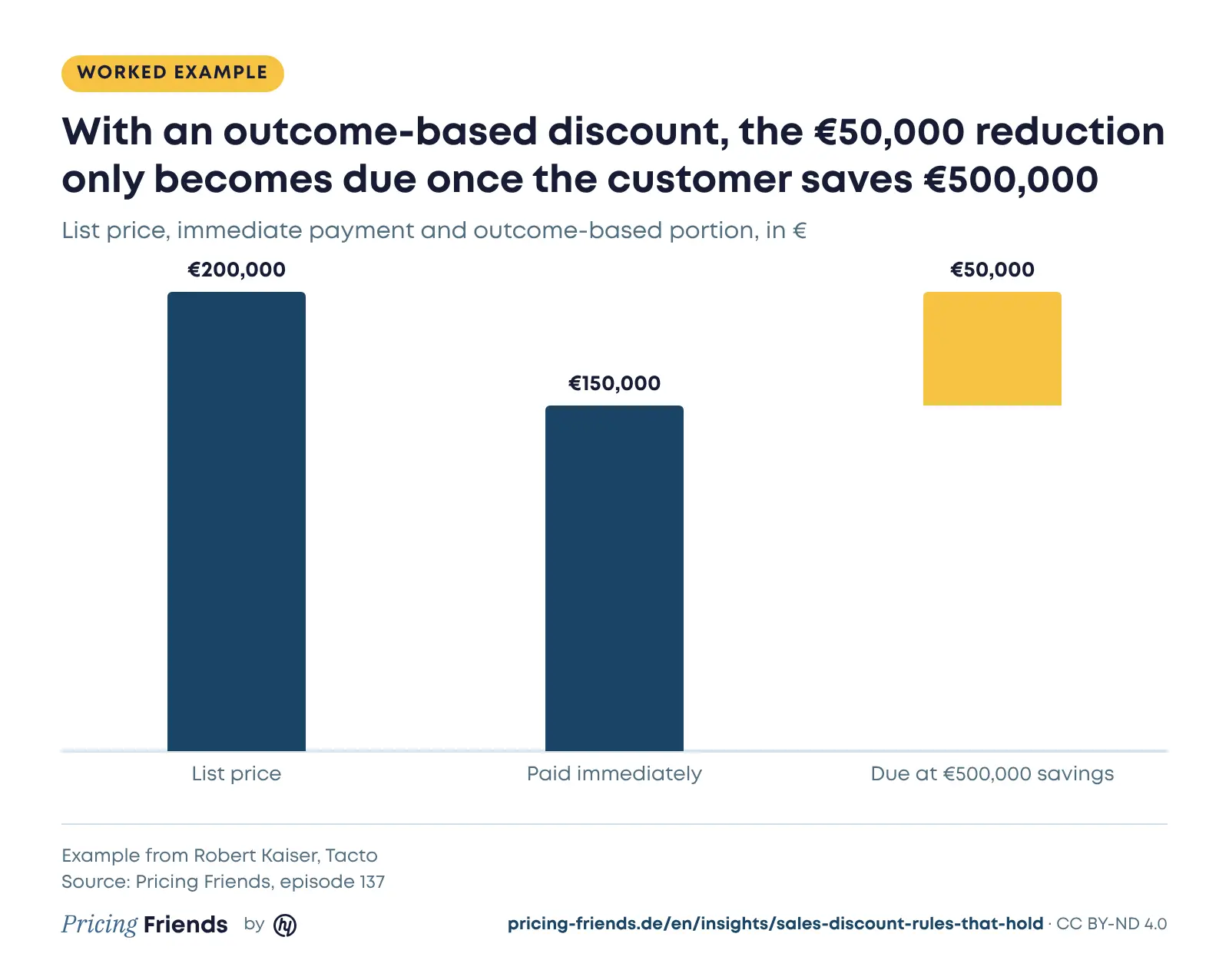
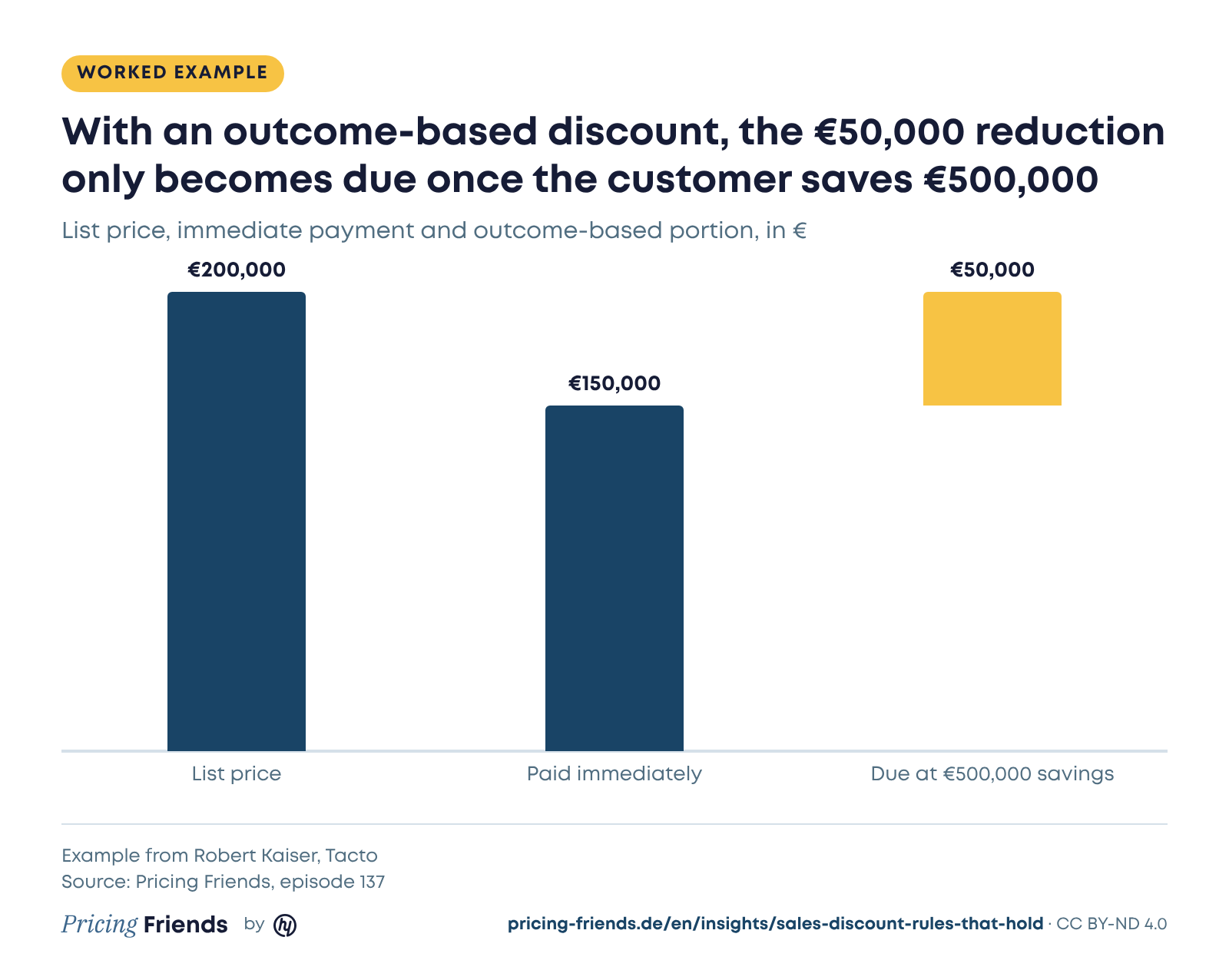
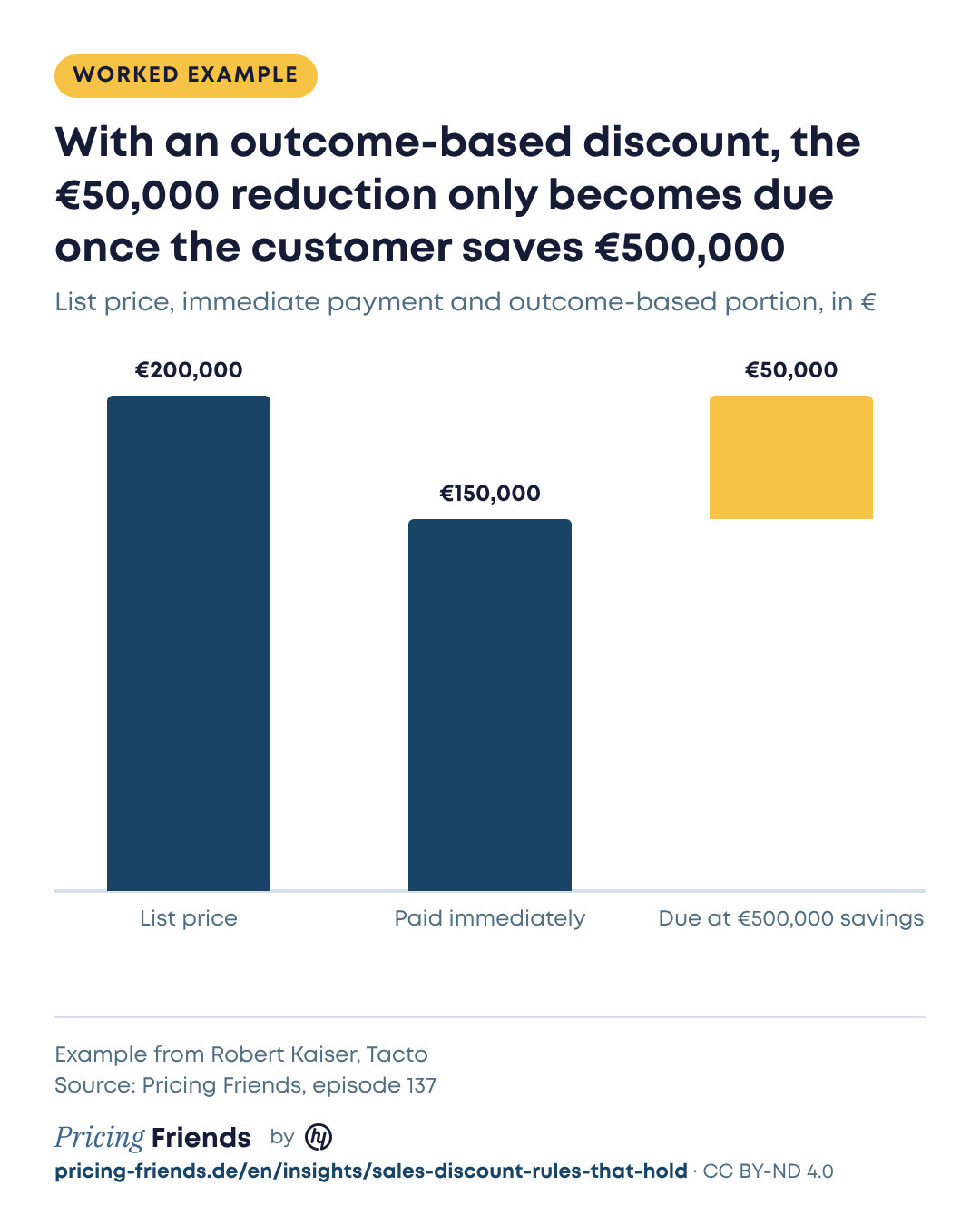
A discount that isn't recognizable as a discount in the contract becomes the new price. Kaiser describes how Tacto handles this: Instead of giving a large discount, part of it is tied to an outcome. In his example, the software has a list price of €200,000, the customer pays €150,000 up front, and the remaining €50,000 is due once savings of €500,000 are reached. The threshold is deliberately set so that both sides are confident they'll reach it. List price, discount and the discount's term also need to be in the quote from the start. Then you can phase out the discount later without the customer feeling ambushed. That's the basis for any later price increase for existing customers.
Approval and commission
Rules only hold if someone enforces them. That's why price enforcement is its own step in our approach: Clear rules for approvals, special terms and discounts make sure the sales team actually applies the pricing logic.
I cover separately what an approval matrix with levels looks like, how a deal desk works and how to plan for several rounds of negotiation with procurement.
Two things make any approval rule effective. Commission is based on the net price; otherwise you're paying your sales team for the discount. And the analysis from the first step runs again every quarter, broken down by rep. Then you'll see whether the rules are working.
Plans instead of percentages
The best discount is the one nobody negotiates. With three plans, the conversation shifts from the discount to the scope of what the customer gets. Instead of “Can you do it cheaper?” the question becomes “Is the smaller plan enough for you?” The customer gets a lower price for less, and your price per unit of value stays stable. For this to work, the three tiers need clear differences in scope.
This fits Kaiser's observation from the start: Many discounts come from the sales team's discomfort with their own price. If you give your reps a price they can explain and a smaller alternative, they'll need fewer discounts.
What you can do on Monday
- Pull all deals from the last 12 months with list and net price from your CRM.
- Calculate the average discount per rep and per month.
- Write a list of the things in return for which you're willing to give a discount.
- Set three approval levels and switch commission to the net price.
- Check your contract template: Does it include list price, discount and expiration date?
Bottom line: No discount without something in return, a deadline and approval
Discounts get out of control when they're granted with nothing in return, no expiration date and no approval. First measure where your discounts land and calculate what they cost. After that, every discount needs something in return, a deadline and a level that approves it.
The free pricing audit on pricing-friends.de shows you in about a minute whether your pricing page displays plans that give your sales team a smaller alternative to a discount. It reads your pricing page live, checks pricing model, packaging and price points, and gives you a score from 0 to 100 with findings. The check follows the approach the hy Consulting Group has developed in more than 600 pricing projects. Check your pricing page for free.
Sources
- SaaS & AI Pricing Report 2027 by hy, pp. 19, 51, 84
- Ian Larkin: The Cost of High-Powered Incentives: Employee Gaming in Enterprise Software Sales, Harvard Business School Working Paper 13-073, published in the Journal of Labor Economics 32 (2014)
- Microsoft: Copilot Studio, pre-purchase discount, accessed October 16, 2026
- Pricing Friends, episode 31: Verhandlungen und Pricing mit Matthias Schranner: Was kann man aus Extremverhandlungen für Preisverhandlungen lernen?
- Pricing Friends, episode 119: Sales, AI und Pricing mit Veronika Wax: Was passiert mit dem Seat-based Pricing, wenn KI-Agenten die Arbeit übernehmen?
- Pricing Friends, episode 137: Procurement Intelligence und Pricing mit Robert Kaiser: Wo findet KI im Einkauf den größten Hebel?
- Pricing Friends, episode 142: SaaS- und AI-Pricing mit Mariella Knospe und Felix Rahlmeyer: Wie bepreist man Software und AI im Jahr 2027?
Quotes are translated from German. The podcast episodes are in German.