
Price increases · 7 min read
Enforcing prices in sales: approvals, deal desk, discount rules

Key points
- In sales, a new price list for B2B software only works with fixed discount levels, a one-page approval matrix and compensation that rewards the price you actually get.
- In software sales, there's no discount without a trade-off. Contract term, prepayment, volume or a smaller plan go into the offer before anyone approves the discount.
- B2B software contracts show the list price and the time-limited discount openly. If only the negotiated price is in the contract, the customer takes the discount for the price.
- A deal desk of sales, finance and pricing reviews software offers outside the approval matrix. If the same exceptions keep piling up, the plan is more likely wrong than the sales rep.
If you sell software through B2B sales, you enforce prices with four building blocks: fixed discount levels, an approval matrix that sets who approves which discount, a trade-off for every discount and sales incentives that match the price. A deal desk handles the special cases. Without these rules, the negotiation ends up setting the price, not your pricing model.
Why a good price list isn't enough
A new price list alone doesn't win over a single customer. If you want to create value through pricing, you have to factor in sales from the start. That's why price enforcement is a separate step in our approach, the last of eight: clear rules for approvals, special terms and discounts, so your pricing logic is actually applied in B2B sales.
This is becoming more important. In the survey for our SaaS & AI Pricing Report 2027, 80% of the 153 participating SaaS and AI vendors plan or are considering a change to their pricing in the next twelve months, and price increases rank second among planned measures. Any increase that sales discounts away again isn't an increase.
Before you build rules, look at where your discounts end up today and what they cost. This article covers the organization behind them: who approves, what goes into the contract, who reviews exceptions and how sales gets paid.
Building block 1: Discount levels and approval matrix
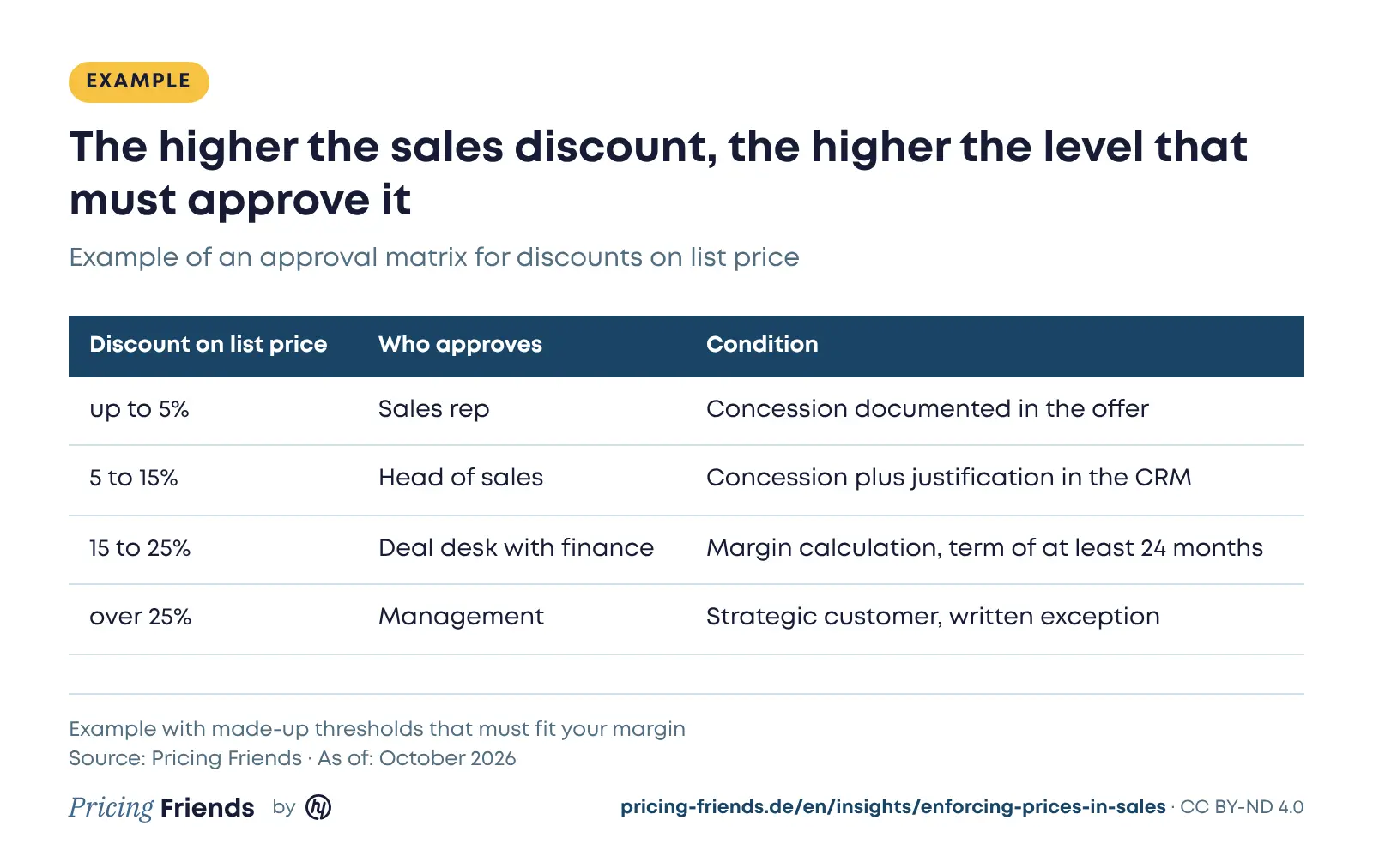
Set a list price, a target price and a floor for each product. In between, an approval matrix sets who approves what. The higher the discount and contract value, the higher the approval level.
Example of an approval matrix (the thresholds are made up and need to fit your margin):
| Discount on list price | Who approves | Condition |
|---|---|---|
| up to 5% | Sales rep | Trade-off documented in the offer |
| 5 to 15% | Head of sales | Trade-off plus justification in the CRM |
| 15 to 25% | Deal desk with finance | Margin calculation, term of at least 24 months |
| over 25% | Management | Strategic customer, written exception |
The tool you use for the matrix matters less than keeping it to one page and making sure everyone in sales knows it.
A fixed framework is also what most companies choose. Ann-Kristin Hansen, Kissan Joseph and Manfred Krafft studied 222 German sales organizations (published in 2008). 61% gave their sales reps a fixed price range, 28% left pricing entirely to management, and only 11% let sales set any price above marginal cost.
Building block 2: No discount without a trade-off
A discount is an exchange: a longer term, prepayment, more volume or a smaller plan in return for a lower price. Matthias Schranner, a former police negotiator, calls this reciprocity. He also describes how it goes wrong: The buyer just says he's disappointed, and the vendor immediately drops 5%.
For enforcement, this means the trade-off is in the offer before anyone approves the discount. Without it, there's no approval, at any level of the matrix.
Building block 3: The list price belongs in the contract
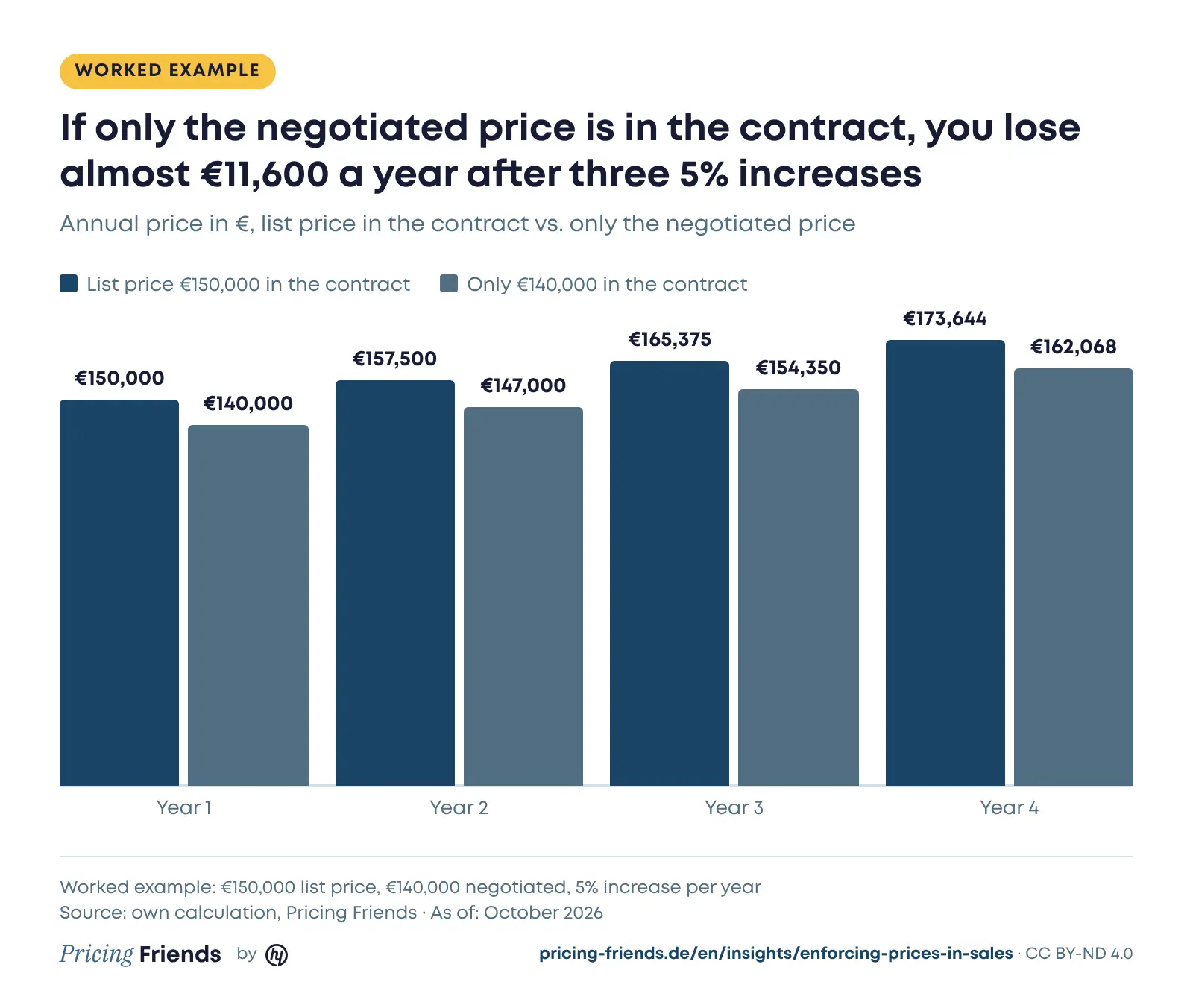
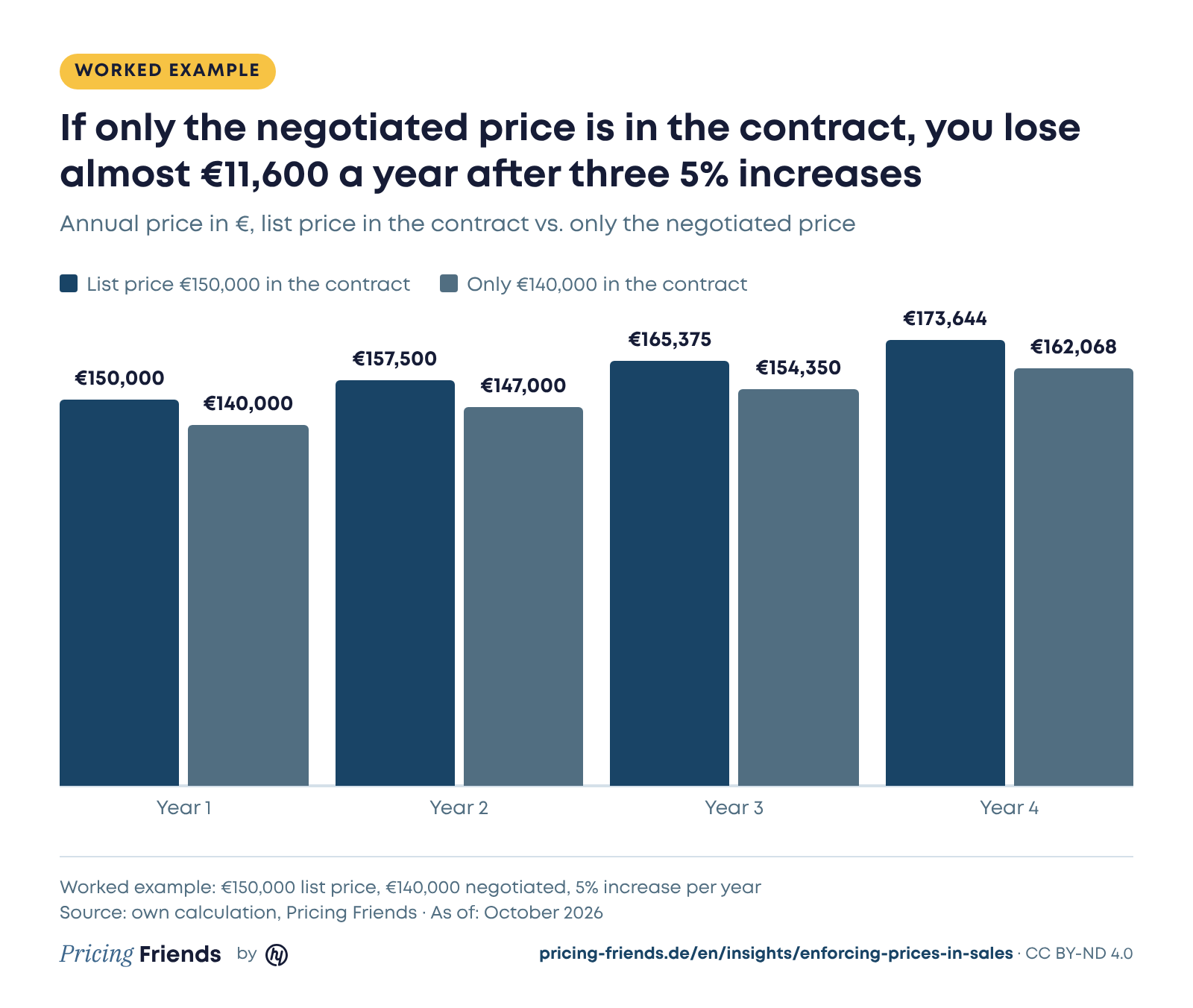
The most expensive mistake often happens only at renewal. Robert Kaiser of Tacto described what happens when the list price is €150,000, you negotiate down to €140,000 and only the €140,000 ends up in the contract. Every later price increase gets hard, because the customer takes the discount for the price. His advice: Show the list price and the discount openly, and say from the start that the discount is only temporary.
Worked example: With €140,000 instead of €150,000 in the contract and an annual price increase of 5%, the gap grows too. After three increases, the customer pays about €162,100 instead of about €173,600 a year. That's almost €11,600 less per year, just because the list price was never in the contract.
The list price in the contract is also the basis for raising prices for existing customers later.
Building block 4: The deal desk for exceptions
A deal desk is a small group from sales, finance and pricing that reviews every offer outside the matrix. It calculates the margin, proposes trade-offs and decides fast. It makes sense once enterprise deals with custom terms come up regularly. Two rules keep it useful: a fixed response time so deals don't stall, and a list of all exceptions that you analyze every quarter. If the same exceptions keep piling up, the plan is more likely wrong than the sales rep. Then check what belongs in the enterprise plan.
Plan for procurement
In B2B, negotiations often run in several rounds: the business unit, procurement, sometimes leadership too. I talked about this on the podcast with Stephan Chassaing de Bourdeille, who has worked in procurement for more than 15 years. My rule of thumb there: less discount in each round than in the one before. So plan ahead how much room you keep for which round, and don't leave it all in the first. His tip from the procurement side: Be careful with price negotiations on a Friday afternoon, because the weekend creates pressure. So timing is also part of the negotiation.
I'm not immune to this myself. On the podcast, I once told how a client, just before signing, wanted one more discount, citing Black Friday. He got €7.30. At least with a trade-off: He had to start on Monday.
Incentives that match the price
Rules only hold if compensation matches them. If sales reps are paid only on revenue or closed deals, every discount is rational from their point of view. In episode 21, on change in organizations, Felix Krohn said goals have to match the strategy, “because in the end that's what the employee feels in their pocket.” In the study by Hansen, Joseph and Krafft, about 72% of companies gave their sales teams pricing leeway, but only about 18% used incentives tied to gross margin. For sales, this means part of variable pay depends on the price achieved, for example the average discount level or the share of deals within the matrix.
What you can do on Monday
- Analyze the discounts of the last twelve months. What's the average discount on the list price, per sales rep and per plan?
- Write an approval matrix on one page. Three or four levels, each with an approver and a condition.
- Define a list of allowed trade-offs. Term, prepayment, volume, plan.
- Change your standard contract. The list price and the time-limited discount appear openly in the contract.
- Review compensation. Does it reward closing at any price?
Enforcement is the last of eight steps in our approach. If a new pricing logic also changes contracts and compensation, the view of a specialized pricing consultancy like hy helps you not miss any of these points.
Bottom line: The price is set in the conversation
The best price list doesn't help much if it gets negotiated away in sales. Discount levels with approvals, a trade-off for every discount, the list price in the contract and compensation that rewards the price turn your price list into the price you actually get. Start by analyzing your discounts, and you'll see where the gaps are.
The free pricing audit on pricing-friends.de shows in about a minute how your plans come across from the outside, without a sales rep next to them. It reads your pricing page live and scores pricing model, packaging and price points from 0 to 100. It checks against the approach hy Consulting Group developed in more than 600 pricing projects.
Sources
- SaaS & AI Pricing Report 2027 by hy, pp. 13, 84
- Ann-Kristin Hansen, Kissan Joseph, Manfred Krafft: Price Delegation in Sales Organizations: An Empirical Investigation, Business Research 1 (2008), pp. 94–104, open access
- Pricing Friends, episode 17: Procurement und Pricing mit Stephan Chassaing de Bourdeille: Wie komme ich mit meinen Preisen am Einkauf vorbei?
- Pricing Friends, episode 21: Change Management und Pricing mit Felix Krohn: Wie stelle ich sicher, dass Organisationen neue Pricing-Konzepte erfolgreich umsetzen?
- Pricing Friends, episode 31: Verhandlungen und Pricing mit Matthias Schranner: Was kann man aus Extremverhandlungen für Preisverhandlungen lernen?
- Pricing Friends, episode 128: Industrie-Pricing und Transformation mit Dr. Amadeus Petzke: Wie bringt man 25 Jahre Industrieexpertise und digitale DNA zusammen?
- Pricing Friends, episode 137: Procurement Intelligence und Pricing mit Robert Kaiser: Wo findet KI im Einkauf den größten Hebel?
Quotes are translated from German. The podcast episodes are in German.