
Pricing strategy · 8 min read
How to measure willingness to pay: which method fits when

Key points
- Asking directly about price gives you the weakest data on willingness to pay for software. Willingness to pay is only measured once someone buys.
- The question decides the method: Van Westendorp gives you a price range, Gabor-Granger a price point, conjoint the value of software plans and features.
- Read surveys on willingness to pay for software as a range and a curve. Respondents overestimate how likely they are to buy and like to name round prices.
- A measurement of willingness to pay for software also surveys non-customers, checks results against the customer's business case and ends with a market test.
If you sell software and want to reset a price, you're best off measuring willingness to pay indirectly and with more than one method. Van Westendorp quickly gives you a price range your customers accept. Gabor-Granger shows how many would still buy at a specific price. Conjoint measures what individual features and plans are worth. In the end, a real test in the market is the most reliable, and that's what the three methods prepare you for.
Why asking directly isn't enough
“What would you pay for this?” is the obvious question, and it gives you the weakest data. In surveys, people like to give the answer they consider sensible. I admit I do this myself, for example when asked whether I'll put on sunscreen more often in the future. Price works the same way. All three methods below measure hypothetically: what someone states in a questionnaire. Willingness to pay is only truly measured once someone buys.
A review by Christoph Breidert, Michael Hahsler and Thomas Reutterer (2006) reaches the same conclusion. Asking directly about price draws unnatural attention to the price, and respondents have no incentive to state their true willingness to pay. Even an honest answer doesn't necessarily lead to a purchase. Overall, the authors don't consider the direct question a reliable method.
The three methods compared
| Method | What you ask | What you get | Limitation |
|---|---|---|---|
| Van Westendorp | Four questions: at what price is it too cheap, a bargain, expensive, too expensive | An accepted price range | Respondents name round numbers, no purchase decision |
| Gabor-Granger | Purchase intent at several specific prices, one after another | A demand curve and the revenue-maximizing price | One product with no alternatives, purchase intent is overestimated |
| Conjoint | Choice between offers with varying features and prices | The value of individual features and the choice between plans | More effort, needs enough respondents and good design |
The methods aren't mutually exclusive. As I once put it: “Combining them gives you fairly valid results too, but the test is of course the best option of all.”
Van Westendorp: fast, but prone to round numbers
Van Westendorp is the fastest method and works as a first read, for example for a new product with no comparable price. You ask about four thresholds and read off the range in which your price seems neither cheap nor off-putting.
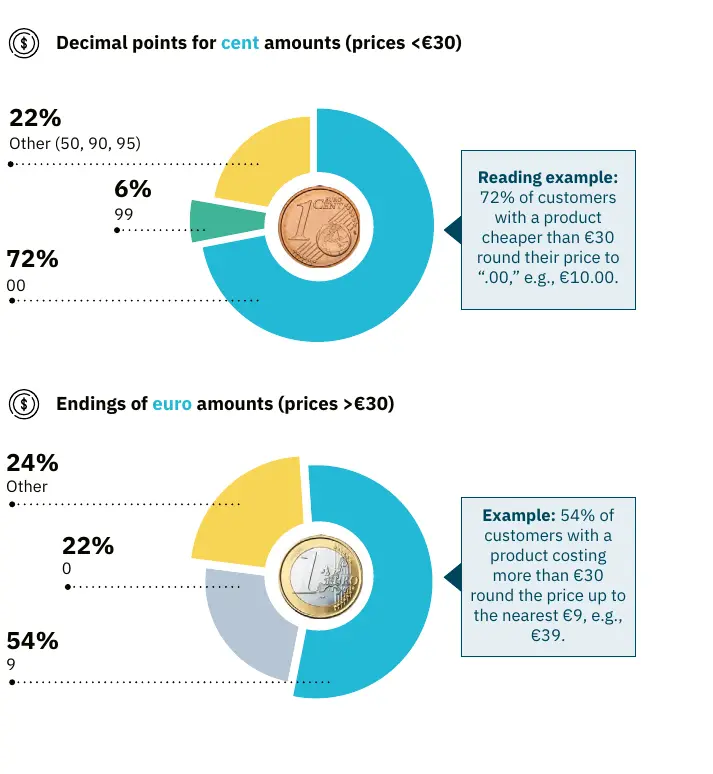
I discussed its weakness with Klemens Keldenich. People asked for the threshold to “expensive” mostly answer with round values such as €5 or €10, even if the product currently costs €7.99. Keldenich has confirmed this from many price tests in retail: These round values are real price thresholds in people's heads. He's still a fan of the method, just not of the intersection point that gets calculated from it as the “optimal price.” So read Van Westendorp as a range, not a point. The market rounds the same way, by the way. For our SaaS & AI Pricing Report 2026, we analyzed software profiles on the German software review platform OMR Reviews together with the platform: 72% of prices below €30 end in .00, and above €30, 54% end in 9.
Gabor-Granger: when price is the real question
Gabor-Granger fits when the product is set and you're only looking for the price. You show respondents several prices one after another and ask each time whether they would buy. That produces a demand curve.
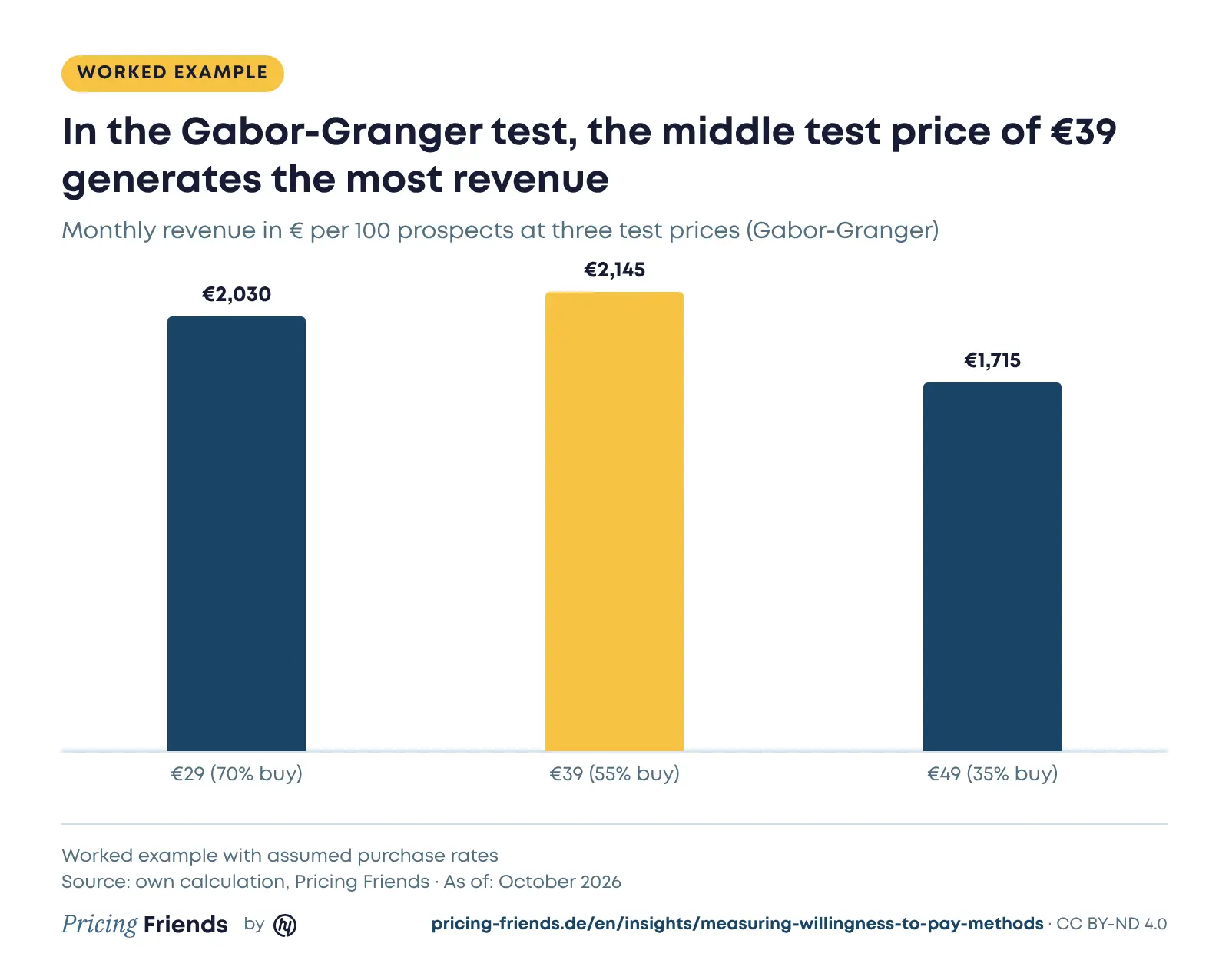
Worked example: At €29 a month, 70% of respondents say they would buy; at €39, 55%; and at €49, 35%. Per 100 prospects, that's €2,030, €2,145 and €1,715 in monthly revenue. The middle price brings in the most, even though it costs you buyers. The absolute percentages in surveys are almost always too high. What holds up is the shape of the curve: where it drops sharply. A comparison with real purchases supports this. Klaus Miller, Reto Hofstetter, Harley Krohmer and John Zhang compared four measurement methods with sales of the same product in an online shop. Hypothetical surveys overestimated willingness to pay but still predicted the best price reasonably well.
Conjoint: when it's about plans and features
Conjoint is the most demanding method and the only one that shows what a feature in a plan is worth. Respondents choose several times between offers that differ in features and price. From their choices, you calculate each feature's contribution to the decision and can simulate how buyers spread across your plans.
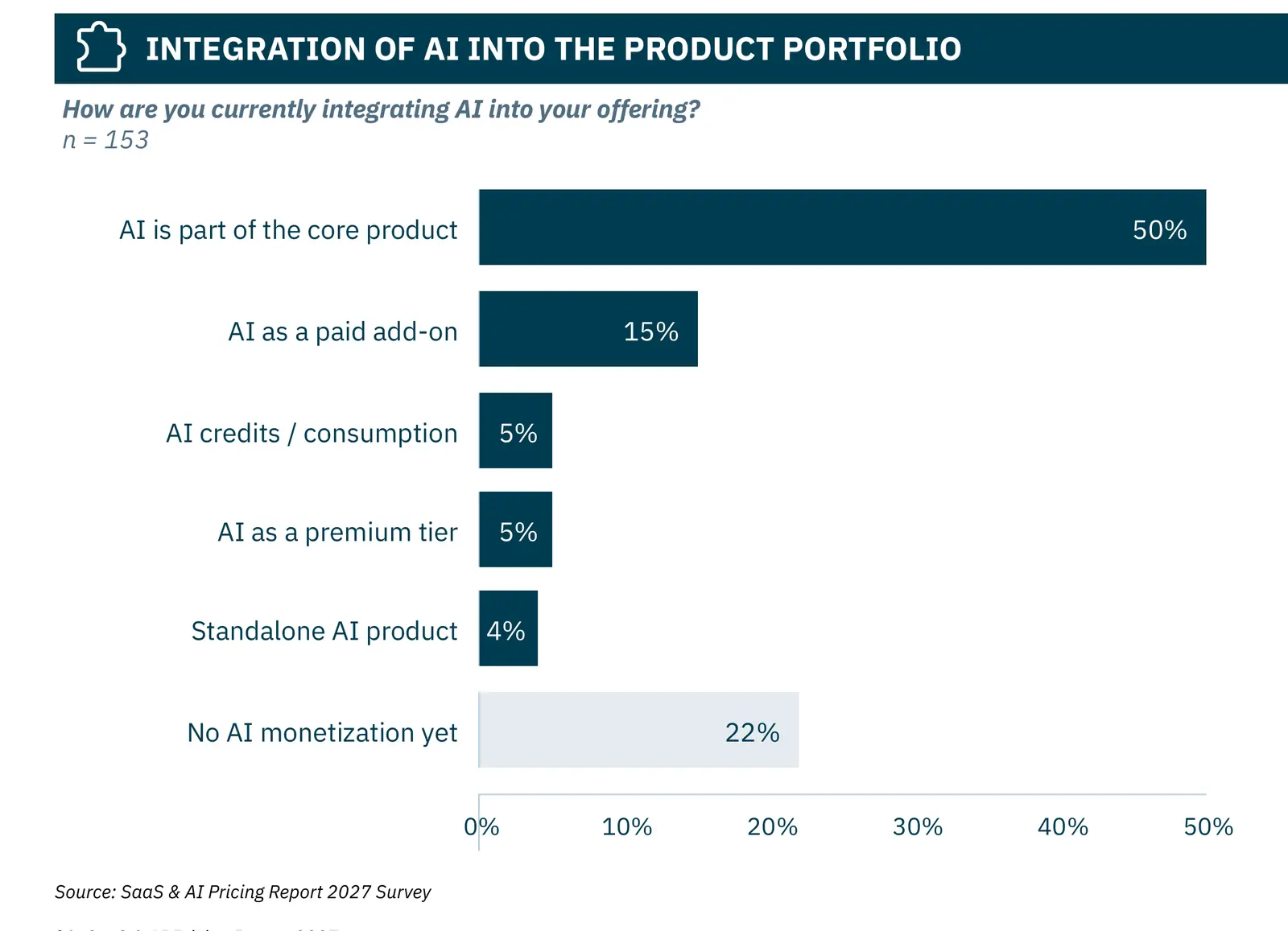
That's the question AI raises right now. In our SaaS & AI Pricing Report 2027, 50% of the 153 software and AI vendors surveyed bundle AI into the core product at no extra charge, and 22% don't monetize it at all yet. The previous year's report already noted that customer value and willingness to pay for AI are still unclear in practice. My impression from projects fits this. On the podcast, I said that it feels like every third project included validation through market research. Today it's less often about whether we can go from €10 to €11 and more often about the plan, the metric and the business model. Arne Wolter of Appinio added in the same conversation that the classic methods still work for this but become more complex. You have to define up front exactly which question you want answered.
Clean data: respondents who just click through
Online surveys usually offer a small incentive for taking part. So some respondents just click through. We filter out these answers, for example anything more than three standard deviations from the mean and questionnaires clicked through in three minutes. Even that isn't entirely clean, because some people answer quickly because they're sure. So check how many answers you've removed and why.
Pay attention to whom you ask, too. Wolter put it in a nutshell: “Most companies talk to their existing customers, at best.” Existing customers know your price and your value. People who don't buy from you yet judge differently, and that group decides how many new customers you win.
B2B with few customers: interviews and the business case
B2B software without a public pricing page often lacks the traffic for a live test. Then online market research and interviews with customers and prospects are the better method. With little traffic, I'd use surveys to narrow the variants down to two first and only test those two in the market.
With high contract values, the customer's business case helps as well. Robert Kaiser of Tacto gave an example in which software delivers €2 million in savings and costs €200,000. If you work through that math together with the customer, you measure willingness to pay directly against the value. I cover separately how to derive a price from customer value.
Competitor prices don't replace this work. On OMR Reviews, prices for accounting and finance software ranged from €0 to €649 last year. You can't read a price off a range like that.
What you can do on Monday
- Define the question. Is it about the price level, a plan, an AI feature or the metric? The method depends on it.
- Pick the method. A range for a new product: Van Westendorp. A price for a finished product: Gabor-Granger. Plans and features: conjoint.
- Survey customers and non-customers. Mix existing customers, lost deals and prospects.
- Clean the data. Decide up front which answers you'll remove.
- Cross-check the result. Does the price fit the customer's business case and your positioning?
- Test in the market. Two variants on the pricing page or in sales, with a clear duration and success metric.
In our approach, the price level is the sixth of eight steps. Packaging, billing model and metric come before it. If you measure willingness to pay before the metric is set, you're measuring the price of a unit that may no longer exist later.
After that, the job is to translate the measured differences between customer groups into plans and prices.
Bottom line: Measure the range, test the price
None of the three methods gives you the right price on its own. Van Westendorp shows the range, Gabor-Granger the shape of demand, conjoint the value of individual features. The result holds up once you check it against your customers' business case and then test it in the market. I'd start with the question you want answered and only then pick the method.
Before you set up a survey, it pays to look at how your pricing model comes across from the outside today. You get that in about a minute with the free pricing audit on pricing-friends.de. It reads your pricing page live, checks pricing model, packaging and price points, and gives a score from 0 to 100 with findings. It checks against the approach hy Consulting Group developed in more than 600 pricing projects.
Sources
- SaaS & AI Pricing Report 2027 by hy, pp. 21, 84
- SaaS & AI Pricing Report 2026 by hy, pp. 36, 40, 45
- Christoph Breidert, Michael Hahsler and Thomas Reutterer: A Review of Methods for Measuring Willingness-to-Pay, Innovative Marketing 2 (4), 2006
- Klaus M. Miller, Reto Hofstetter, Harley Krohmer and Z. John Zhang: Measuring Consumers' Willingness to Pay: Which Method Fits Best?, GfK Marketing Intelligence Review 4 (1), 2012
- Pricing Friends, episode 8: Psychologie und Pricing mit Klemens Keldenich: Können uns Preise eigentlich zum Narren halten?
- Pricing Friends, episode 12: Neurowissenschaft und Pricing mit Kai-Markus Müller: Kann NeuroPricing das Rätsel des perfekten Preises lösen?
- Pricing Friends, episode 38: Sonderfolge, Sebastian zu Gast bei Subscribe Now: Wie Axel Springer die Preise optimiert
- Pricing Friends, episode 137: Procurement Intelligence und Pricing mit Robert Kaiser: Wo findet KI im Einkauf den größten Hebel?
- Pricing Friends, episode 143: SaaS- und AI-Pricing mit Arne Wolter: Wird KI zur Commodity?
- Pricing Friends, episode 144: SaaS & AI Pricing Report mit Arne Wolter, Benedikt Böringer, Felix Rahlmeyer, Melanie Riebel & Norman Nielsen: Wie verändert KI das Pricing von morgen?
Quotes are translated from German. The podcast episodes are in German.