
Pricing strategy · 7 min read
Price differentiation in B2B SaaS: Capturing willingness to pay

Key points
- Price differentiation in B2B software turns different customer value into different prices: through plans, a pricing metric that grows with the customer, and markups or discounts by customer segment.
- In software, price differentiation works best through plans customers choose themselves. Each tier needs a fence of features or limits, or large customers buy small.
- Every price tier of a B2B software product needs a reason you can explain in one sentence. Price differences without a reason cost trust with procurement.
- When the price of B2B software is negotiated, sales needs fixed rules for approvals and discounts. Otherwise the best negotiator gets the lowest price.
If you sell B2B software, your customers don't all pay the same, because they don't all get the same value from it. Price differentiation means turning those differences into prices: through plans customers choose from, through a metric that grows with usage, and through markups or discounts for specific segments. For this to work, every price tier needs a fence that holds and a reason the customer accepts.
Three types, and what they mean in SaaS
The textbook classification goes back to the economist Arthur Pigou and has three degrees. We discussed it on the podcast with Prof. Martin Fassnacht of WHU. Translated into software, it looks like this:
| Degree | Principle | In B2B SaaS | Fence | Risk |
|---|---|---|---|---|
| First degree | Each customer pays their own price | Individually negotiated enterprise contracts | Contract and negotiation | Discounts without rules, the same service at very different prices |
| Second degree | Customers sort themselves | Plans, volume tiers, usage metric, add-ons | Features, limits, volume | Plans without a clear difference, customers buy too small a plan |
| Third degree | Price per customer group | Markups or discounts by size, industry, country, startups or nonprofits | Verifiable attribute | Customers feel treated unfairly when the reason is missing |
In practice, you usually combine all three. The plans on your pricing page are second degree, the enterprise negotiation is first degree, and a country surcharge is third degree.
Second degree: Customers choose for themselves
For software, this is the most important lever, because it works without negotiation. Fassnacht explained why: “I like this performance-based price differentiation because, as you just said, Sebastian, customers can sort themselves.” His example was streaming services whose cheapest option comes with ads. If you can put up with ads, you pay less. If you don't want them, you pay more.
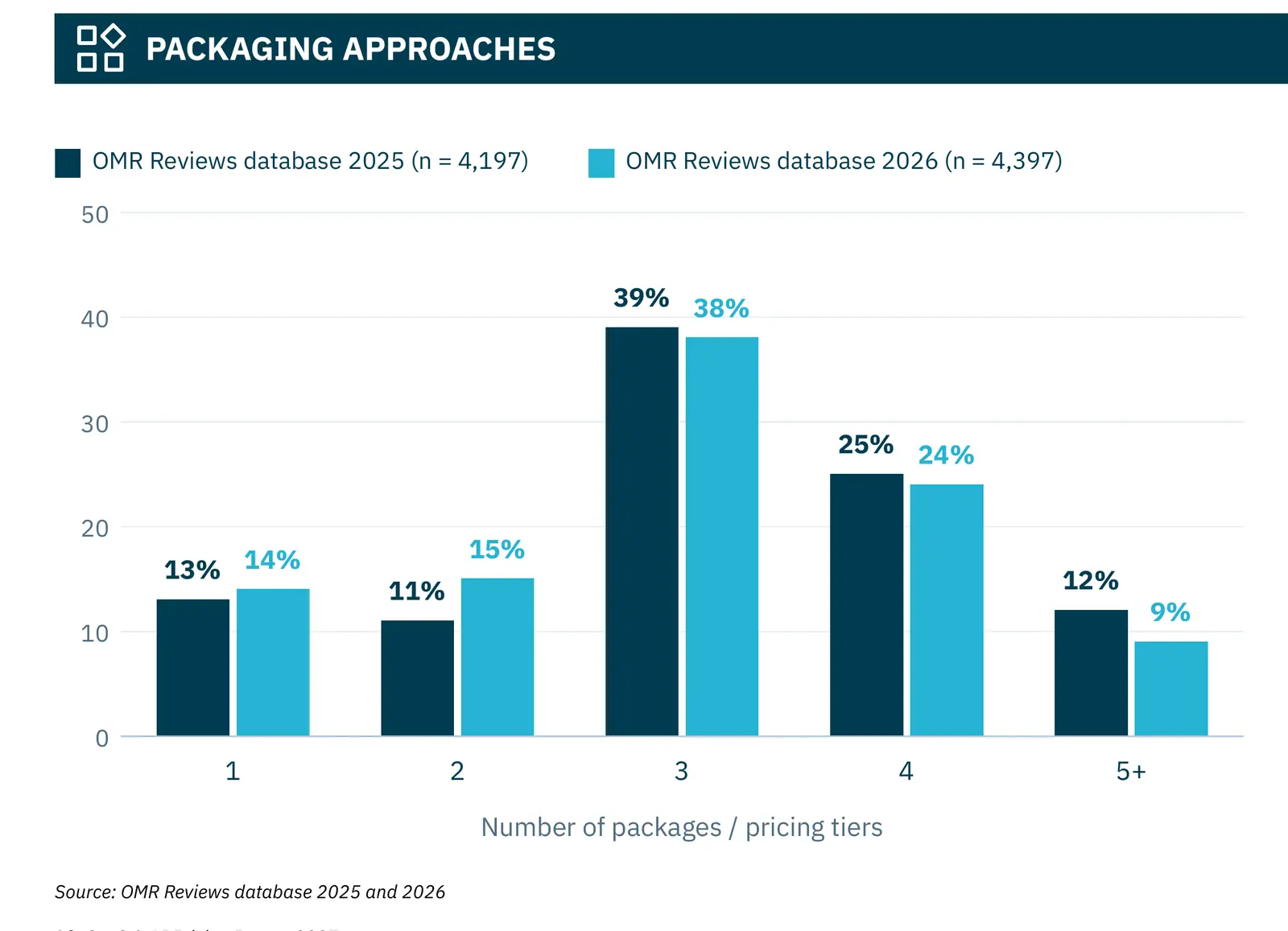
The best-known tool for this is good-better-best. My colleague Mariella Knospe summed it up: “Good, better, best is really a tool, first of all, for addressing different levels of willingness to pay, different customer segments.” The mechanics: The entry plan lowers the barrier for price-sensitive customers, and the premium plan captures high willingness to pay. For our SaaS & AI Pricing Report 2027, we analyzed 4,397 software profiles on the German software review platform OMR Reviews: 38% show exactly three plans, 24% show four. For this to work, the three tiers need to be clearly separated from each other.
The second route is the metric. If the price grows with users, transactions or credits, the large customer automatically pays more than the small one. Looking ahead, the 153 SaaS and AI companies we surveyed for the report expect the seat to lose 31 percentage points as the main metric, while outcomes, credits and consumption gain. So differentiation moves out of the plan name and into billing.
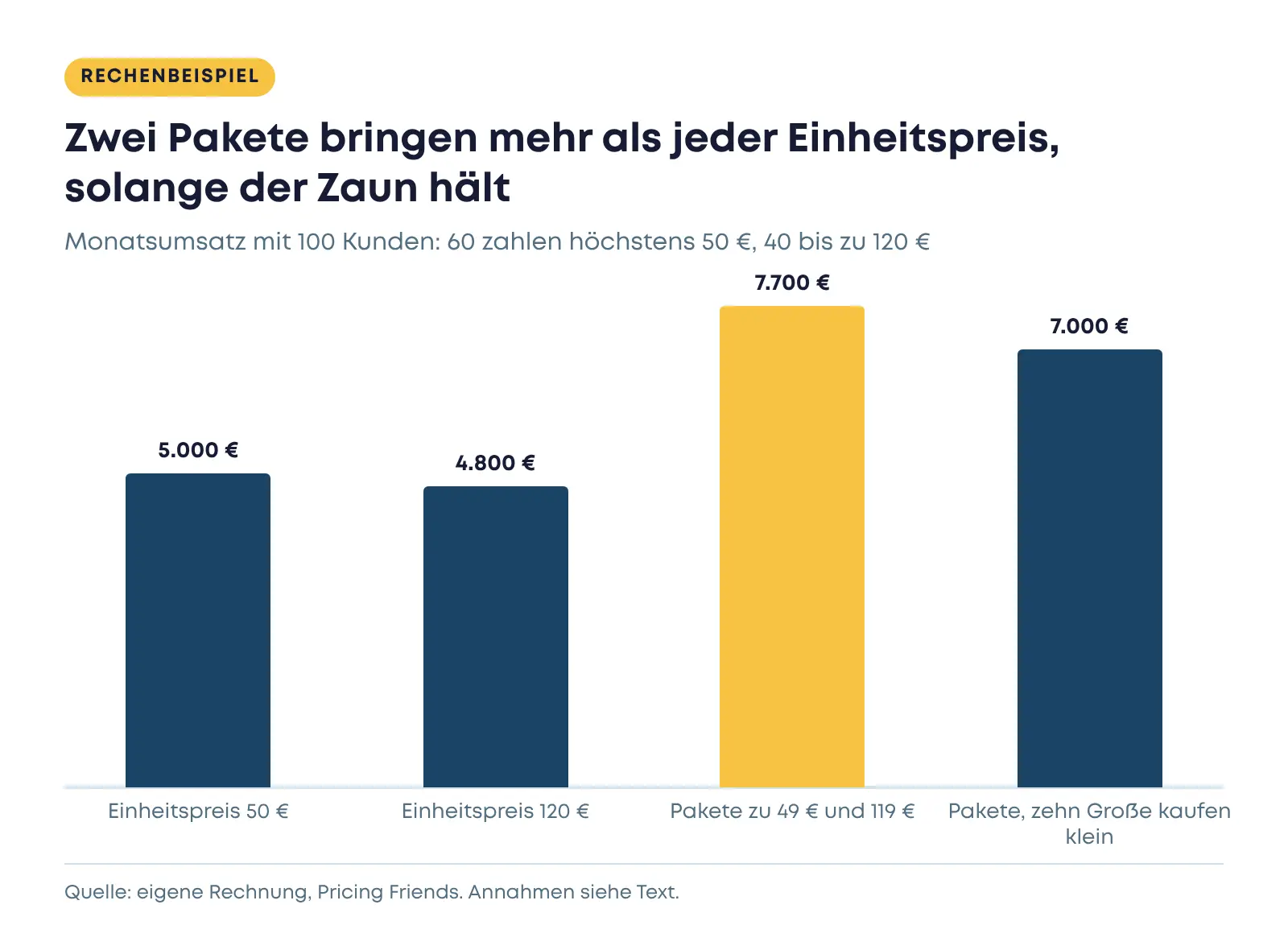
Worked example: Say you have 100 customers. 60 of them will pay at most €50 a month, and 40 would pay up to €120 because they need integrations and permission management. At a single price of €50, you make €5,000 a month. At €120, you make €4,800, because you lose the 60 smaller customers. With two plans at €49 and €119, where integrations and permission management are only in the larger plan, you make €2,940 plus €4,760: €7,700. But if 10 of the 40 large customers switch to the small plan because the fence is too low, revenue drops to €7,000. The fence is the real lever.
The economist Hal Varian described this logic for information goods such as software in 1997, in a paper on versioning. The vendor designs the versions so that customers with high willingness to pay choose the expensive one on their own and everyone else chooses the cheap one. If the cheap version is also worth it for the customer with high willingness to pay, the vendor in Varian's model earns only as much as if there were no differentiation at all.
Third degree: Segments with a reason
Markups and discounts by customer group are common in B2B, but companies often use them only halfway. My colleague Christoph Röttgen described this for IT service providers. They differentiate mainly by seniority: A junior costs less than a senior, and project management costs more than development. The customer's industry, size and project complexity, on the other hand, barely play a role. Often it stops at a flat surcharge for a few countries, such as Switzerland. That's a start, but it isn't a pricing logic yet.
When we recommend more price differentiation in our projects, it's usually about exactly these attributes: industry, size, segment and complexity. For software, region and customer status are added, such as startup programs or nonprofit pricing.
The trend points that way. Instead of rigid rate cards, the focus is shifting to prices based on usage behavior, company size or willingness to pay. And it doesn't only go up. In last year's edition, for which we examined 100 software profiles for price changes, 37% of the changes were lower entry prices, often through a new starter plan. That raises the question of how low you should go with your entry price.
Fairness: No reason, no trust
In B2B, buyers compare. Gerd Kerkhoff, who sat on the buyer side for decades as founder of a procurement consultancy, warned that if you set prices differently at the same time, “and they aren't justified, [...] then that's something that really destroys trust.” The buyer who paid the higher price ends up looking bad.
This leads to a simple rule: Every price tier needs a reason you can explain to the customer in one sentence. “The larger plan includes integrations and permission management” is such a reason. “Large customers pay more” isn't, as long as you can't say what extra the large customer gets, such as support, security or contract terms.
First degree: Keep negotiation under control
At the top end, B2B deals are almost always negotiated. That's first-degree price differentiation, and it goes wrong fast. Without rules, the best negotiator ends up with the lowest price, and the customer's willingness to pay no longer matters. That's why it's a separate step in our approach: clear rules for approvals, special terms and discounts. In sales, that mainly means fixed approval levels for discounts.
What you can do on Monday
- Sort customers by revenue. Pull revenue per customer from billing and see how widely it varies. If large and small customers pay almost the same, you're giving away willingness to pay.
- Name the value drivers. Which three features or services do your best customers use that smaller ones barely touch? Those are your fences.
- Test the fence. Can a large customer buy the small plan and still get everything important? Then the fence doesn't hold.
- Write down segment rules. Every markup and discount with its attribute, size and justification, on one page.
- Limit negotiation room. Decide who approves which discounts.
Price differentiation is the seventh of eight steps in our approach. It requires that you know the willingness to pay of your segments. There are several methods for measuring it, each with its own strengths.
Bottom line: Differentiate by service, justify by value
A single price either leaves small customers out or leaves money with large ones. Plans and metrics that customers choose from are the most important lever in software, and segment pricing is added where an attribute justifies it. We expect the seat to lose importance as the main metric. That shifts differentiation further into billing. So check first whether your fences hold.
Whether your plans look from the outside like tiers with a clear difference is something the free pricing audit on pricing-friends.de shows in about a minute. It reads your pricing page live, checks pricing model, packaging and price points, and gives a score from 0 to 100 with findings. It checks against the approach the hy Consulting Group developed in more than 600 pricing projects.
Sources
- SaaS & AI Pricing Report 2027 by hy, pp. 18, 19, 32, 83, 84
- SaaS & AI Pricing Report 2026 by hy, pp. 42, 47
- Pricing Friends, episode 94: IT Services und Pricing mit Christoph Röttgen: Wie verändern KI und Standardisierung das Geschäftsmodell?
- Pricing Friends, episode 108: Einkauf und Pricing mit Gerd Kerkhoff: Warum scheitern gute Preisstrategien oft im Einkauf?
- Pricing Friends, episode 136: Wissenschaft und Preismanagement mit Prof. Dr. Martin Fassnacht: Die Marke schafft den Wert, wer schöpft ihn am Ende ab?
- Pricing Friends, episode 142: SaaS- und AI-Pricing mit Mariella Knospe und Felix Rahlmeyer: Wie bepreist man Software und AI im Jahr 2027?
- Hal R. Varian: Versioning Information Goods, University of California, Berkeley, 1997
Quotes are translated from German. The podcast episodes are in German.