
Pricing strategy · 6 min read
How to move from seat-based to usage-based pricing without losing revenue

Key points
- When software moves from seats to usage-based pricing, the target is a hybrid model with a fixed base. Allowances or volume commitments secure predictable revenue.
- Before switching to usage-based pricing, a software vendor recalculates every existing customer. Any bill that drops by a quarter or more, or more than doubles, gets its own conversation.
- When software moves to usage-based pricing, new customers start on the new model right away. Existing customers switch in waves at renewal, starting with those who see little change.
- When switching to usage-based pricing, the software sales team explains the new model and gets the new amount into the customer's budget early.
If you sell software per user today and want to move to usage-based pricing, you'll lose revenue from your existing customers in two places. Customers who use little suddenly pay less. And during the transition, customers and sales don't understand the new model yet. You avoid both with three decisions: you choose a hybrid target model with a fixed base, you recalculate every existing customer one by one, and you switch in waves, with sales in front.
Why so many companies are switching now
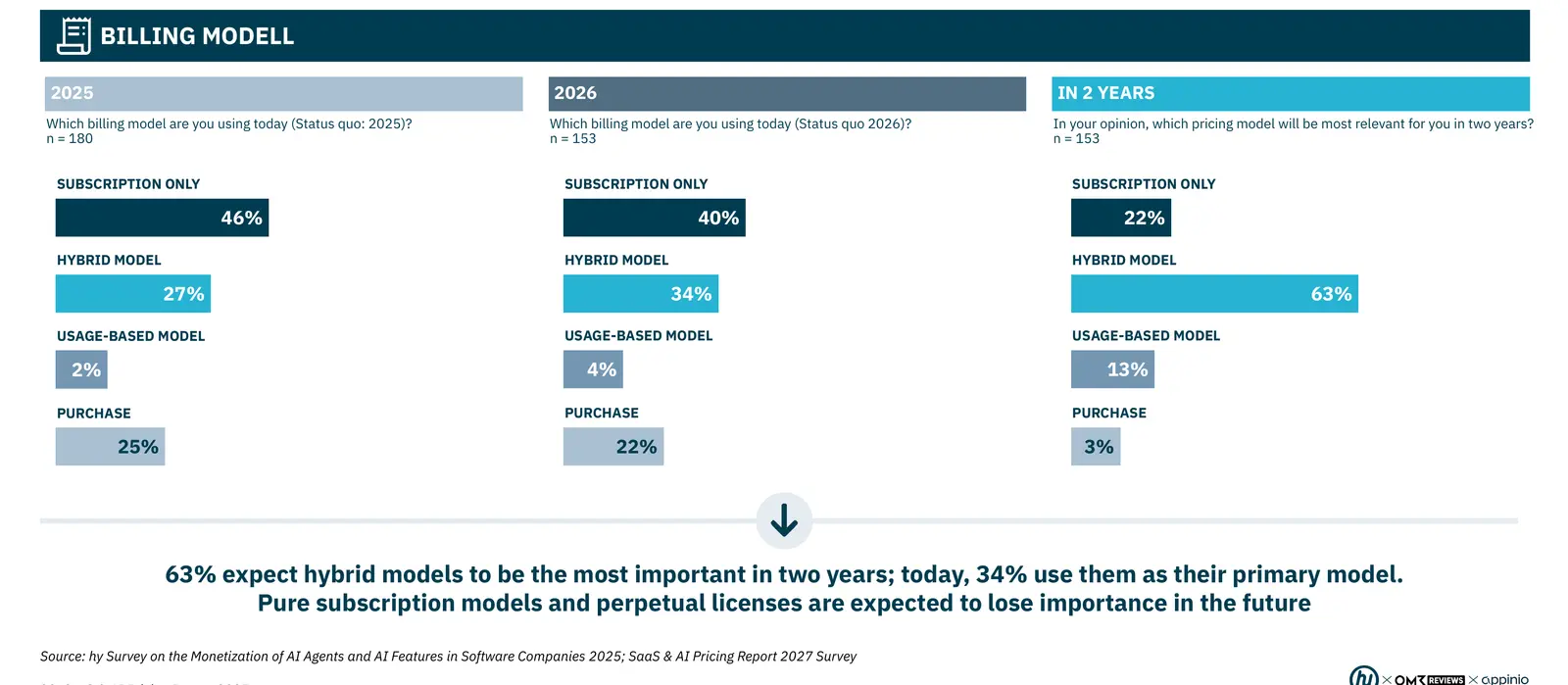
In the survey for our SaaS & AI Pricing Report 2027, 80% of the 153 participating SaaS and AI companies plan or are evaluating a change to their pricing in the next 12 months. The most frequently cited measure is the move from a seat model to a hybrid model, ahead of price increases. So most companies aren't aiming for a pure usage model. Today, 4% bill purely on usage as their main model. In two years, 13% expect it to be their most important model, while 63% expect a hybrid one.
The reason is simple. When AI creates ongoing costs and fewer people operate the software, a pure per-user price hits its limit. Whether that already applies to your product, five questions on seats and usage will tell you. This article assumes the decision has been made.
Where you lose revenue in the switch
Light users pay less. In a seat model, every license costs the same, including the ones that are rarely used. On average, these customers subsidize the heavy users. In a pure usage model, that balance disappears, and these customers suddenly pay less.
Revenue becomes unpredictable. With a subscription, your revenue and the customer's costs are easy to plan. With pay-as-you-go, predictability is low on both sides, and revenue fluctuates with usage. The vendor then carries more volume and revenue risk. Snowflake, which bills by consumption, says so openly in its annual report: because customers decide when they use the platform, the company says it lacks the visibility into revenue that a typical subscription vendor has.
Customers hold themselves back. Customers who pay per use fear fluctuating monthly bills and hesitate to use the software so they don't waste anything. That lowers usage, and your revenue with it.
Five steps to switch your existing customers
- Analyze usage data per customer. For every customer, you need the past 12 months of paid licenses, active users, the volume of the new unit and, for AI features, your costs. Without this table, every switch is a bet.
- Set a hybrid target model. Two variants secure predictable base revenue: an allowance included in the base fee with top-ups billed by consumption, and a volume commitment at a discounted rate, with overage billed in packs at higher rates. A spending cap takes away the customer's fear of an open-ended bill.
- Recalculate every existing customer. Put the old and new bill side by side, customer by customer. The result is a list of winners, losers and outliers, as in the worked example below.
- New customers first, existing customers in waves. New customers start directly on the new model. Existing customers switch at contract renewal, starting with those for whom little changes. That way you learn on easy cases before the hard ones come.
- Prepare your sales team. Whoever leads the conversation has to explain the new model and be able to justify the added value. Customers also need to see their consumption at any time, so the bill isn't a surprise.
In episode 102, I asked Boy Hengstmann exactly that: who ultimately has to “deal with the fallout of whatever three consultants and management somehow came up with?” At evasys, he migrated existing customers from a license model to a subscription, a different switch with the same mechanics. Looking back, he names two things he would do differently. First: “We should have started conversations even earlier and even more proactively, and above all supported our customers' processes better, especially budget planning on their side.” Second, he would have prepared the account managers better for difficult conversations from day one. Your customer has to fit the new amount into their budget before they can pay it.
Worked example: three existing customers, one new model
A vendor currently charges €50 per user per month. The new model: a €500 monthly base fee with 2,000 transactions included, then €0.20 per transaction.
| Customer | Users | Transactions per month | Today | New model | Change |
|---|---|---|---|---|---|
| A | 20 | 6,000 | €1,000 | €1,300 | 30% more |
| B | 30 | 3,000 | €1,500 | €700 | 53% less |
| C | 10 | 9,500 | €500 | €2,000 | four times |
| Total | 60 | 18,500 | €3,000 | €4,000 | 33% more |
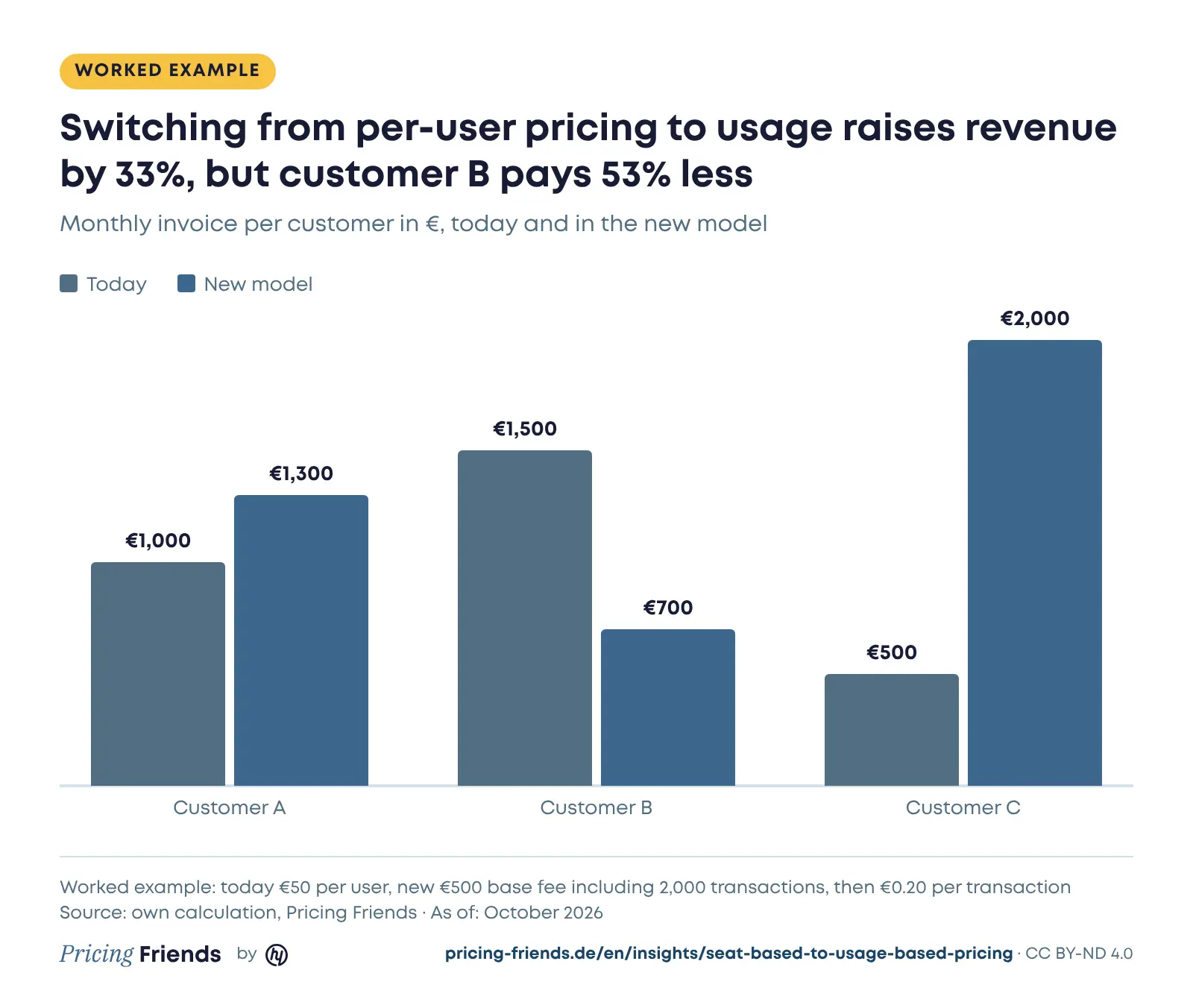
On paper, revenue grows by a third. In practice, you'd lose €800 a month from customer B and probably lose customer C entirely after a fourfold increase. Three guardrails prevent that:
- For customers like B, a minimum commitment equal to the current bill applies for the remaining term. In return, their allowance goes up, so they get more for the same money.
- For customers like C, the price rises in steps over two or three renewals. They finally pay for their consumption, but not in a single step.
- For customers like A, a good explanation of why they pay more is enough: they use the software more intensively than average.
What you can do on Monday
Build the table from the worked example with your real customers before anyone debates price points. Flag every customer whose bill drops by more than a quarter or more than doubles. This group needs its own rule and its own conversation. There's a rule of thumb for sizing the base fee and allowance. Prepare customers who will pay more as you would for a price increase.
In our approach, price enforcement is a separate step, with rules for approvals and special terms. In a model switch it matters even more, because every customer will ask for an exception. Recalculation, rules and customer conversations all interlock in a switch like this. A specialized pricing consultancy like hy can plan them together.
Bottom line: Recalculate first, then switch
You keep the revenue from existing customers if you choose a hybrid target, recalculate every existing customer beforehand and have fixed rules for the outliers. New customers start on the new model right away, and existing customers follow at renewal. Sales decides the rest: they have to get the new price into the customer's budget early enough.
The free pricing audit on pricing-friends.de shows how your current model comes across on your pricing page in about a minute. It reads your pricing page live and checks pricing model, packaging and price points using the approach hy Consulting Group has developed in more than 600 pricing projects.
Sources
- SaaS & AI Pricing Report 2027 by hy, pp. 13, 29, 30, 31, 38, 40, 59
- Snowflake: Annual Report (Form 10-K) for the fiscal year ended January 31, 2026, SEC, risk factor “We may not have visibility into our future financial position and results of operations”
- Pricing Friends, episode 102: Software-Abos und Pricing mit Boy Hengstmann: Wie verbindet evasys Kundentreue und Transformation?
Quotes are translated from German. The podcast episodes are in German.