
Pricing strategy · 7 min read
Per user or usage-based: which pricing model fits?
hy pricing teamReviewed by experts at hy
- Published
- Updated
Key points
- For B2B software, a per-user price fits as long as value and costs grow with the number of users. Usage-based pricing fits when both grow with volume.
- If per-user software takes work off the customer's hands, the number of paid licenses drops exactly when the software works best.
- With usage-based software pricing, the customer has to be able to budget the pricing unit in advance. So units such as documents or search queries work better than tokens.
- For most B2B software vendors, a base fee plus a usage component fits. Only 4% of the SaaS and AI vendors surveyed bill purely on usage.
If you sell B2B software and bill per user today, that model fits as long as customer value and your costs grow with the number of people who work with the software. A usage-based pricing model fits when value and costs grow with volume: with requests, documents or transactions. Many vendors end up in between, with a fixed base plus a variable part.
Where the market stands today
The per-user price is still the norm. In our survey of 180 software companies for the SaaS & AI Pricing Report 2026, 54% billed per user and 41% per feature bundle. 59% combined several metrics. In the 2027 edition, for which we surveyed 153 SaaS and AI companies, the pure subscription leads among billing models at 40%, followed by hybrid models at 34%. Only 4% use pure usage-based billing as their main model.
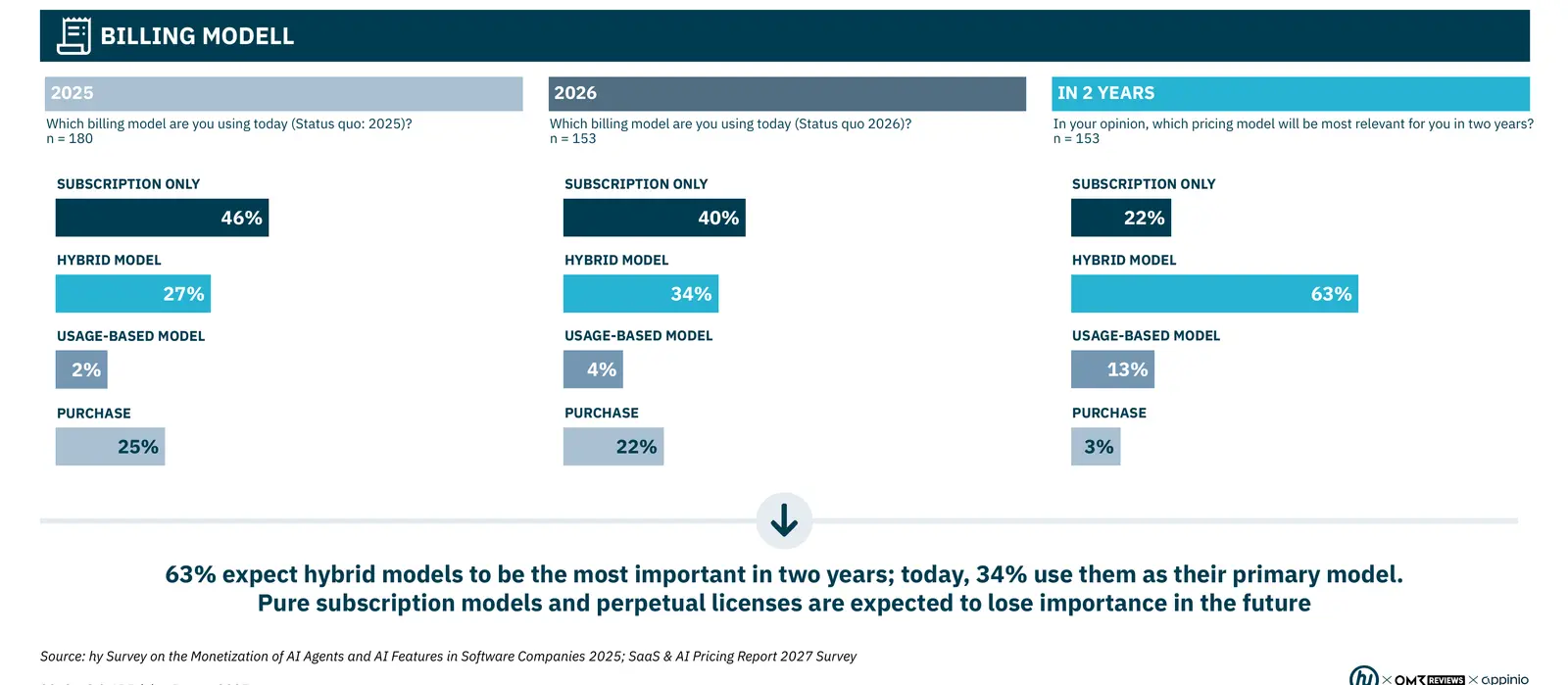
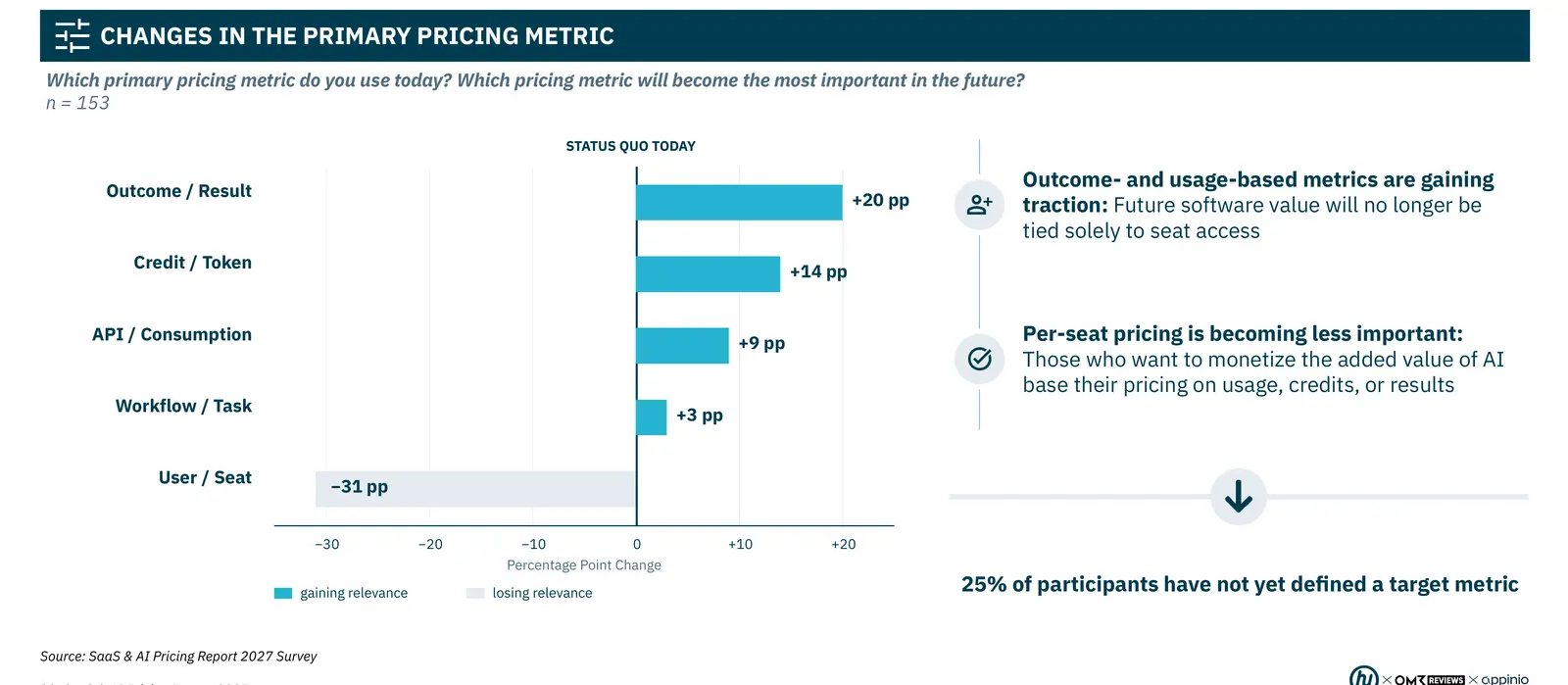
Expectations look very different. As the most important metric of the future, the seat loses 31 percentage points, outcomes gain 20, and credits and tokens gain 14 percentage points. 25% haven't set a target metric yet. In two years, 63% expect a hybrid model to be the most important and 13% a purely usage-based one.
Sebastian Voigt, partner at hy, put forward a hypothesis on the podcast: In classic software such as ERP, CRM or document management, a second metric is more likely to be added to the per-user price, such as an amount per payroll run. The per-user price is an inefficient mechanism in itself. It still works because it gives budget certainty: no outliers, and nobody has to go to the boss three times to ask for more money.
What the two models do
The pricing metric is the unit your customer pays for. It decides two things the price itself can't control: whether your revenue grows with the customer's value and whether it grows with your variable costs.
| Per user (seat) | Usage-based | |
|---|---|---|
| Customer pays for | Access per person | Consumption: requests, documents, minutes, credits |
| Predictability for the customer | high, fixed amount | low, the invoice fluctuates |
| Predictability for you | high | low, revenue fluctuates |
| Cost risk | sits with you as soon as individual users consume a lot | sits with the customer |
| Barrier to use | none, everyone uses it without fear of extra costs | users hold back so they don't waste anything |
| Typical case | daily copilot, email drafts, CRM summaries | video generation, data analysis, infrequent batch processes |
Source: SaaS & AI Pricing Report 2027, p. 29 and p. 38.
Snowflake, which bills on consumption, describes what low predictability means for the vendor in its annual report. Because customers control their consumption freely and revenue is recognized only as it's consumed, the company lacks the visibility into when a contract turns into revenue that typical subscription vendors have.
Five questions for your decision
- Does value grow with headcount? If each person in the tool has their own workflows, settings and data, the seat is a fair unit. That's how Veronika Wax explains why Demodesk sticks with per-user pricing for its core product: Each sales rep automates their own workflows there.
- Are your customers still growing through headcount? Felix Rahlmeyer of the German software review platform OMR Reviews sums up the catch: Seat-based pricing “is of course based on companies growing, and they grow through headcount, and that just isn't happening as much anymore.” If your software takes over work, the number of licenses drops. And it drops exactly when the software works best. Julius Göllner of ARRtist describes the same limit: ongoing AI costs with fewer users.
- How much do your costs per customer fluctuate? Classic SaaS products scaled with almost no marginal costs; with AI, every interaction costs money. If individual power users consume many times more, a fixed per-user price squeezes your gross margin. In its AI pricing playbook, the investor Bessemer Venture Partners cites gross margins of 50% to 60% for AI companies, compared with 80% to 90% for classic SaaS.
- Can your customer calculate the unit in advance? Benedikt Böringer of Jamie warns that a metric requiring complicated calculations before the purchase slows down sales, even if it would be fair. Units the customer counts anyway work better than tokens. At nyris, Anna Lukasson-Herzig bills per search query via the API because the value can be measured there: At a large retailer, each query brings in €3.40 more revenue on average than text search.
- How fixed is your customer's budget? In public administration, a pure token model fails because of rigid budget logic. So at Rulemapping, Ina Remmers bills by case volume, with an annual volume estimate.
If you answer yes to the first question and no to the second and third, stay with the seat. If you answer yes to the second and third and have a countable unit for the fourth, you need a variable component. Most answers are mixed, and then a hybrid model is the honest solution.
Worked example: the same software, three prices
A document software vendor has a customer with 40 users at €50 per user per month, so €2,000 a month. The customer processes 8,000 documents a month. With a new AI feature, a year later it processes twice that volume with 25 users.
| Model | Today | In one year | Quiet month (3,000 documents) |
|---|---|---|---|
| Per user, €50 | €2,000 | €1,250 | €2,000 |
| Per document, €0.25 | €2,000 | €4,000 | €750 |
| Hybrid: €1,000 base incl. 4,000 documents, then €0.25 | €2,000 | €4,000 | €1,000 |
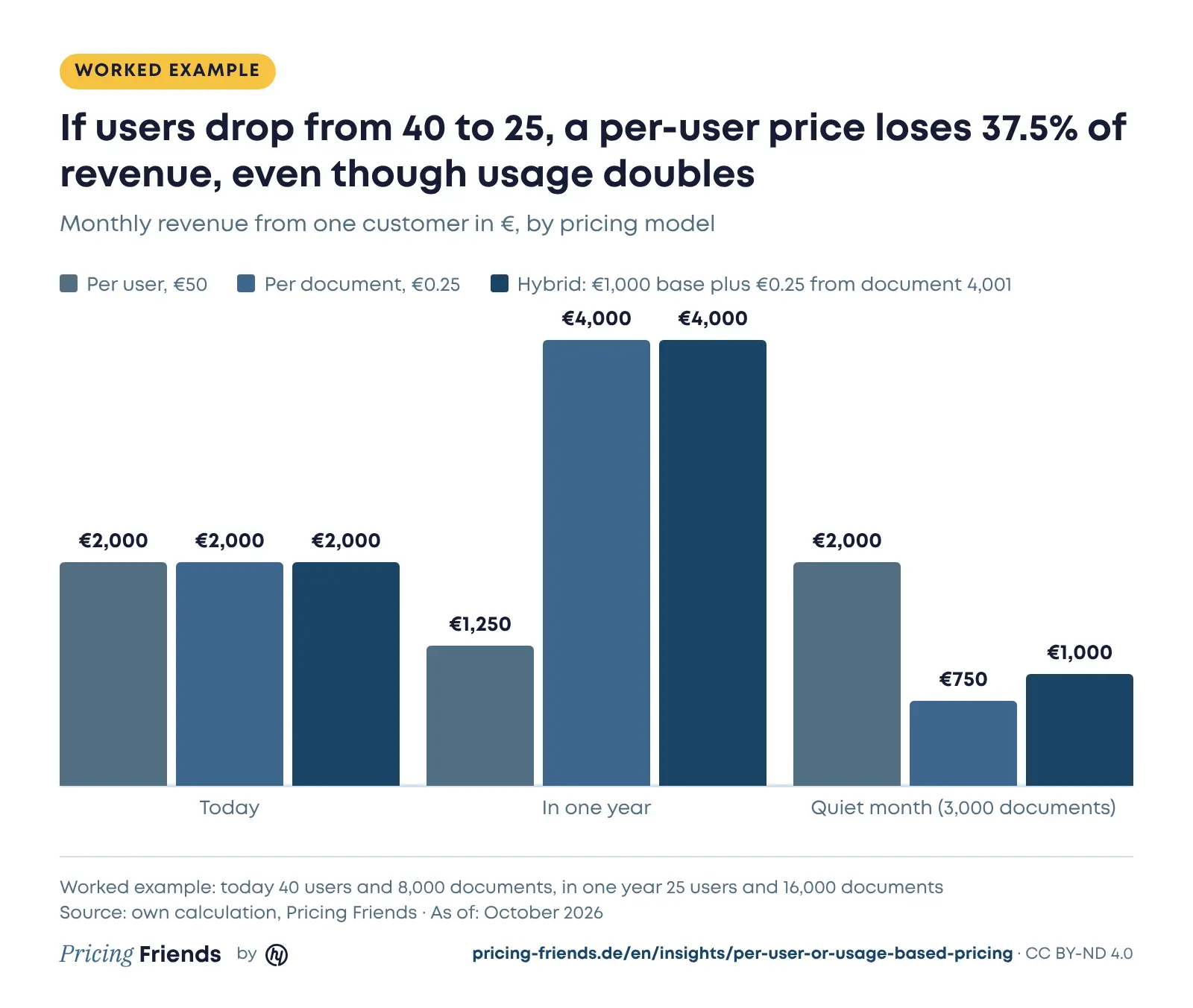
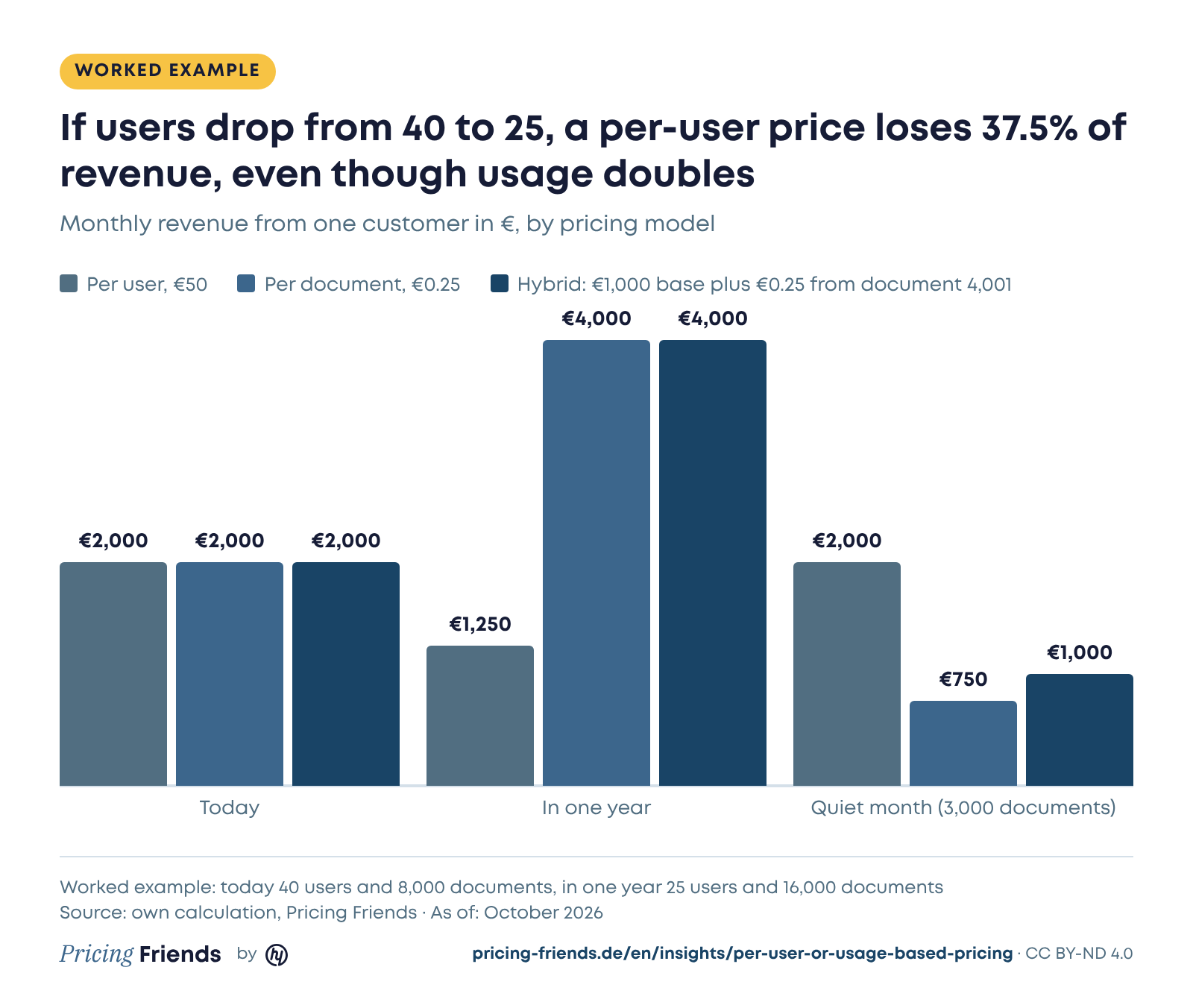
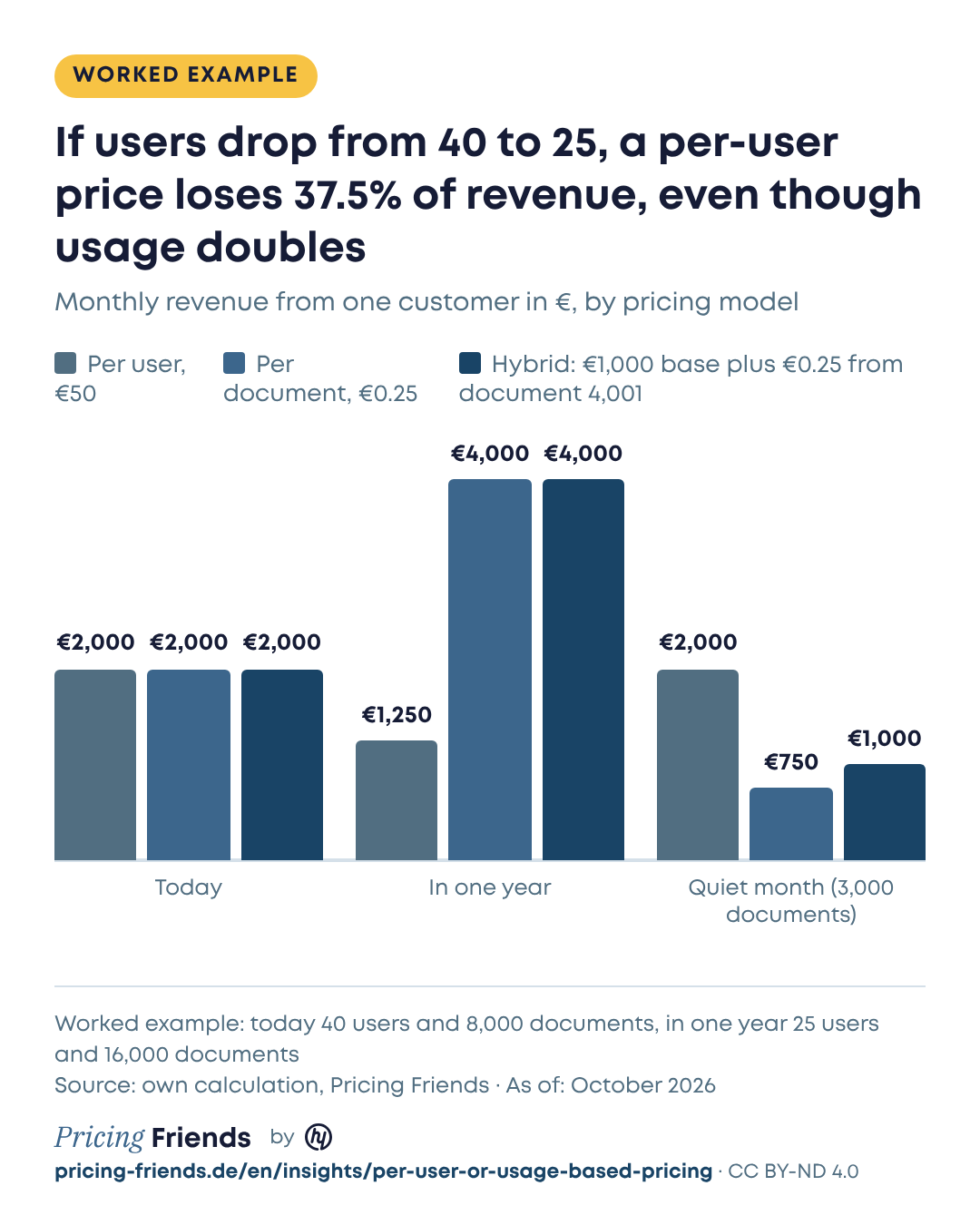
Per user, the vendor loses 37.5% of revenue even though the customer gets more value. Purely usage-based, revenue grows too but collapses in a weak month, and the customer gets a fluctuating invoice. The hybrid holds a floor and still grows with volume.
What you can do on Monday
Pull three numbers for each customer from the last 12 months: paid licenses, active users and the volume of a unit you can measure. Sort customers by volume per license. If a few customers consume many times the median and pay the same, that's your signal for a variable component. If volume per license is tightly clustered, stay with the seat and invest in better packaging instead.
In our approach, the metric comes after the billing model and before the price level. If you set the price first and then look for the unit, you end up calculating backward.
For combining a base fee and usage, there are three levers. If you've already decided, your existing customer base needs its own migration plan.
Bottom line: The metric follows value, the model follows predictability
Per user stays right as long as each additional person at the customer adds value and your costs per person are stable. As soon as your software takes over work or individual customers consume many times more, you need a unit that grows with volume. Because B2B buyers still want a fixed budget, the answer for most is a fixed base plus a variable part.
The free pricing audit on pricing-friends.de shows in about a minute how your current metric comes across on your pricing page. It reads your pricing page live and checks pricing model, packaging and price points. It's based on the approach hy Consulting Group has developed in more than 600 pricing projects.
Sources
- SaaS & AI Pricing Report 2027 by hy, pp. 12, 29, 30, 31, 32, 35, 38
- SaaS & AI Pricing Report 2026 by hy, p. 19
- Pricing Friends, episode 99: Sonderfolge: SaaS-Pricing, AI und die Zukunft der Preismodelle, Dr. Sebastian Voigt bei Julius Göllner
- Pricing Friends, episode 104: KI-Bilderkennung und Pricing mit Anna Lukasson-Herzig: Wie bepreist man visuelle Suche, vom E-Commerce bis zur Maschinenausfallzeit?
- Pricing Friends, episode 119: Sales, AI und Pricing mit Veronika Wax: Was passiert mit dem Seat-based Pricing, wenn KI-Agenten die Arbeit übernehmen?
- Pricing Friends, episode 126: SaaSpocalypse - Panel mit Gülsah Wilke, Toni Schmidt, Gordian Braun und Felix Rahlmeyer: Stirbt User-based Pricing durch KI?
- Bessemer Venture Partners: The AI pricing and monetization playbook, February 2026
- Snowflake Inc.: Annual report (Form 10-K) for the fiscal year ended January 31, 2026
Quotes are translated from German. The podcast episodes are in German.