
Pricing strategy · 7 min read
Value-based pricing for software: Set your price by the value you create

Key points
- Value-based pricing for software sets the price between the vendor's costs as the floor and the customer's value as the ceiling.
- In value-based pricing, the value of software is measured against the customer's alternative. An AI agent is compared with personnel costs, an assistive feature with other software.
- In value-based pricing, software vendors put a number on the value for each customer segment and choose a pricing metric that grows with value and is easy to estimate.
- With value-based pricing, a software vendor captures only part of the customer's value. The buyer's budget and the comparison with other software often pull the price well below it.
Value-based pricing means you set your price by the value your software creates for the customer, not by your costs or by what competitors charge. Costs set the floor, value sets the ceiling, and the price sits in between. For software, it takes four steps: find the customer's reference point, put a number on the value for each customer segment, choose a metric that grows with value, and then set the price level. This article is for founders, CEOs and product leaders at software companies.
Prof. Dr. Martin Fassnacht has described what it's about: “In price management, and I prefer that term to pricing, the point is to capture the value created from the customer's perspective.”
Three ways to a price, and the role each one plays
I usually put it like this: “You can do cost-plus, competition-based or value-based pricing.” In practice, you need all three, just in different roles.
| Approach | Starting point | Role in value-based pricing |
|---|---|---|
| Cost-based | Your own costs plus margin | Floor: below it, you lose money |
| Competition-based | Prices of comparable offers | Reference point customers measure you against |
| Value-based | Value to the customer | Ceiling and guide for the price |
The economist Hal Varian explained back in 1997 why costs make a poor starting point for software: Information goods have high fixed costs to produce and low costs for each additional copy. Cost-based prices then make little sense, and value-based prices fit much better.
AI makes the floor more important. Classic SaaS products could scale with almost no additional cost. With AI, every interaction costs real money. I once put it this way: “We don't want to do cost-based pricing, but you usually do need some kind of lower threshold.” Still, the floor must not become the price. In its AI pricing playbook, the investor Bessemer Venture Partners observes that many founders fall back on cost plus markup: They calculate their delivery costs, double them and charge too little, because asking for more feels uncomfortable.
Step 1: Find the customer's reference point
The value of your software is always relative. It's measured against what the customer would do without you. AI shifts that comparison.
| What you sell | Which budget pays for it | What the customer compares it with |
|---|---|---|
| Feature that supports people | Software budget | Other software, competing tools |
| Agent that completes a task on its own | Personnel budget | Personnel costs, day rates, tasks left undone |
| Workflow that covers an entire process | Process budget | Current process costs, agency, outsourcing |
Source: SaaS & AI Pricing Report 2027, p. 46 and p. 54.
An agent that takes over the work of half a position gets compared with a salary. A feature that makes the same person faster gets compared with other software. For the same value, that can mean a very different price.
Step 2: Put a number on the value for each customer segment
The same transaction is worth different amounts to different customers. My example on the podcast was an AI phone assistant that answers calls: “A call like that has a completely different value for two different customers.” For a hair salon, it's about an appointment that brings in €25–100, depending on hair length. For a real estate agent, the same call can lead to a €60,000 commission.
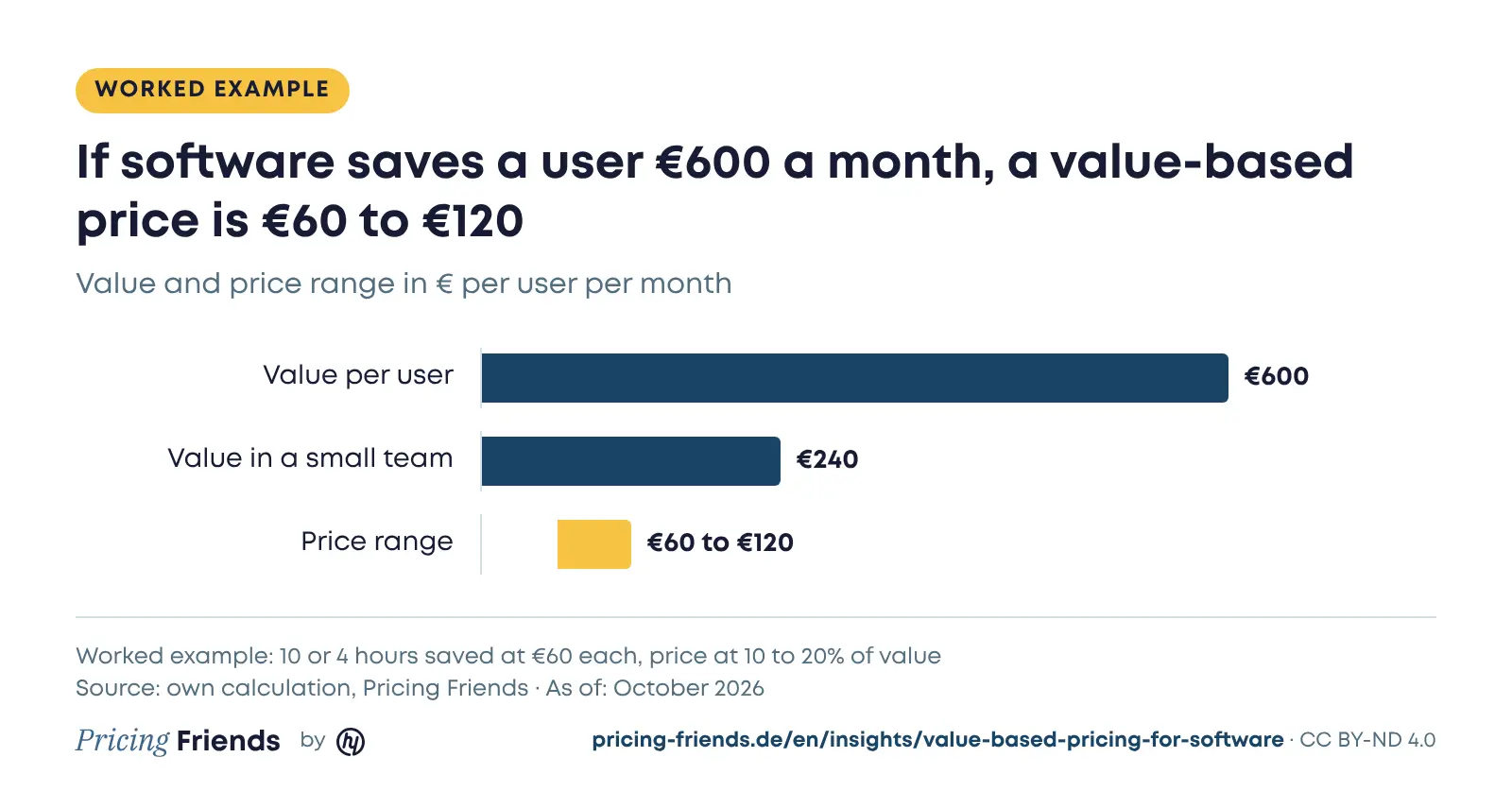
Worked example (assumed values): Your software saves a sales rep ten hours a month. At €60 an hour, that's €600 in value per user per month. For a small team with little sales volume, it may be only four hours, so €240. Calculate this value separately for each customer segment, because these differences will later shape your plans. They're also the basis for pricing customer segments differently.
Step 3: Choose a metric that grows with value
The pricing metric decides whether your revenue grows with the customer's value and whether it grows with your variable costs. A per-user price often reflects value only roughly. I once asked whether, for a CRM, revenue or deals won wouldn't actually be the better metric.
That's why Dr. Anna Lukasson-Herzig of nyris bills only by API calls. For her, it's the fairest metric, because it grows directly with usage and the value delivered. Benedikt Böringer of Jamie draws a line: A metric the customer has to work out laboriously before buying slows down sales. So the best metric is one that rises with value and that the customer can still estimate in their head.
Step 4: Set the price level
Now comes the number. Jamie shows how close to the ceiling you can go. Benedikt Böringer described how Jamie arrived at its price: “If you went by that, you'd quickly end up at software costs of a few hundred to €1,000 a month.” And further: “In the end, nobody spends that much on a software solution. So we had to find a middle ground.” Jamie launched at €99 a month for up to 100 meetings. Today there's an unlimited plan for €47.
The lesson: Value sets the ceiling, while the buyer's budget and the comparison with other software pull the price down. You capture part of the value, never all of it. In the worked example above, with €600 in value, you might charge €60–120 per user, so 10–20%. That range is an assumption. Only measuring willingness to pay shows whether it holds.
In our approach to pricing projects, this is step VI: Customer value and willingness to pay are translated into concrete prices, including the variable costs of AI.
Where value-based pricing hits its limits
The purest form would be a price per outcome. The investor Oliver Pabst has given an order of magnitude: About 5% of AI companies will adopt outcome-based pricing. That matches my experience: It takes a narrow, repeatable use case that is fully measurable. So for most software products, value-based pricing is a way of thinking about metric and price level, not a billing model.
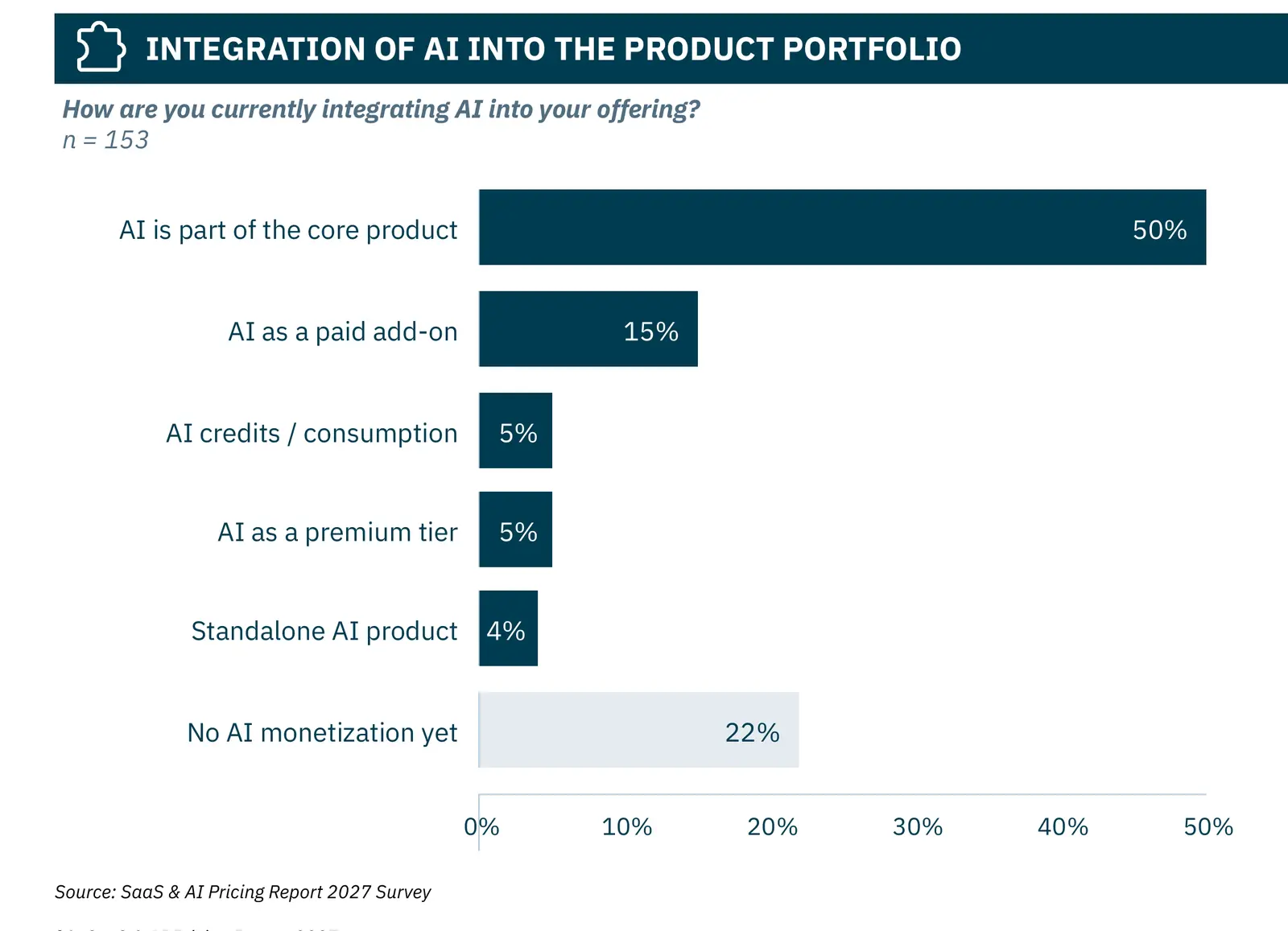
The more common gap is elsewhere: Value gets created but not captured. In our SaaS & AI Pricing Report 2027, 50% of the 153 SaaS and AI companies surveyed bundle AI into the core product at no extra charge, and 22% don't monetize it at all yet. That can be right if AI is meant to strengthen retention. But it should be a deliberate decision.
What you can do on Monday
- Take your five largest customers and write down what they would do without your product.
- Assign each one a budget: software, personnel or process.
- Put a number on the value per month, with assumptions you write down openly.
- Put your current price next to it. Is it at 1% of the value or at 50%?
- Check whether your metric grows with that value.
Bottom line: Value sets the ceiling
Value-based pricing aligns the price with the customer's value. Costs set the floor, value sets the ceiling, and the customer's reference point decides where you land in between. Jamie shows that the price is often well below the calculated value. If you know the value, you at least know how much room you have.
The free pricing audit on pricing-friends.de gives you a first read on your pricing page in about a minute. It reads your pricing page live, checks pricing model, packaging, price points and entry offer, and gives a score from 0 to 100 with findings. It applies the approach hy Consulting Group has developed in more than 600 pricing projects. Check your pricing page for free.
Sources
- SaaS & AI Pricing Report 2027 by hy, pp. 12, 21, 31, 35, 46, 54, 84
- Pricing Friends, episode 7: Softwarelizenzen und Pricing mit Timo Müller: Wie beeinflusst die Preisgestaltung das Softwaregeschäft?
- Pricing Friends, episode 84: KI und Pricing mit Dr. Oliver Pabst: Warum gelingt echtes Value-Based Pricing nur 5 % der Softwareanbieter?
- Pricing Friends, episode 89: AI Agents und Pricing mit Malte Kosub: Welches Preismodell funktioniert wirklich für KI-Telefonassistenten?
- Pricing Friends, episode 99: Sonderfolge: SaaS-Pricing, AI und die Zukunft der Preismodelle, Dr. Sebastian Voigt bei Julius Göllner
- Pricing Friends, episode 108: Einkauf und Pricing mit Gerd Kerkhoff: Warum scheitern gute Preisstrategien oft im Einkauf?
- Pricing Friends, episode 136: Wissenschaft und Preismanagement mit Prof. Dr. Martin Fassnacht: Die Marke schafft den Wert, wer schöpft ihn am Ende ab?
- Pricing Friends, episode 140: Meeting Intelligence und Pricing mit Benedikt Böringer: Wie Jamie seinen eigenen Weg zwischen Cost- und Value-Based Pricing gefunden hat?
- Hal R. Varian: Versioning Information Goods, University of California, Berkeley, 1997
- Bessemer Venture Partners: The AI pricing and monetization playbook, February 2026
Quotes are translated from German. The podcast episodes are in German.