
AI pricing · 7 min read
Outcome-based pricing: when a price per outcome pays off

Key points
- Outcome-based pricing, a price per outcome, only pays off for software when outcomes are measurable, attributable, valuable and frequent. Otherwise, a hybrid or credits fit better.
- With outcome-based pricing for software, what counts as resolved is defined from the start. Otherwise the customer also pays where a human had to step in.
- A minimum commitment, a cost cap, a parallel usage price and a clearly defined unit make outcome-based pricing predictable for software vendors and customers.
- According to hy's SaaS & AI Pricing Report, only 8% of software and AI vendors use or plan to use outcome-based pricing for AI agents.
Outcome-based pricing means your customer pays only for an outcome achieved, such as a resolved support request, a filled position or a recovered payment. For software vendors, it pays off when the outcome is clearly measurable, can be clearly attributed to your product and happens often enough for outliers to even out. For most products, an outcome component in a hybrid model is safer than a pure price per outcome.
Much discussed, rarely implemented
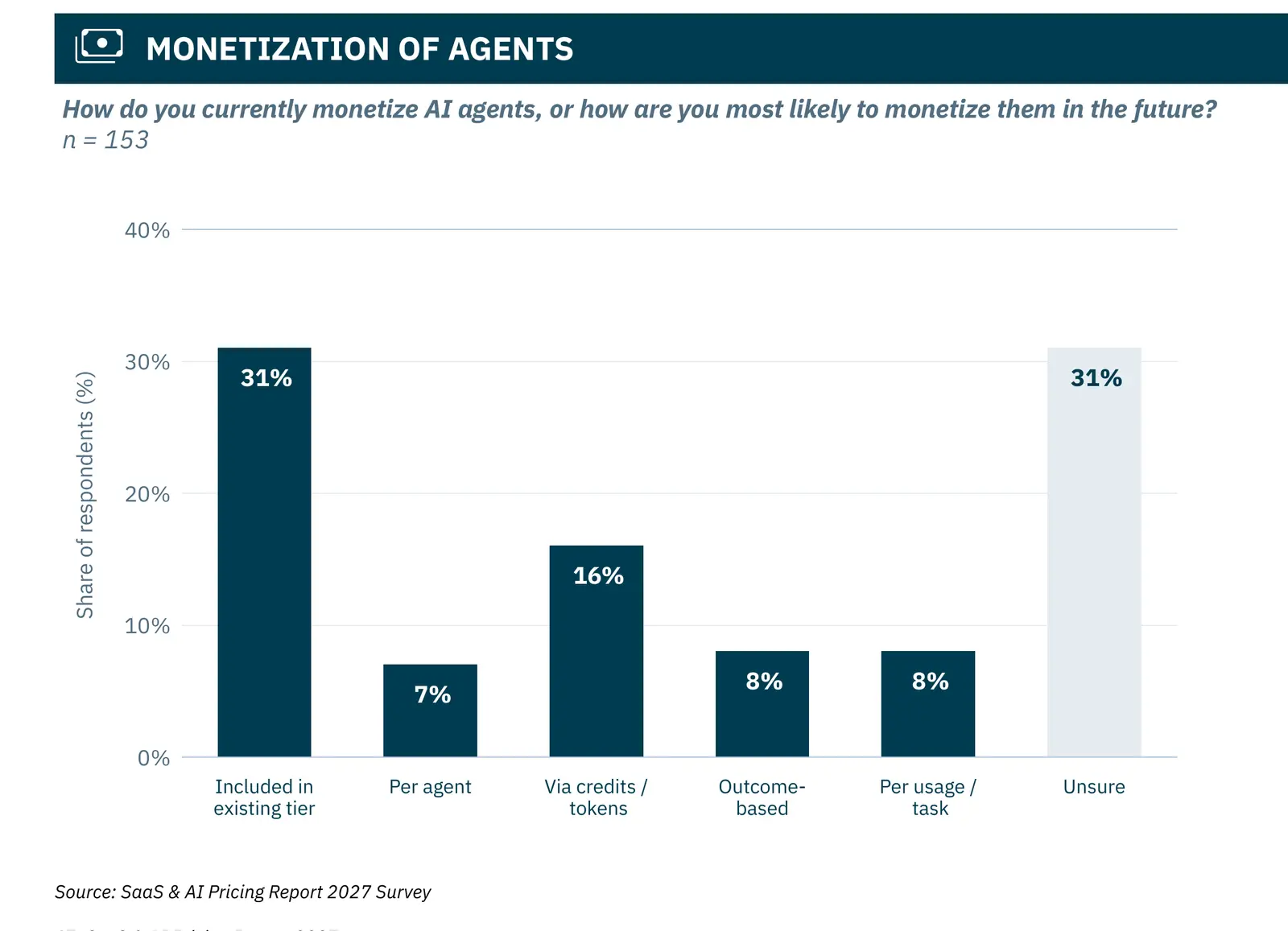
For our SaaS & AI Pricing Report 2027, we surveyed 153 software and AI vendors online. As the future primary metric, the outcome gains 20 percentage points there, more than any other metric. For agents, though, only 8% of respondents use or plan to use outcome-based prices. 31% bundle agents into existing plans, and another 31% are unsure. So we expect prices per agent, task or workflow to catch on much faster than prices per outcome.
On our panel, I summed it up like this: “There's a lot of talk about outcome-based pricing, but nobody's doing it.” Oliver Pabst of Redalpine sees it as only a small part of the market: “It'll be a small part, because it really takes genuine differentiation.” I once paraphrased his hypothesis this way: at most 5% of tech companies will manage outcome-based pricing, probably even fewer.
In our interviews and projects, the topic still often comes up very early. Once we check whether it's technically feasible and whether customers would rather have stability, the shine usually wears off fast.
Four conditions, all must be met
We name three conditions: the outcome is clearly measurable, the software's share in it is traceable, and both sides see the economic value. I add a fourth: you need a very narrow use case that repeats often, because in the end you don't want to argue over whether the problem was solved. Malte Kosub of Parloa sees it the same way. For him, outcome-based pricing is “a very relevant pricing mechanism for vendors that have a very repetitive and very clear value proposition.”
| Condition | Test question | Good fit | Poor fit |
|---|---|---|---|
| Measurable | Is there a clear yes or no, with no debate? | Chargeback won, decided by Visa and Mastercard | Better decisions in the team |
| Attributable | Would the outcome not have happened without your software? | Agent fully resolves the request | Revenue lift after a sales training |
| Value for both | Does your contact at the customer win too when you earn? | Filled position, paid only when the contract is signed | Procurement software that takes a share of savings |
| Frequent | Do long and short cases even out over the month? | Thousands of support requests | A few large projects a year |
The third row is easy to miss. Fabian Heinrich of Mercanis describes the conflict like this: in procurement, an employee's bonus depends on savings. If the software claims a share of them, the buyer gives up part of their own success. So Mercanis prefers to see itself as a vendor that makes the buyer shine.
What goes wrong in practice
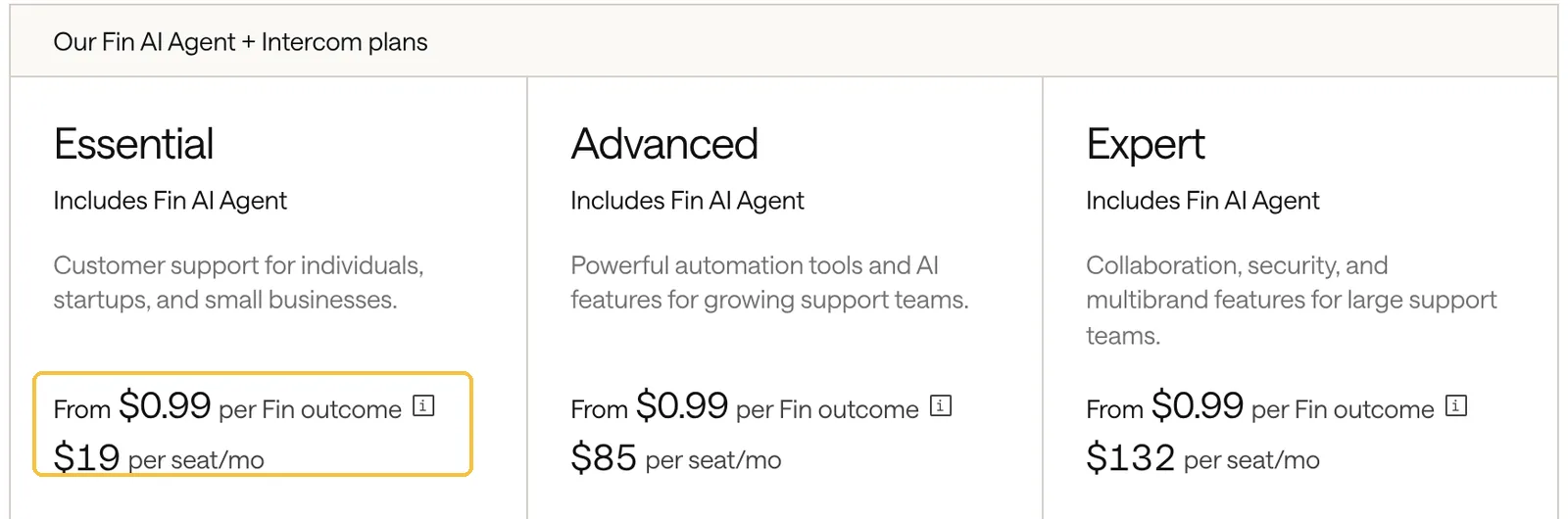
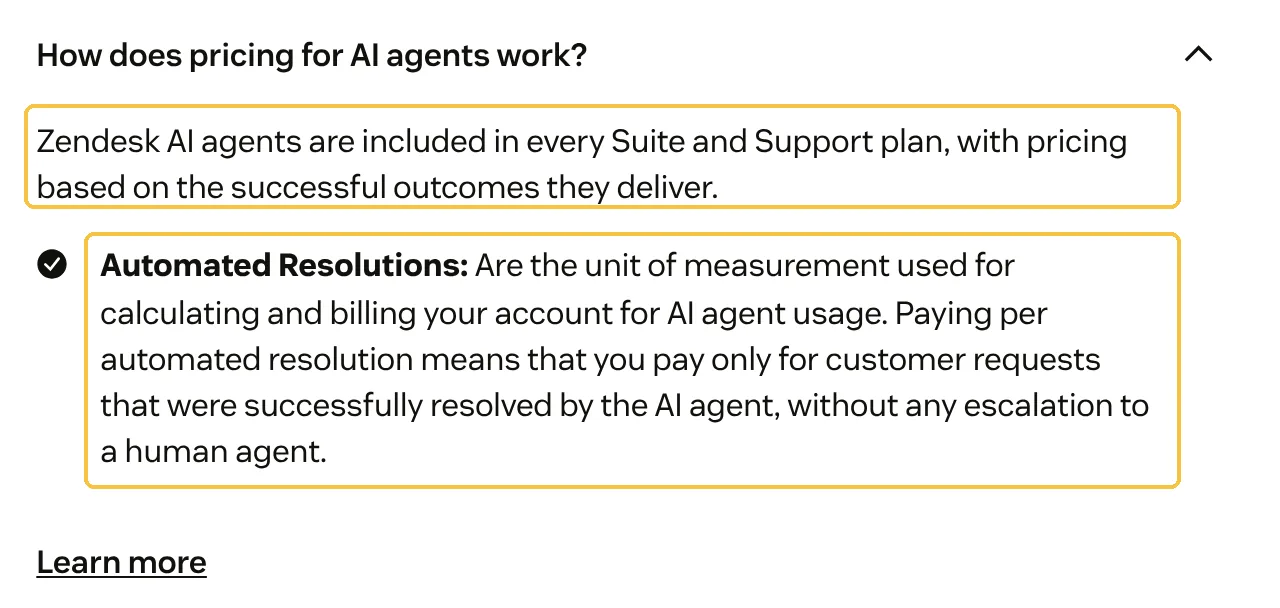
The best-known example is Intercom. Fin launched at $0.99 per outcome and is now a hybrid of seats and a price per resolved request, because the “assumed resolution” was charged even when a human rightly stepped in. The lesson: the rules for what counts as resolved belong in the model from the start. Intercom has since published them. A resolution counts when the customer confirms after Fin's last answer that it helped, or leaves the conversation without asking for more help. If they come back to the same conversation later because they do need help, the resolution is deducted again. Others are following: since May 2026, Zendesk has charged $1.50 per resolved request, with three clearly defined levels. The full Intercom story and the Chargeflow example are part of the question of how to price AI agents.
Arne Wolter of Appinio boils the core problem down to one question: “The problem is defining what actually counts as a success, and how do I price it?” There is also the variance. Malte Kosub describes how one conversation can be resolved in 40 seconds and another in twelve minutes. A fixed price per resolution has to price in that risk, and in the end one side loses.
Four building blocks that protect an outcome price
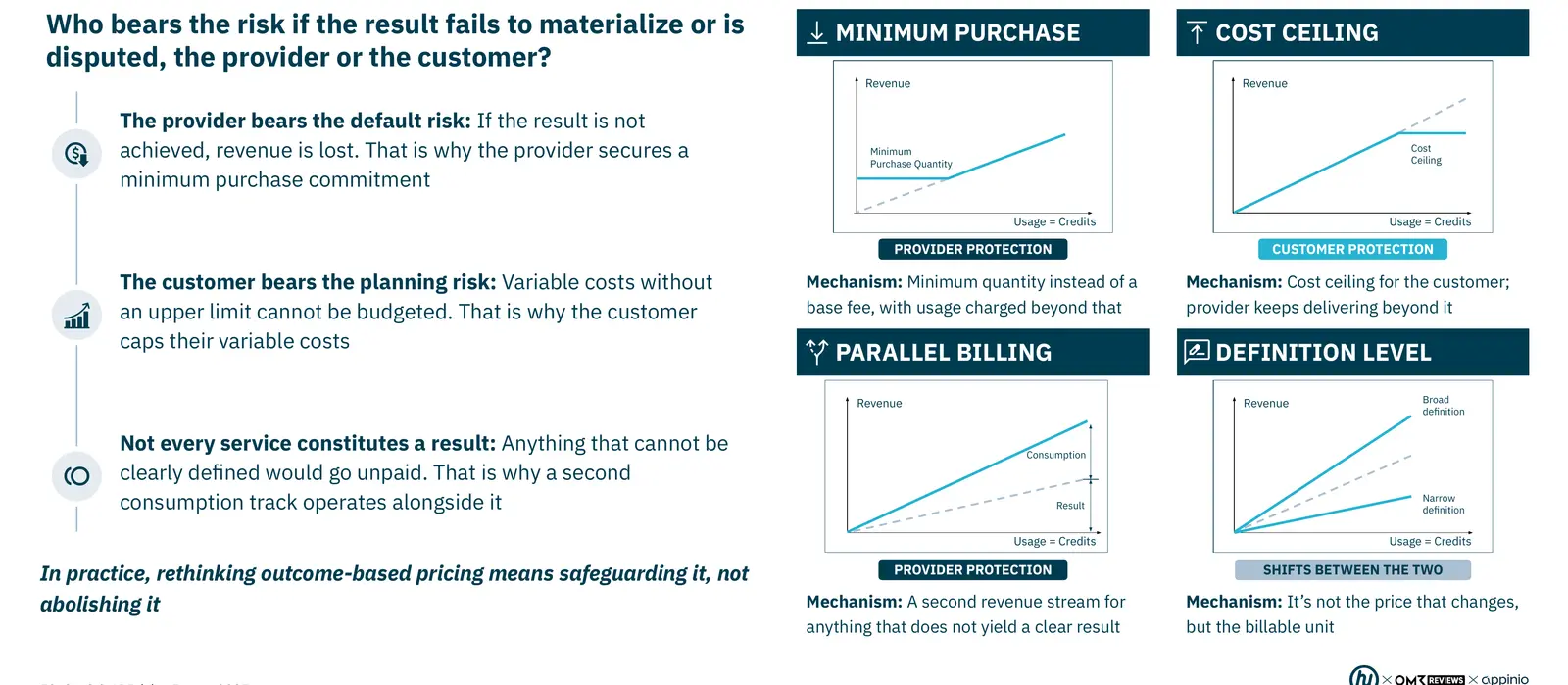
A price per outcome alone is rarely enough. Four building blocks bring back predictability:
- Minimum commitment. If the outcome doesn't happen, you lose the revenue. A minimum volume instead of a base fee protects you, and anything above it is billed by outcome. Intercom requires around 50 resolutions a month.
- Cost cap. Customers can't budget for variable costs without a cap. A cap protects them, and you keep delivering beyond it.
- Parallel usage path. Anything that can't be clearly defined as an outcome would go unpaid. A second, usage-based price runs alongside.
- Definition level. Instead of the price, you adjust the unit: a narrow definition of “resolved” protects the customer, a broad one protects you.
Worked example: a price per resolved request
A support employee costs a company €30 an hour and resolves four requests an hour, so €7.50 per request. An AI agent that fully resolves requests takes 20% of that value: €1.50 per resolved request. That's the logic I sketched on the podcast: labor cost per case is the benchmark, and a share of it is the price.
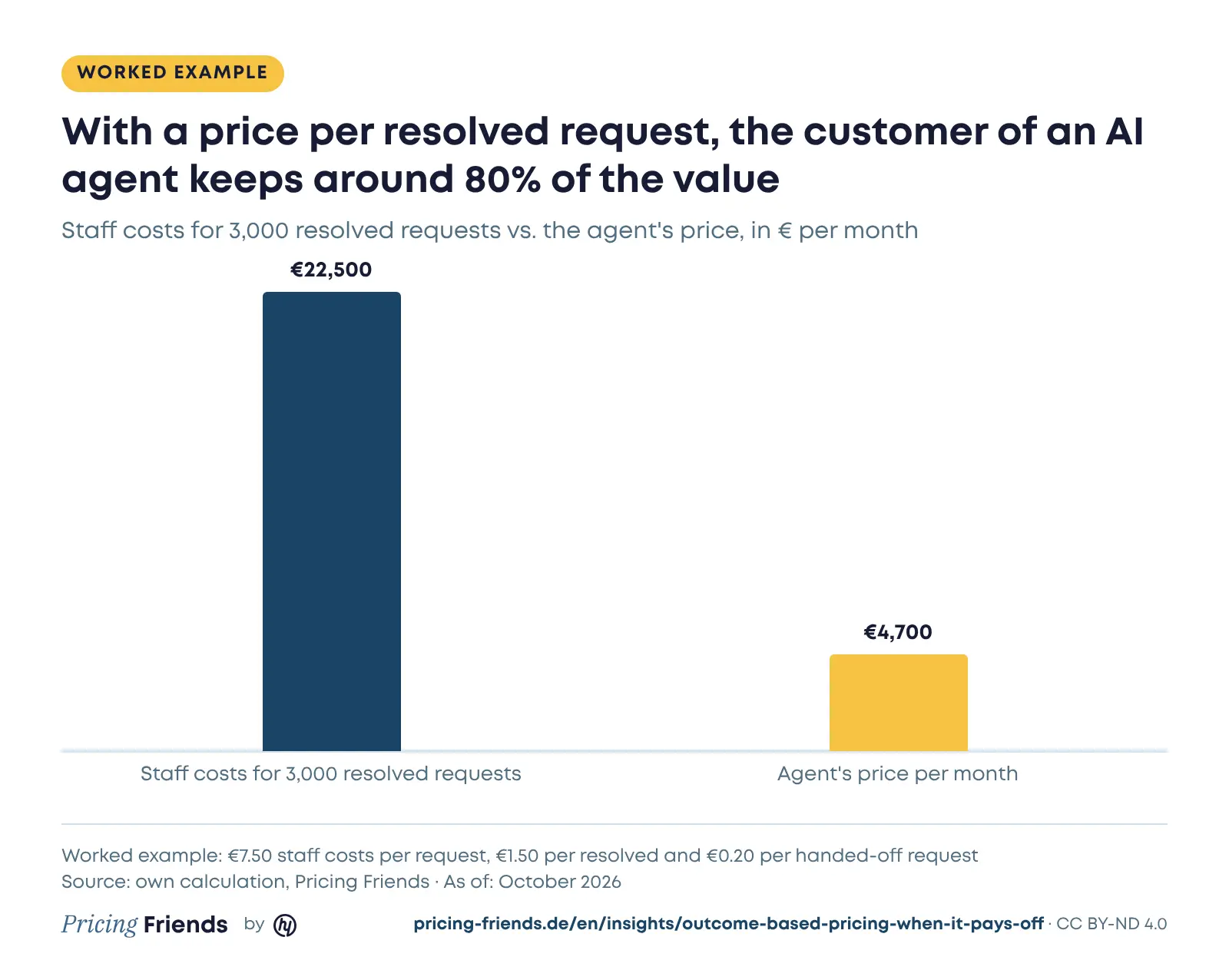
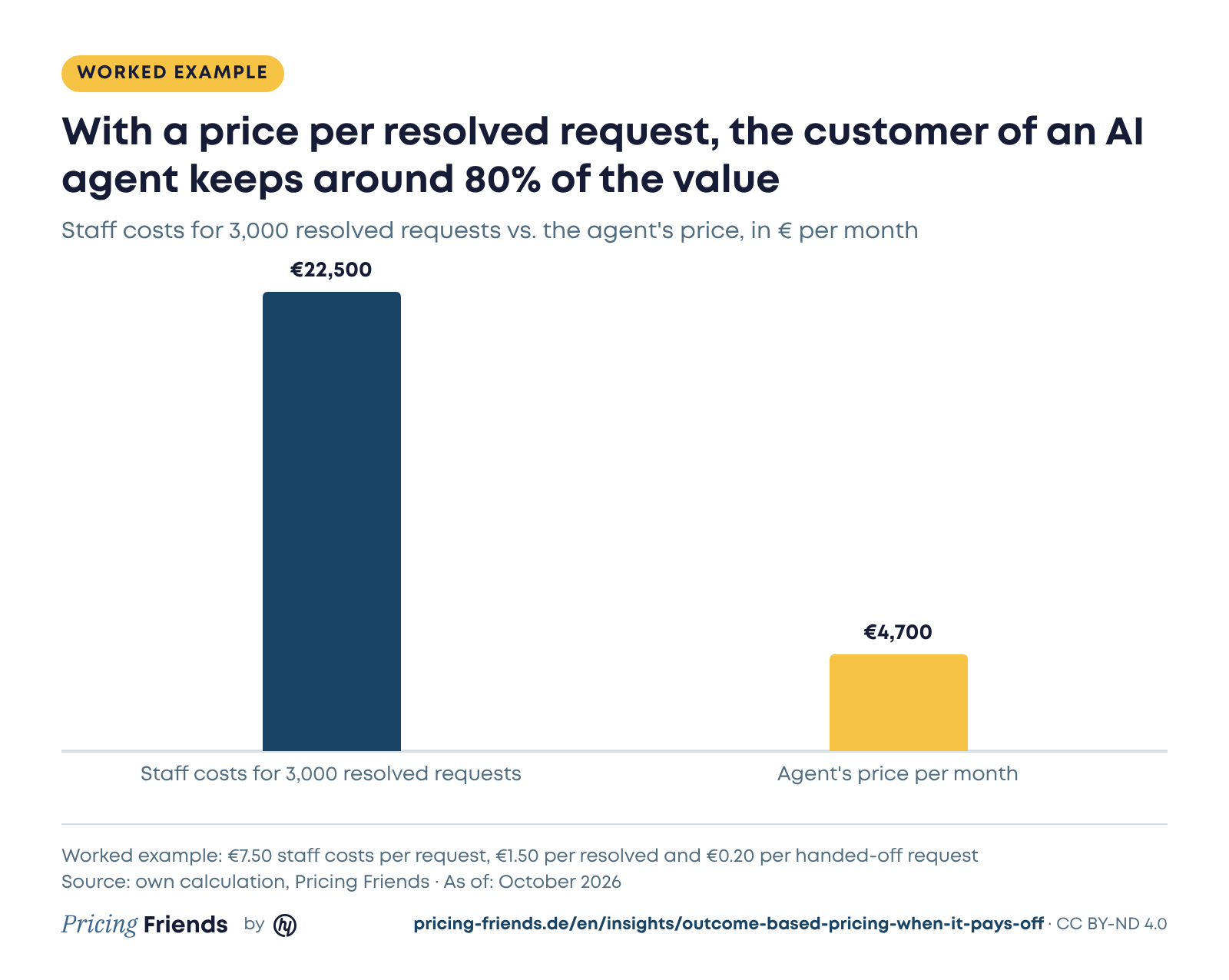
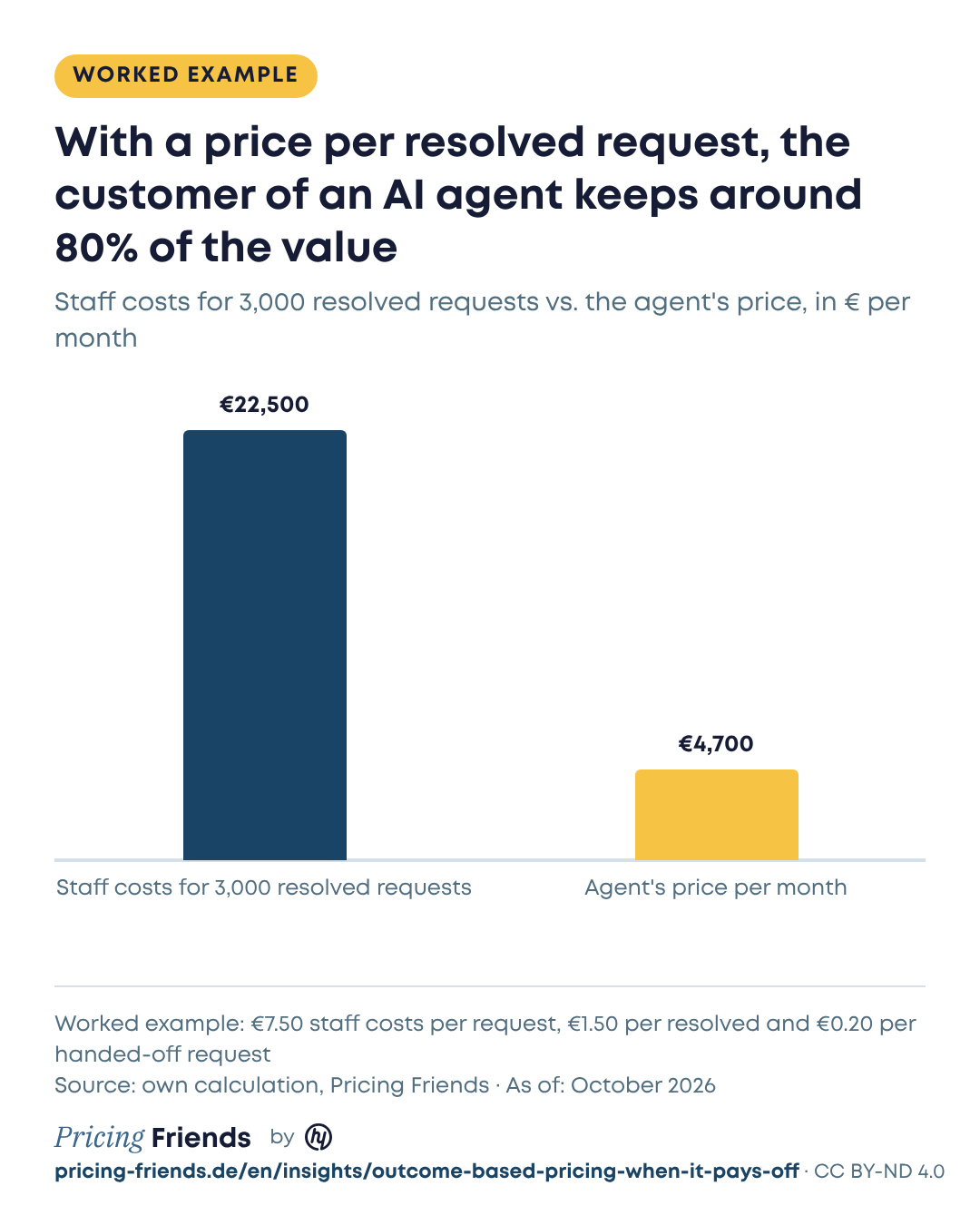
With safeguards, the offer looks like this: at least 1,000 resolved requests a month, which means €1,500 minimum revenue for you. A cap of €6,000 a month for the customer. And €0.20 for every request the agent handles and hands off to a human, as a parallel usage path. If the agent resolves 3,000 requests and hands off 1,000, the customer pays €4,700. The 3,000 resolved requests would have cost €22,500 with staff. After deducting the €4,700, the customer keeps €17,800, around 80% of the value. The numbers are made up; the building blocks come from our report.
What you can do on Monday
Write down your three most important use cases and run each through the four rows of the table. If a case fails any row, it belongs in a hybrid model of base fee plus usage or a credit-based model. If a case passes all four, work through the numbers as above and test it with a few customers before it goes on the pricing page. In our approach, this is the pricing metric question, which has to be answered before any price level.
Bottom line: Define the outcome first, then price it
A price per outcome only pays off when the outcome is clearly measurable, attributable to your software, valuable to both sides and frequent. That applies to few use cases, such as support, chargebacks or recruiting. For everyone else, an outcome component with a minimum commitment, a cost cap and a parallel usage path is safer than a pure price per outcome.
The free pricing audit on pricing-friends.de shows how your current pricing model looks from the outside in about a minute. It reads your pricing page live and checks pricing model, packaging and price points using the approach hy Consulting Group developed in more than 600 pricing projects.
Sources
- SaaS & AI Pricing Report 2027 by hy, pp. 32, 47, 55, 56, 57, 58, 59, 83
- Intercom: Fin outcomes, definition of a resolution, accessed October 17, 2026
- Pricing Friends, episode 84: KI und Pricing mit Dr. Oliver Pabst: Warum gelingt echtes Value-Based Pricing nur 5 % der Softwareanbieter?
- Pricing Friends, episode 89: AI Agents und Pricing mit Malte Kosub: Welches Preismodell funktioniert wirklich für KI-Telefonassistenten?
- Pricing Friends, episode 99: Sonderfolge: SaaS-Pricing, AI und die Zukunft der Preismodelle, Dr. Sebastian Voigt bei Julius Göllner
- Pricing Friends, episode 143: SaaS- und AI-Pricing mit Arne Wolter: Wird KI zur Commodity?
- Pricing Friends, episode 144: SaaS & AI Pricing Report mit Arne Wolter, Benedikt Böringer, Felix Rahlmeyer, Melanie Riebel & Norman Nielsen: Wie verändert KI das Pricing von morgen?
Quotes are translated from German. The podcast episodes are in German.