
AI pricing · 10 min read
How to price AI features and agents: four questions in a fixed order

Key points
- An AI feature in software competes with software budgets, an AI agent with personnel costs. Packaged as an add-on, an AI agent gets compared with a per-seat surcharge.
- If a software vendor's AI costs vary widely by customer, usage metrics or credits protect the margin. If AI usage is even, a fixed per-seat surcharge is enough.
- Outcome-based pricing for AI software comes last. It needs an outcome that vendor and customer can measure without dispute.
- For AI features and agents, most software vendors end up with a hybrid of a predictable base and a variable part that grows with the work done.
If you sell software and are rolling out AI features or agents, you face the question of how to make money from them. My thesis: With AI, the efficiency logic is far ahead of the monetization logic. An AI feature can take a lot of work off the customer's plate and still not bring the vendor a single extra euro.
The numbers from the SaaS & AI Pricing Report 2027 back this up. For the report, we surveyed 153 software and AI vendors online. 50% of them build AI into the core product at no extra charge, and 22% don't monetize it at all. For agents, 31% put them into existing plans, and another 31% are unsure. At the same time, 80% are planning or considering a change to their pricing in the next 12 months.
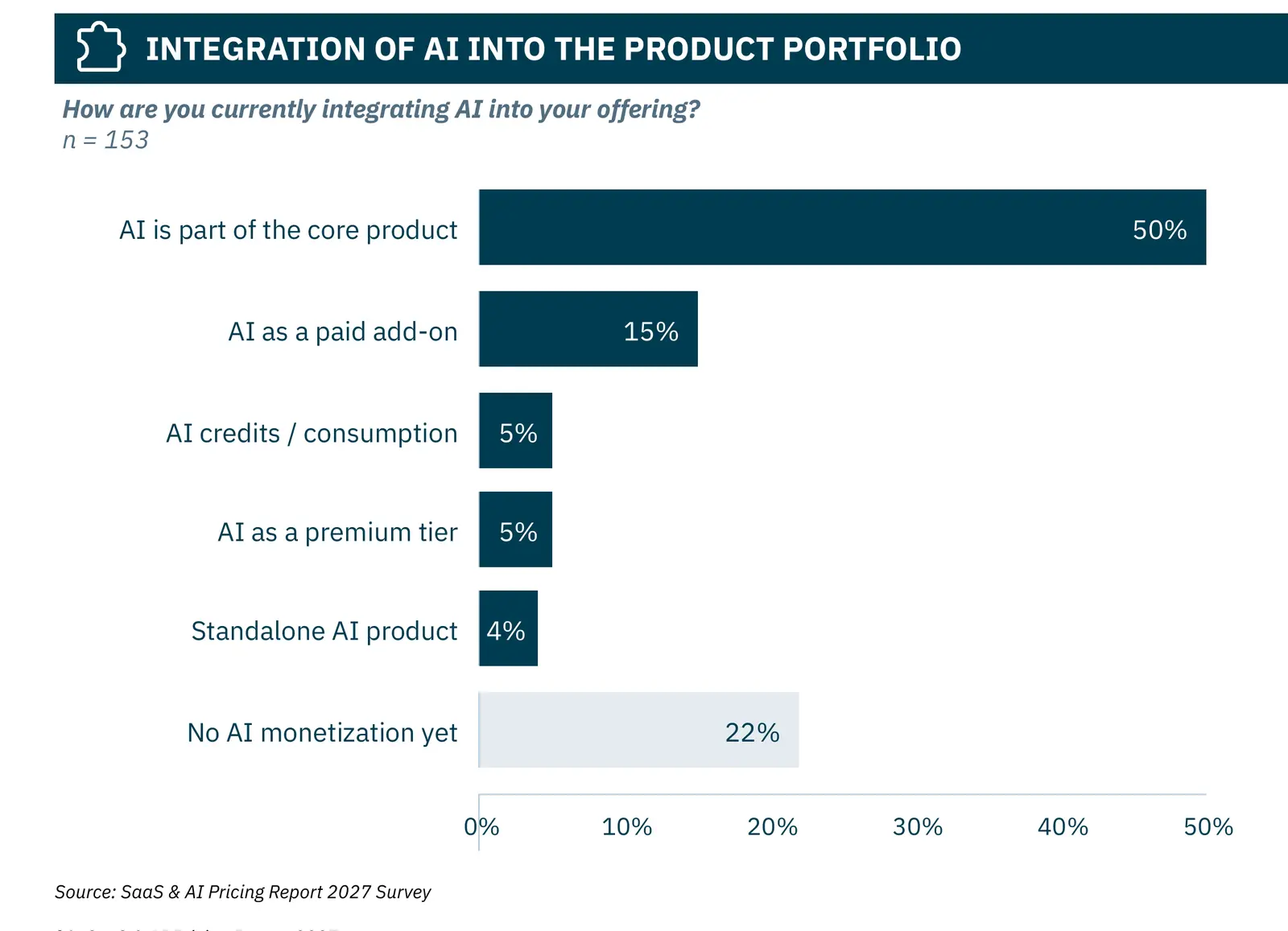
The possible models are well known. The hard part is the order of the decision. Outcome-based pricing often comes up very early in our interviews and projects. Once we check whether it's technically feasible and whether customers even want it, the shine often fades fast. So the path below breaks the decision into four questions. Each one rules out models before the next comes up.
Question 1: Which budget does your customer pay from
This fork sets the price ceiling. We distinguish three cases:
- AI feature, software budget. The AI makes people faster or better. The person remains responsible for the result. Your benchmark is other tools, and the ceiling is the customer's software budget.
- Agent, personnel budget. The agent completes a task on its own. The benchmark is human work: personnel costs, day rates, tasks left undone. The ceiling is the cost of the work the agent replaces.
- Workflow, process budget. Several agents cover an entire process. The comparison is the current process cost, for example for an agency, consultants or outsourcing.
A simple test for your product: Who answers for the result in the end, a person or your software? If it's a person, you're selling a feature. Then you compete with licenses and end up with a surcharge, an add-on, a higher tier or credits. If it's your software, you're selling work. Then a price per agent, task or outcome is possible, capped by personnel costs.
If an agent is packaged like a feature, it lands in the IT budget as an add-on. Procurement then compares it with a surcharge of about €20 per seat, not with a salary.
Question 2: How much do your costs per customer vary
Classic SaaS products scaled with almost no marginal costs. With AI, every interaction costs real money. That's why this question comes before any price point.
Even usage. Copilots for email drafts or summaries in the CRM get used to a similar degree by most users. Here, a fixed per-seat surcharge or inclusion in the core product works. B2B buyers know the model and face no budget uncertainty. The risk is power users whose token costs squeeze the margin. Don't underestimate budget certainty. It's one reason per-user pricing has worked for so long: Nobody has to go to the boss three times to ask for more money.
Highly variable usage. Video generation, data analysis or occasional batch processes cost a lot per call and vary widely by customer. Here, usage-based metrics protect the margin. In return, the customer fears a fluctuating bill.
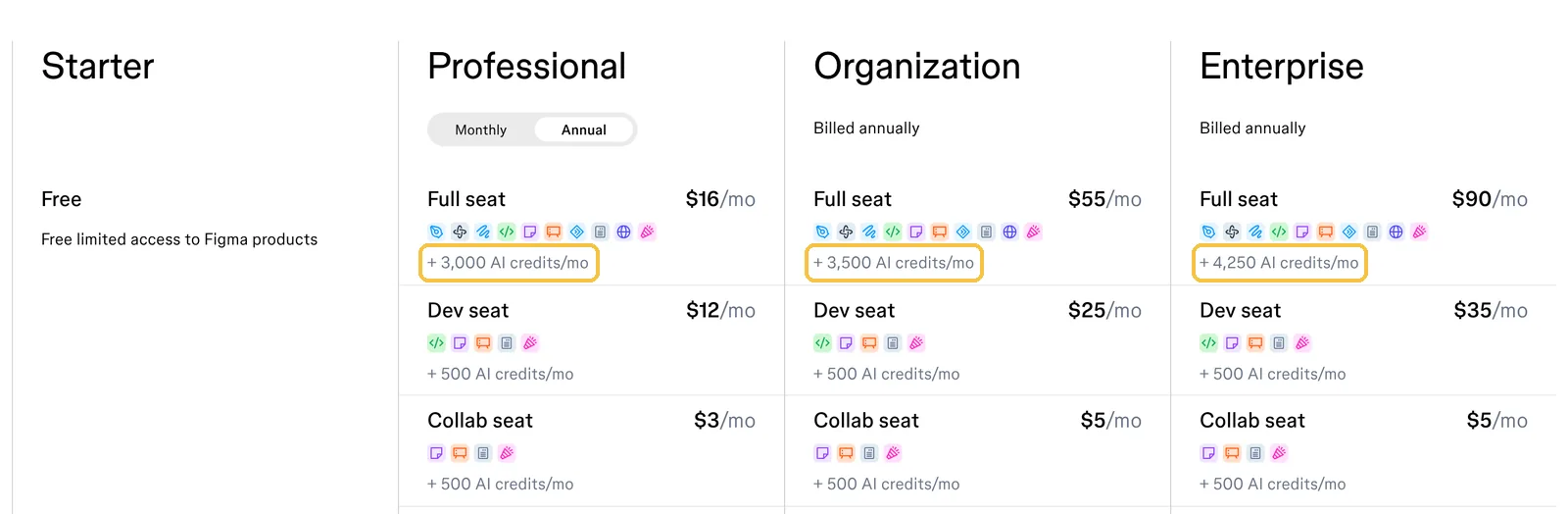
Credits bridge both cases. In our worked example, a text response equals one credit, an image 10 credits, a minute of audio 25 credits and a second of video 50 credits. The customer sees one unit and one price, and underneath you map very different costs. Figma shows this within a seat model: Every license includes monthly AI credits that are shared across the team. Anyone who needs more buys extra, via pay-as-you-go or as a credit add-on. Since the launch, gross margin has risen 2.5 percentage points to 85%, and net dollar retention stands at 136%. Figma itself calls the second quarter of 2026 the first full quarter in which AI credits generated revenue, and attributes the 136% to customers expanding both seats and add-ons with AI credits. The model works well when credits via the license are cheaper than credits bought on top. Then it pays for the customer to buy more seats instead of just credits.
How prices per unit will develop is open. I have a firm hypothesis that AI pricing, that is, token pricing, will develop exactly like telecom pricing over the past 30 years. For phone service, we long had a base fee plus a price per minute; today the flat rate is standard. We'll see whether I turn out to be right.
Question 3: What is the smallest unit of work your customer recognizes
This question only comes up if Question 1 landed on agent or workflow. Work can already be defined and priced through tasks or workflows today. So we expect agent pricing to catch on much faster than outcome-based pricing.
Good units are ones the customer counts even without you. Two examples:
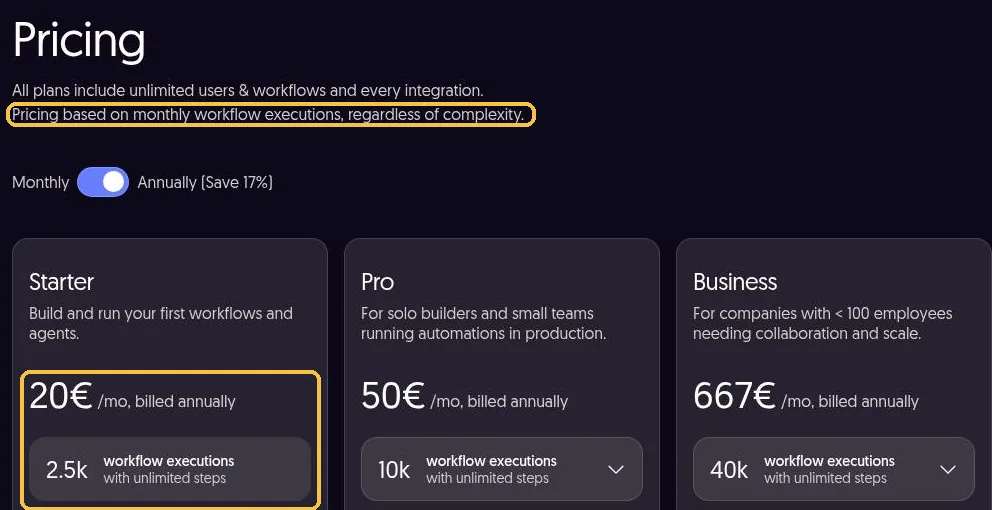
- n8n bills per workflow execution, regardless of the number of steps. The Starter plan costs €20 a month for 2,500 executions.
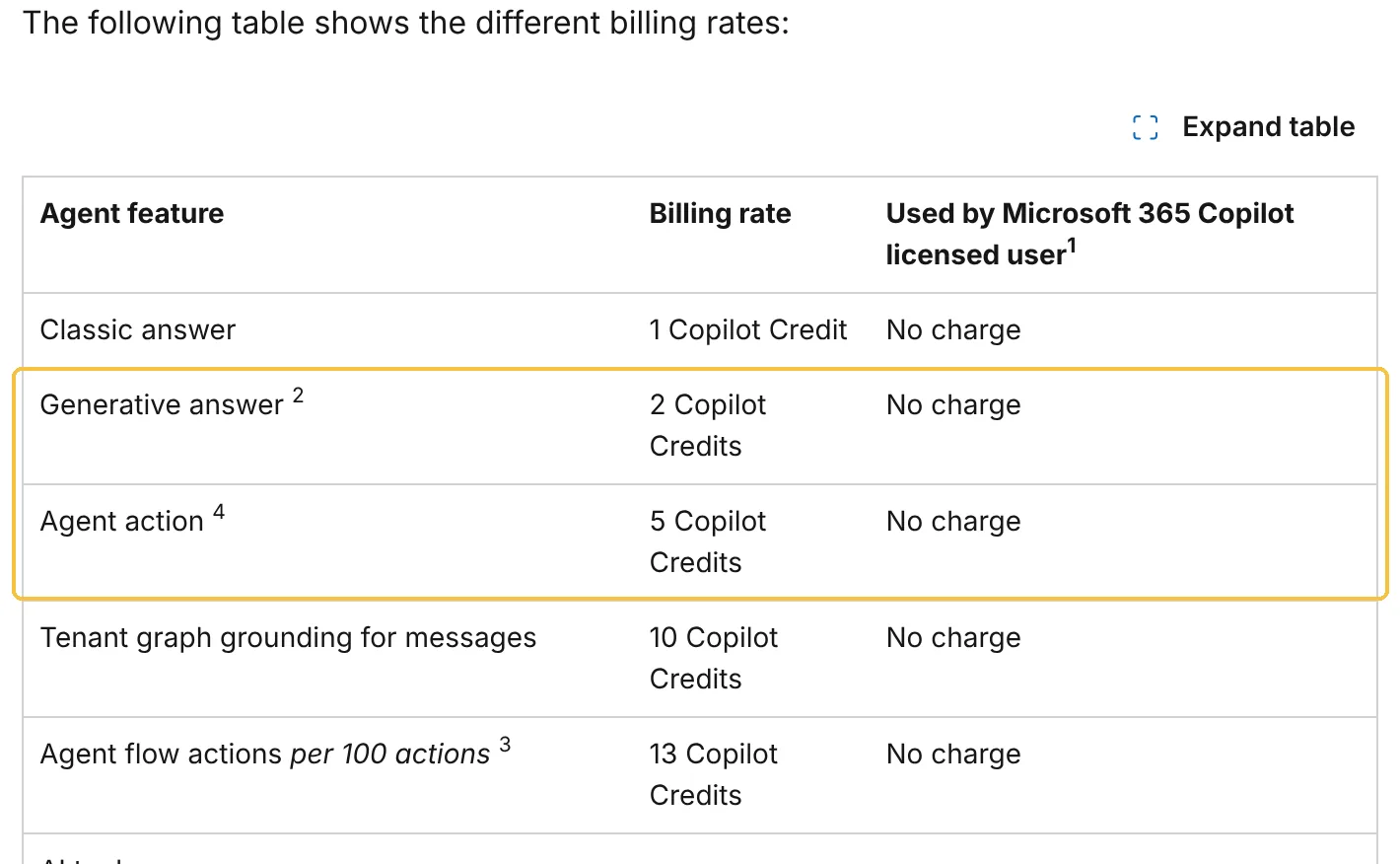
- Microsoft Copilot Studio sticks with a single credit unit but weights it by type of work. A generative answer costs two credits, an agent action five. That makes the jump from answer to completed action visible in the price, without a second metric.
Salesforce takes a similar route: keep the seat model and add Agentforce on top as a variable component. Since May 2025, Salesforce has sold Flex Credits for this. One agent action costs 20 credits, or $0.10, and credits come in packs of 100,000 for $500. Customers can convert user licenses into credits and credits into licenses.
Question 4: Can the outcome be measured without dispute
Only now does outcome-based pricing come to the table. It requires three conditions: The outcome is clearly measurable. The AI's share in it is traceable. Both sides see the economic value. I'd add: You need a very narrow use case that repeats often and is 100% measurable, because in the end you don't want to argue about whether the problem was solved.
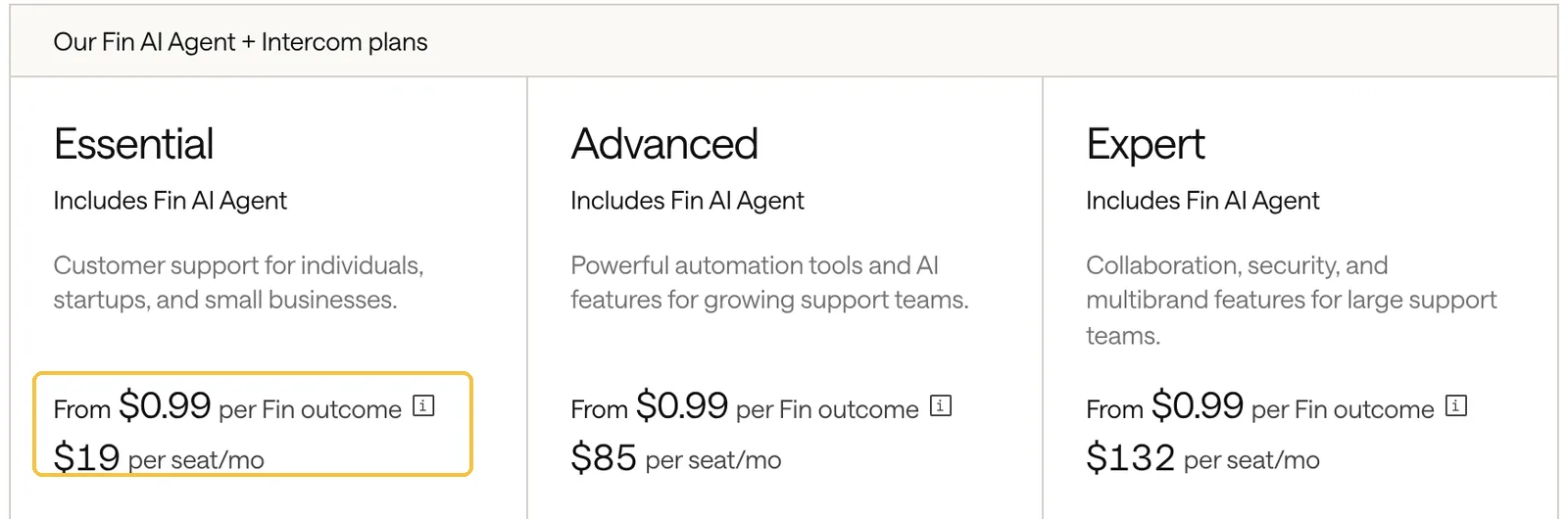
Intercom shows how quickly that dispute arises. Fin launched as a support agent at $0.99 per outcome instead of seats or tokens. As it grew, criticism arose over the “assumed resolution”: It cost money even when a person rightly stepped in. According to our report, as of 2026 Fin was a hybrid of seats at $29–132 a month plus $0.99 per resolved request, with a minimum of around 50 per month. Through “Fin Guidance,” customers have a say in what counts as resolved.
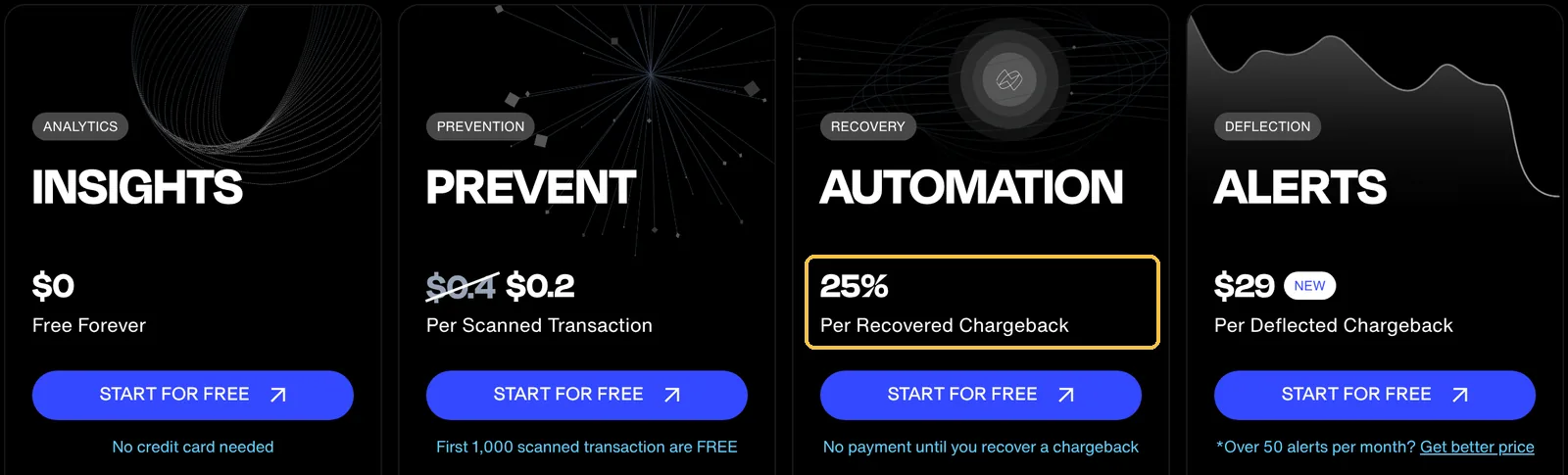
Chargeflow solves the definition problem differently. Visa and Mastercard decide whether a chargeback is won. Chargeflow charges 25% of the recovered amount, $29 per prevented chargeback and $0.20 per scan from the 1,000th scan. The model works because a third party determines the outcome.
Where that clarity is missing, vendors deliberately forgo it. Veronika Wax explains why Demodesk doesn't bill per lead: “We want a partnership with our customers, not an argument over whether an outcome was actually achieved or not.”
The models compared
| Model | Fits when | Risk | Example |
|---|---|---|---|
| Included in the core product | AI defends the core product, usage is even | Margin drops with every power user | 50% of respondents |
| Add-on or seat surcharge | Daily copilot, stable usage | Power users squeeze gross margin | 15% of respondents |
| Premium tier | AI is a clear reason to upgrade | Customers on the entry plan never see the value | 5% of respondents |
| Credits | Usage and costs vary widely | Customers hold back to save credits | Figma |
| Per task or workflow | The unit is countable for the customer | Disputes over what counts as a task | n8n, Microsoft |
| Per outcome | Outcome measurable, AI's contribution attributable | Definition disputes, lost revenue | Intercom, Chargeflow |
| Hybrid | Customer needs predictability, you need cost coverage | Two metrics need explaining | Microsoft |
In the end, almost everyone lands on hybrid
The four questions rarely lead to a pure model. They determine what belongs in the fixed base and what becomes variable. Today, 34% of respondents use a hybrid model as their main model, and 63% expect it to be the most important one in two years.
For companies with investors, there's a second side to this. Felicitas May of Beyond Capital Partners described it from a private equity perspective: “What do we get paid for at exit? For the quality of revenue, not for a potential shot at revenue.” So Felicitas May advises adding to the subscription model instead of abandoning it. A predictable base plus a variable part does both.
The building blocks decide who carries the risk: Allowances with top-ups give you predictable base revenue, a minimum commitment protects you in outcome-based models, and a cost cap protects the customer. If your pricing page, contracts and sales all depend on the same change, an outside view pays off, for example from a specialized pricing consultancy such as hy.
What you can do on Monday
Take your most important AI offering and answer the four questions in writing, one sentence each. Does your pricing page match the answers? An agent listed there as an add-on for a few euros per seat gets compared with software, even though it does work. You can get a first read in about a minute with the free pricing audit on pricing-friends.de. It reads your pricing page live and checks your pricing model, packaging and price points. The check follows the approach hy Consulting Group developed in more than 600 pricing projects.
Bottom line: Budget first, then the metric, the price last
First, clarify which budget your customer pays from. A feature competes with software, an agent with staff. After that, the variability of your costs, the countable unit of work and the measurability of the outcome decide which metric holds up. Outcome-based pricing sits at the end of the path because it has the most prerequisites. For most vendors, the answer will be a hybrid: a predictable base plus a variable part that grows with the work done. That way, efficiency for the customer also becomes revenue for you.
Sources
- SaaS & AI Pricing Report 2027 by hy, pp. 12, 13, 21, 30, 38, 39, 40, 41, 46, 47, 50, 51, 54, 56, 57, 58, 59, 83
- Figma: Second Quarter 2026 Financial Results, August 5, 2026
- Salesforce: Salesforce Introduces New Flexible Agentforce Pricing, May 15, 2025
- Pricing Friends, episode 99: Sonderfolge: SaaS-Pricing, AI und die Zukunft der Preismodelle, Dr. Sebastian Voigt with Julius Göllner
- Pricing Friends, episode 119: Sales, AI und Pricing mit Veronika Wax: Was passiert mit dem Seat-based Pricing, wenn KI-Agenten die Arbeit übernehmen?
- Pricing Friends, episode 143: SaaS- und AI-Pricing mit Arne Wolter: Wird KI zur Commodity?
- Pricing Friends, episode 147: AI Value Creation im Private Equity: Wie wird aus KI-Effizienz echter Umsatz?
Quotes are translated from German. The podcast episodes are in German.