
Pricing strategy · 7 min read
Hybrid pricing: when a base fee plus usage pays off

Key points
- Hybrid pricing, a base fee plus a usage price, pays off for software with widely varying usage and a fixed purchasing budget. If usage is even, a simple subscription is still better.
- In hybrid pricing for software, the allowance in the base fee should cover a typical customer in most months. Top-ups are meant for growth and peaks.
- In hybrid pricing, software customers who commit to a volume up front should pay less than those who top up on the spot. A cost cap takes the fear out of procurement.
- 34% of 153 SaaS and AI vendors surveyed use hybrid pricing as their main model today. 63% expect to in two years.
Hybrid pricing means your customer pays a fixed base fee per month or year plus a variable amount that grows with usage. For software vendors, it pays off when your costs or the value to the customer swing widely with usage. The customer still gets a predictable budget. If all customers use about the same amount and your costs barely grow with usage, a simple subscription is still the better choice.
Everyone knows the model from the phone bill
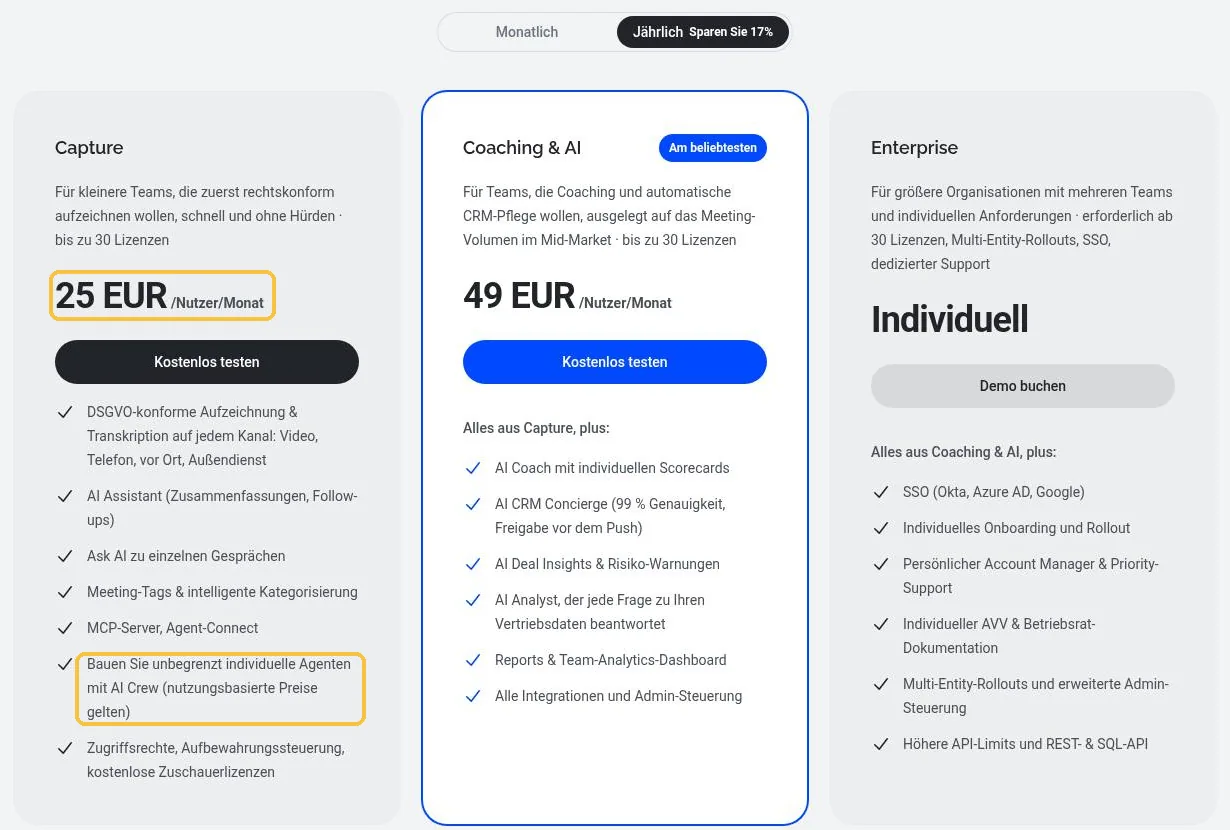
I once explained hybrid pricing with the phone plan we had for years: €25 a month and 3 cents per minute. The base fee covers the line and availability, and the per-minute price grows with what you actually use. My expectation back then: Models like this would become more common in software, because API calls and transactions would matter more than the individual user.
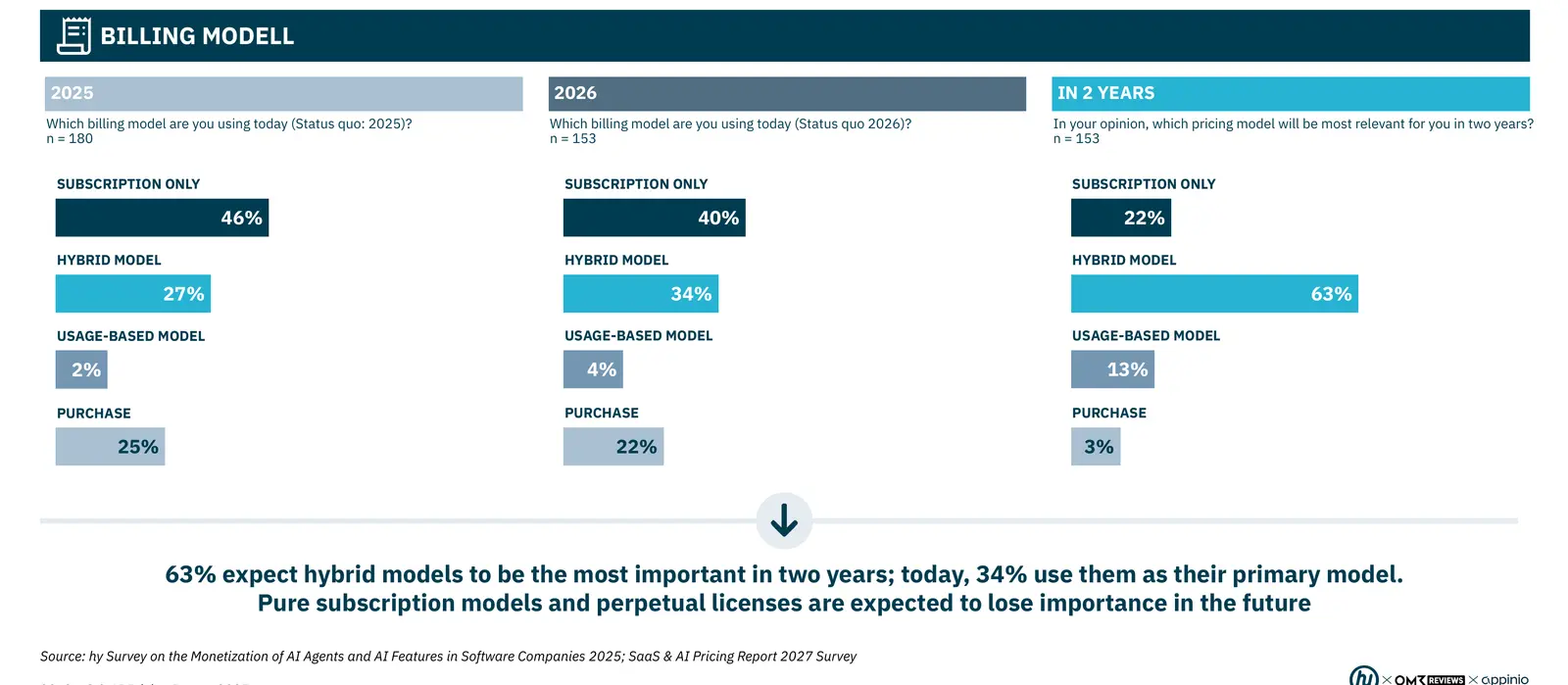
The numbers from our SaaS & AI Pricing Report 2027 point that way. Of the 153 SaaS and AI companies we surveyed for it, 34% use a hybrid model as their main model today, up from 27% the year before. In two years, 63% expect it to be their most important model. The pure subscription drops from 40% to an expected 22%. Moving from a seat model to a hybrid model is the most-planned pricing initiative for the next 12 months. For established software products, we expect hybrid pricing to become the standard for AI. The fixed base provides predictability, and the variable part reflects usage and costs.
Where hybrid sits between subscription and pure usage
Each billing model splits predictability and cost risk differently between you and the customer.
| Subscription | Hybrid | Pay-as-you-go | |
|---|---|---|---|
| Predictability for you | high | medium: base plus variable part | low: revenue fluctuates |
| Predictability for the customer | high | medium: fixed base, variable usage | low: costs fluctuate |
| Cost risk for you | high with power users | medium: base costs predictable | low: margin always secured |
| Cost risk for the customer | low | medium: risk of overage | high: costs follow usage |
Source: SaaS & AI Pricing Report 2027, p. 29.
Hybrid gives up some predictability on both sides and gets cost coverage in return. For B2B buyers, predictability often matters more than the exact price. That's why Melanie Riebel of Chaos doesn't expect fully open pay-as-you-go models even four years out, “because predictability is just incredibly important to customers.” Veronika Wax reached the same conclusion for Demodesk: “That’s why we believe that, for us, a combination of a platform fee or seat fee plus usage-based pricing for the agents is the fairest and most transparent way.”
When hybrid pays off: four conditions
- Your costs grow with usage. Classic SaaS products scaled with almost no marginal cost, but with AI features and agents every interaction costs money. Without a variable part, you pay for power users out of your margin.
- Usage varies widely between customers. In a pure subscription, occasional users and heavy users pay the same. The variable part makes the price fairer for both.
- The customer needs a fixed budget. In B2B, software is paid for from budgets set once a year. The base fee is the part procurement can plan for with certainty. An example from the AI pricing playbook by the investor Bessemer Venture Partners shows how fixed these budgets are: At the billing vendor Zenskar, customers' IT heads often ask to move overage invoices into the following year's budget.
- Usage can be measured and explained. A good metric is technically measurable, clearly billable and easy for customers and sales to understand.
If only the first condition applies and all customers use about the same amount, a higher subscription price is often enough. If the third doesn't apply, for example with developers buying individual API calls by credit card, pure pay-as-you-go also fits.
The three levers
What goes into the base. The base fee can include seats, a platform fee or a usage allowance. There are two variants. With an allowance plus top-ups, the base includes a fixed volume, and anything above it is billed by consumption. With a volume commitment, the customer commits to a discounted volume, and overage is billed in bundles at a higher rate.
How big the allowance is. If it's too big, you get hardly any variable revenue, and you have a subscription with a complicated pricing page. If it's too small, almost every customer pays extra every month. Then the allowance looks like a hidden price. As a rule of thumb, a typical customer shouldn't exceed their allowance in most months. Top-ups are meant for growth and peaks.
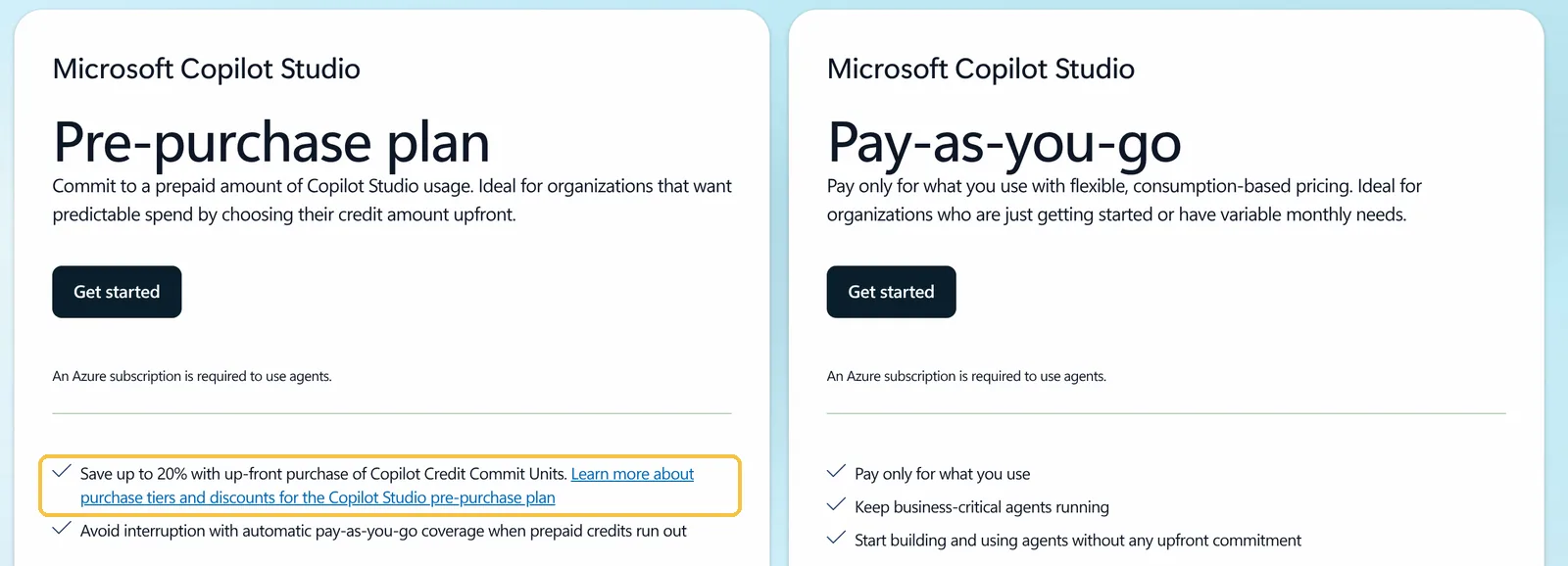
What usage above the allowance costs. Customers who commit up front should pay less than those who top up on the spot. I recommend this all the time: Credits cost, say, €1.50 each, and anyone who commits to 1,000 gets a discount. Anyone who buys 1,000 via pay-as-you-go doesn't. Microsoft did exactly this with Copilot Studio, according to our report as of 2026, with three parallel ways to buy: the Capacity Pack at $200 a month with 25,000 credits, pay-as-you-go with no up-front purchase, and a pre-purchase with up to 20% off.
For the fear of an open-ended bill, there's a fourth building block: a cost cap, above which you keep delivering without charging. It makes the model easier to sell to procurement.
Worked example: one model, three customers
A piece of software costs a €400 base fee per month, with 1,000 transactions included. Each additional transaction costs €0.30. Customers who commit for a year to at least 4,000 additional transactions a month pay €0.24 for each additional transaction, which is 20% less.
| Customer | Transactions per month | Without commitment | With commitment |
|---|---|---|---|
| Small | 800 | €400 | not worthwhile |
| Mid-size | 2,500 | €850 | not worthwhile |
| Large | 6,000 | €1,900 | €1,600 |
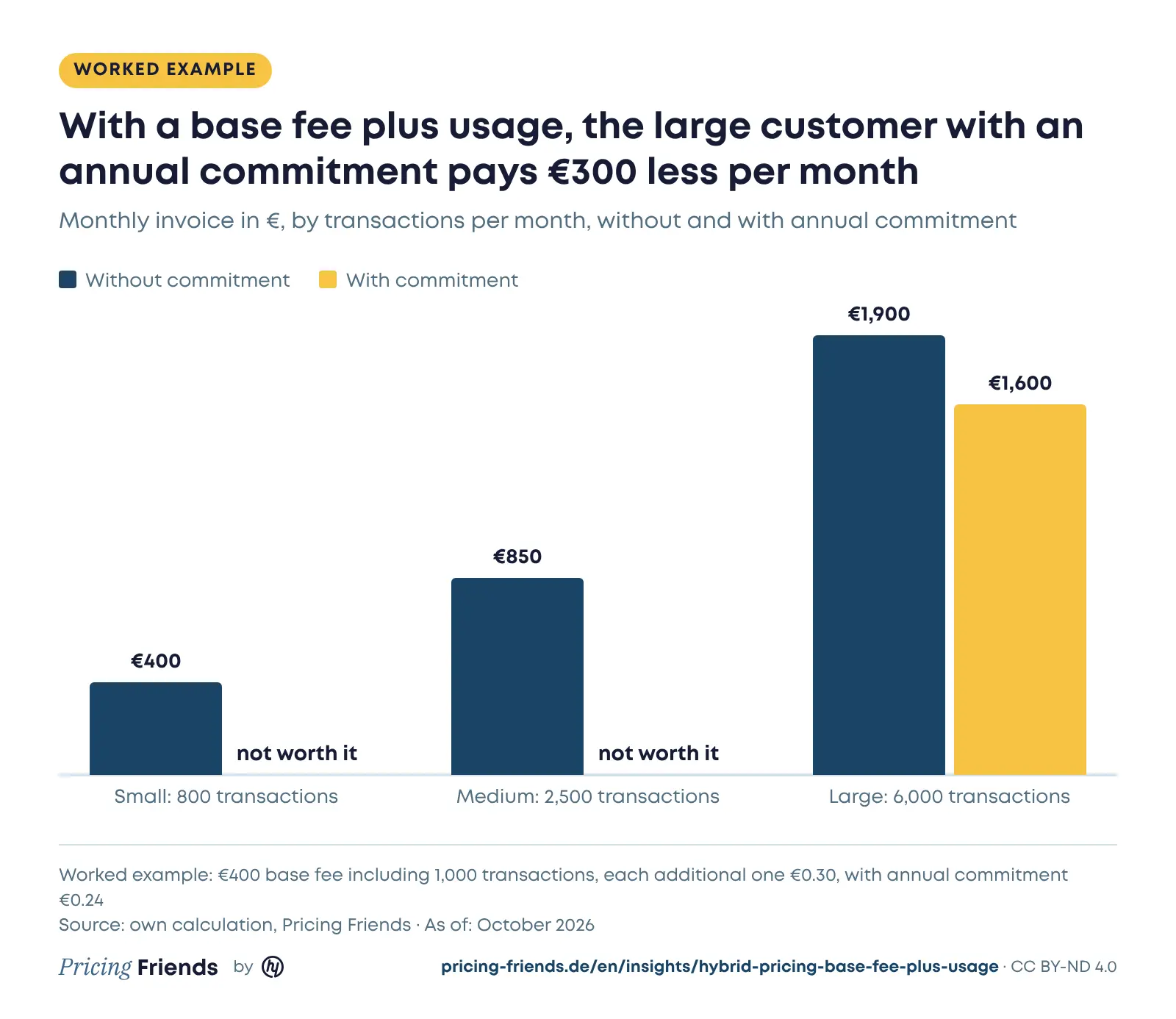
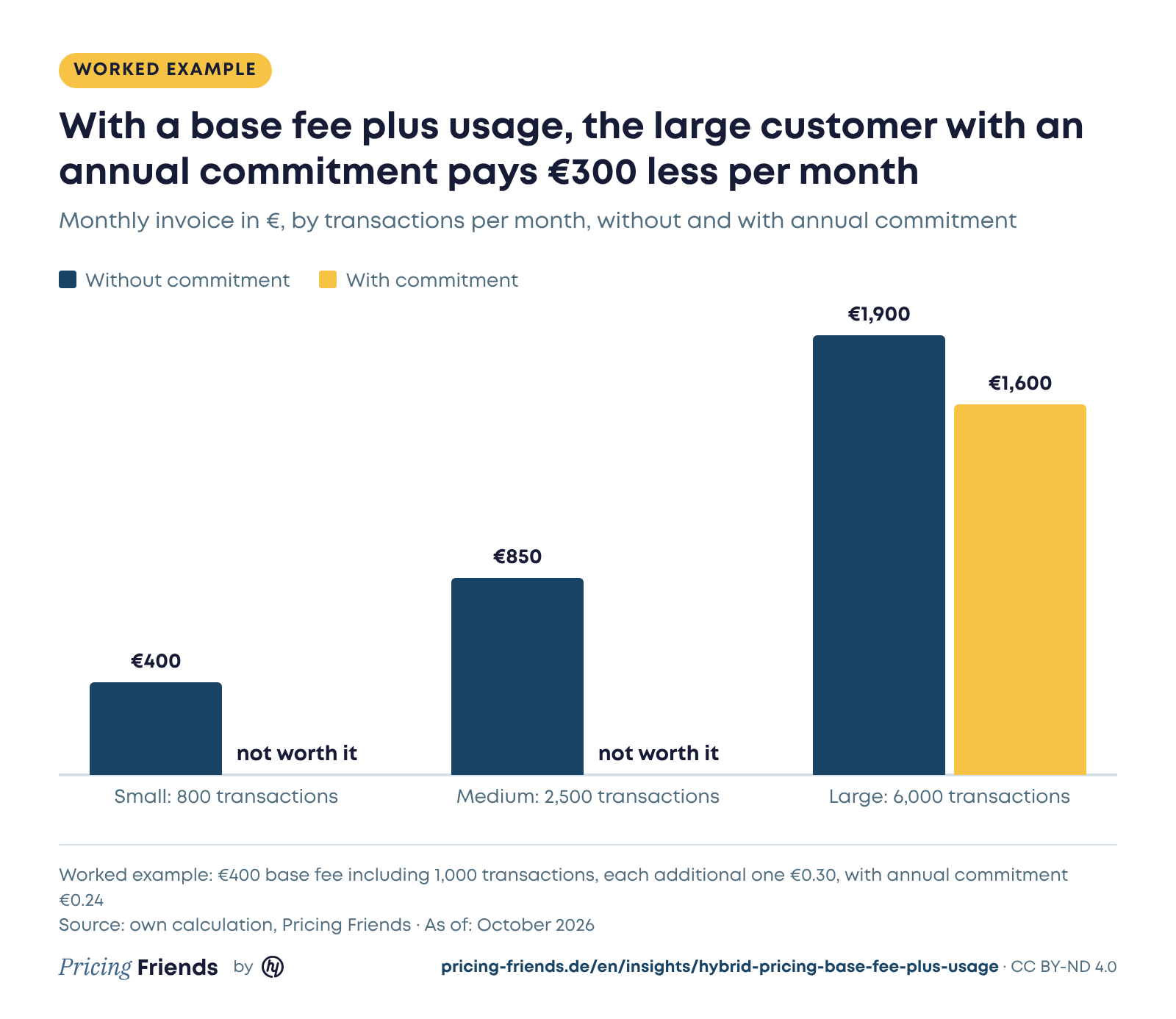
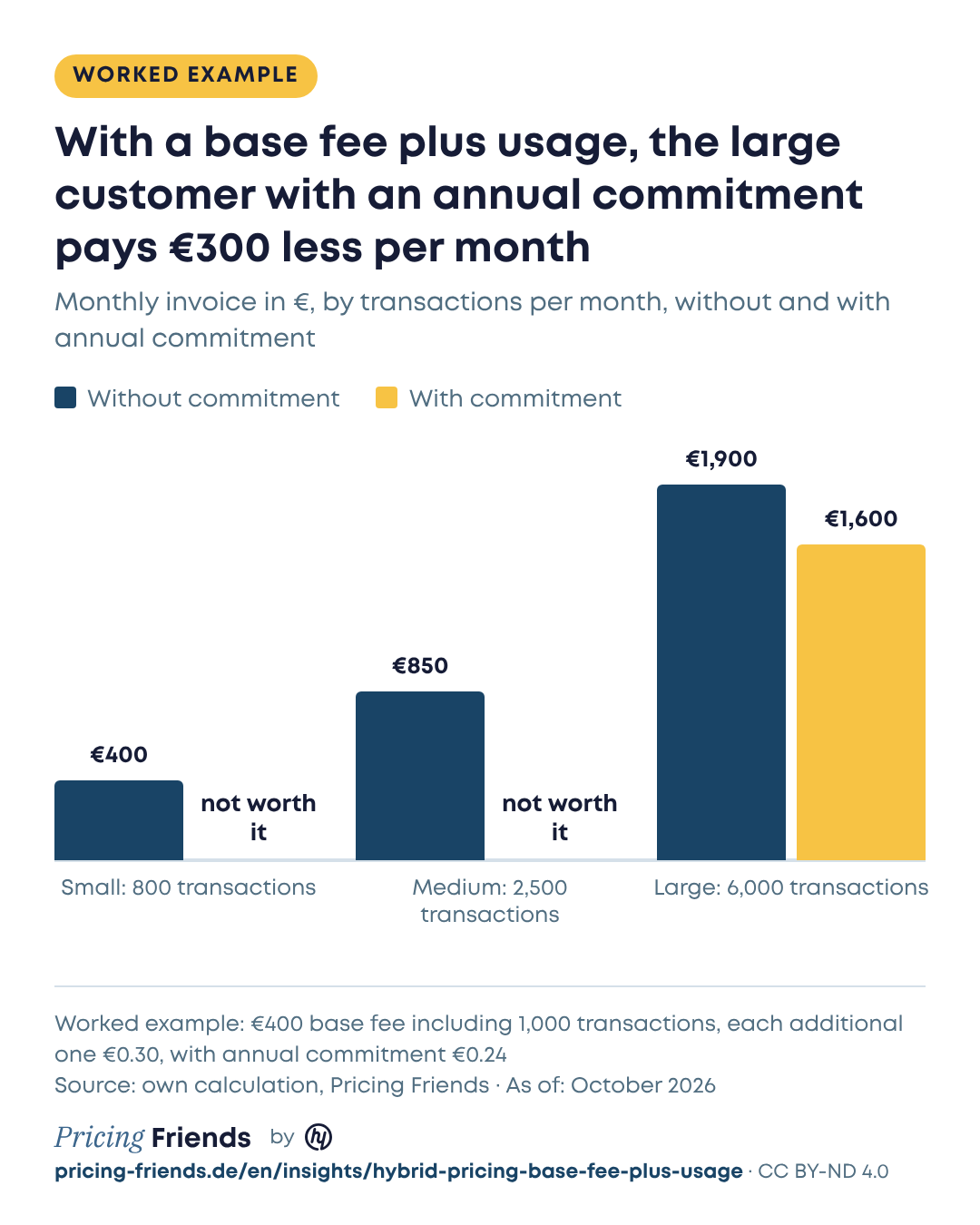
The small customer pays only the base and can plan with certainty. The mid-size customer pays by consumption and sees what they're paying for. The large customer saves €300 a month by committing, and in return you get predictable revenue of €1,360 a month instead of a fluctuating amount.
What you can do on Monday
Put your usage data from the past 12 months next to your price list. Check the four conditions above. If at least three apply, run the model from the worked example with your real customers: Where should the allowance sit so the typical customer rarely exceeds it, and how much revenue do top-ups bring in? Before that, work out whether your metric should be usage-based at all. For the variable part, credits as a billing unit are an option too.
In our approach, the billing model and the pricing metric are two separate steps. Hybrid is a billing model. Which unit goes into the variable part, whether transactions, credits or outcomes, is the second decision.
Bottom line: The base for predictability, usage for fairness
Hybrid pricing pays off when your costs or the value to the customer swing with usage and procurement still demands a fixed budget. The base fee secures revenue for you and predictability for the customer, the allowance covers the normal case, and top-ups cover the peaks. Customers who commit up front should pay less than those who top up on the spot.
The free pricing audit on pricing-friends.de shows where your pricing page stands today in about a minute. It reads your pricing page live and checks pricing model, packaging and price points. It's based on the approach hy Consulting Group developed in more than 600 pricing projects.
Sources
- SaaS & AI Pricing Report 2027 by hy, pp. 12, 13, 29, 30, 33, 38, 40, 51, 59, 83
- Pricing Friends, episode 99: Sonderfolge: SaaS-Pricing, AI und die Zukunft der Preismodelle, Dr. Sebastian Voigt bei Julius Göllner
- Pricing Friends, episode 119: Sales, AI und Pricing mit Veronika Wax: Was passiert mit dem Seat-based Pricing, wenn KI-Agenten die Arbeit übernehmen?
- Pricing Friends, episode 142: SaaS- und AI-Pricing mit Mariella Knospe und Felix Rahlmeyer: Wie bepreist man Software und AI im Jahr 2027?
- Pricing Friends, episode 144: SaaS & AI Pricing Report mit Arne Wolter, Benedikt Böringer, Felix Rahlmeyer, Melanie Riebel & Norman Nielsen: Wie verändert KI das Pricing von morgen?
- Bessemer Venture Partners: The AI pricing and monetization playbook, February 2026
Quotes are translated from German. The podcast episodes are in German.