
AI pricing · 7 min read
Credits as a pricing model: when they work, when they confuse

Key points
- Credits fit software that bundles services with very different costs, such as text, image and video. If you sell only one service, a price per transaction is clearer.
- With credit-based software, the customer has to see before every action how many credits it costs. A coverage table translates credits into work.
- Credits for software belong in a predictable budget with a cost cap. Surprise invoices and credits that expire unnoticed drag down the next purchase.
- According to hy's SaaS & AI Pricing Report, only 5% of software and AI vendors charge for AI through credits or usage.
Credits are a currency of their own. Your customer gets them with a subscription or buys them up front, then uses them to pay for different services in your product. They work for software vendors whose AI features vary widely in cost, such as text, image and video in one product. The precondition: the customer sees before buying how far the credits will go. They confuse when the customer only learns from the invoice what an action cost.
What credits are good for
Credits bridge your technical costs and a unit the customer sees. In the example from our SaaS & AI Pricing Report 2027, a text response costs about 0.2 cents, an image about 2 cents, a minute of audio about 5 cents and a second of video about 10 cents. These become one credit, 10, 25 and 50 credits. The customer sees an account with, say, 500 credits a month. Underneath, you map costs that differ by a factor of 50.
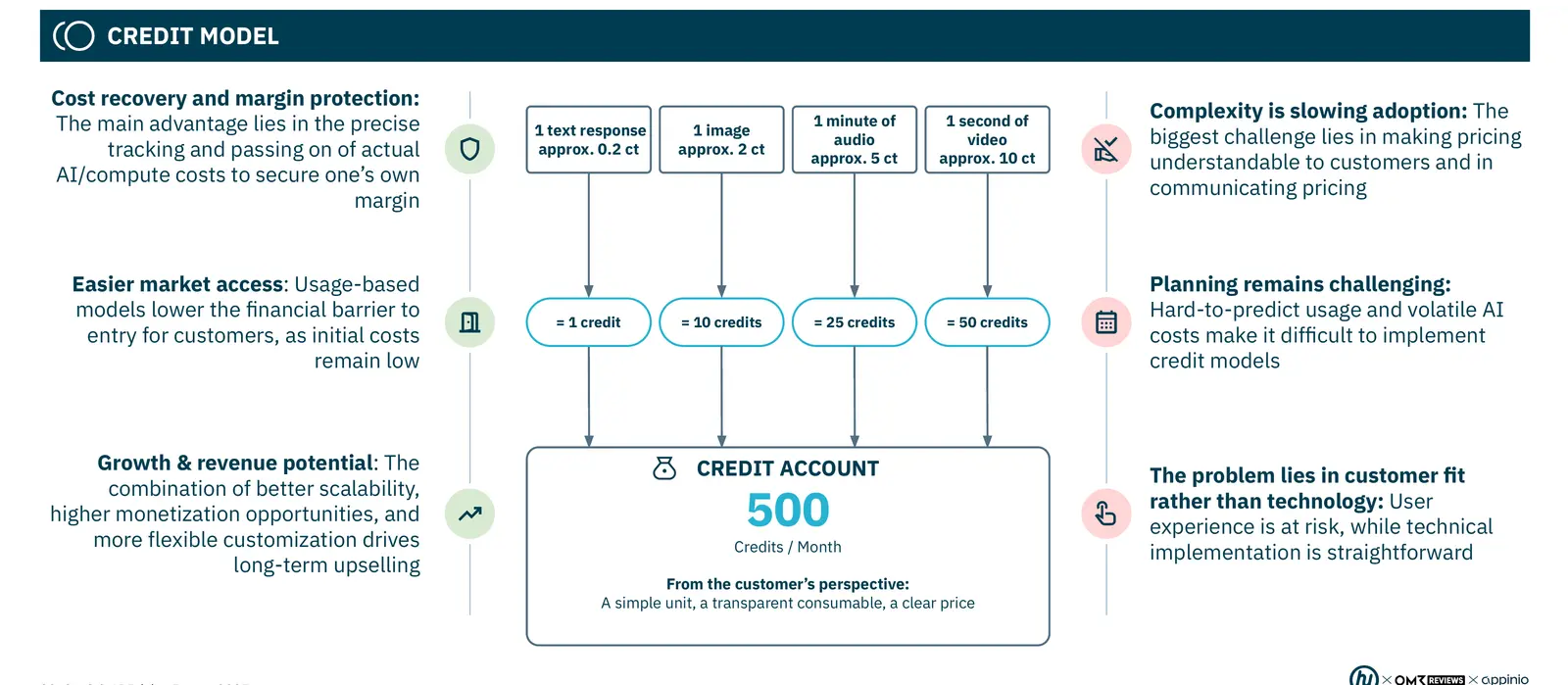
The model has three advantages: You cover your AI costs and protect your margin, entry gets cheaper for the customer, and revenue grows as usage grows. It's still rare. Of the 153 SaaS and AI companies we surveyed for the report, 5% currently monetize AI through credits or usage, while 50% fold it into the core product. As the future primary metric, though, credits and tokens gain 14 percentage points.
My colleague Mariella Knospe names the weakness in episode 142: “Credits are an abstract currency too.” So the problem sits with the customer: Implementation is technically simple, but clarity suffers.
When credits work
- Your product has several services with very different costs. If you sell only one service, you don't need an intermediate currency. A price per transaction is easier to understand.
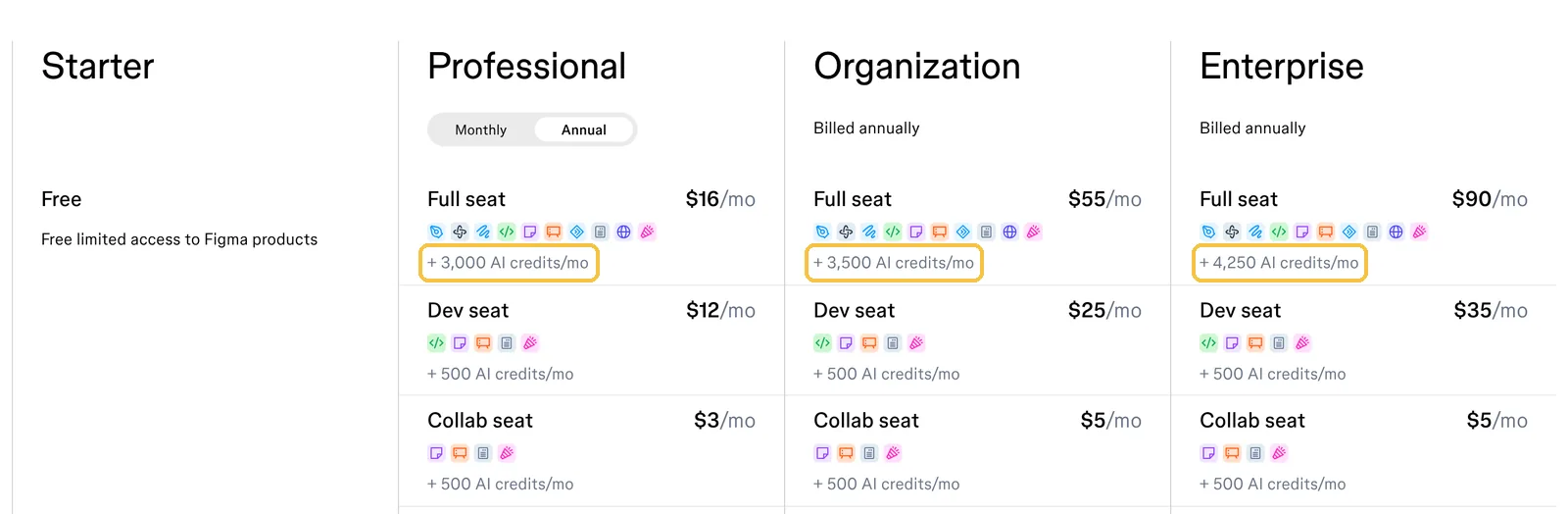
- The credits sit inside a predictable budget. Chaos bundles its usage-based credits into fixed annual subscriptions with monthly or annual allowances. The customer gets a predictable budget and still uses AI as needed. Figma gives every license monthly credits that are shared across the team.
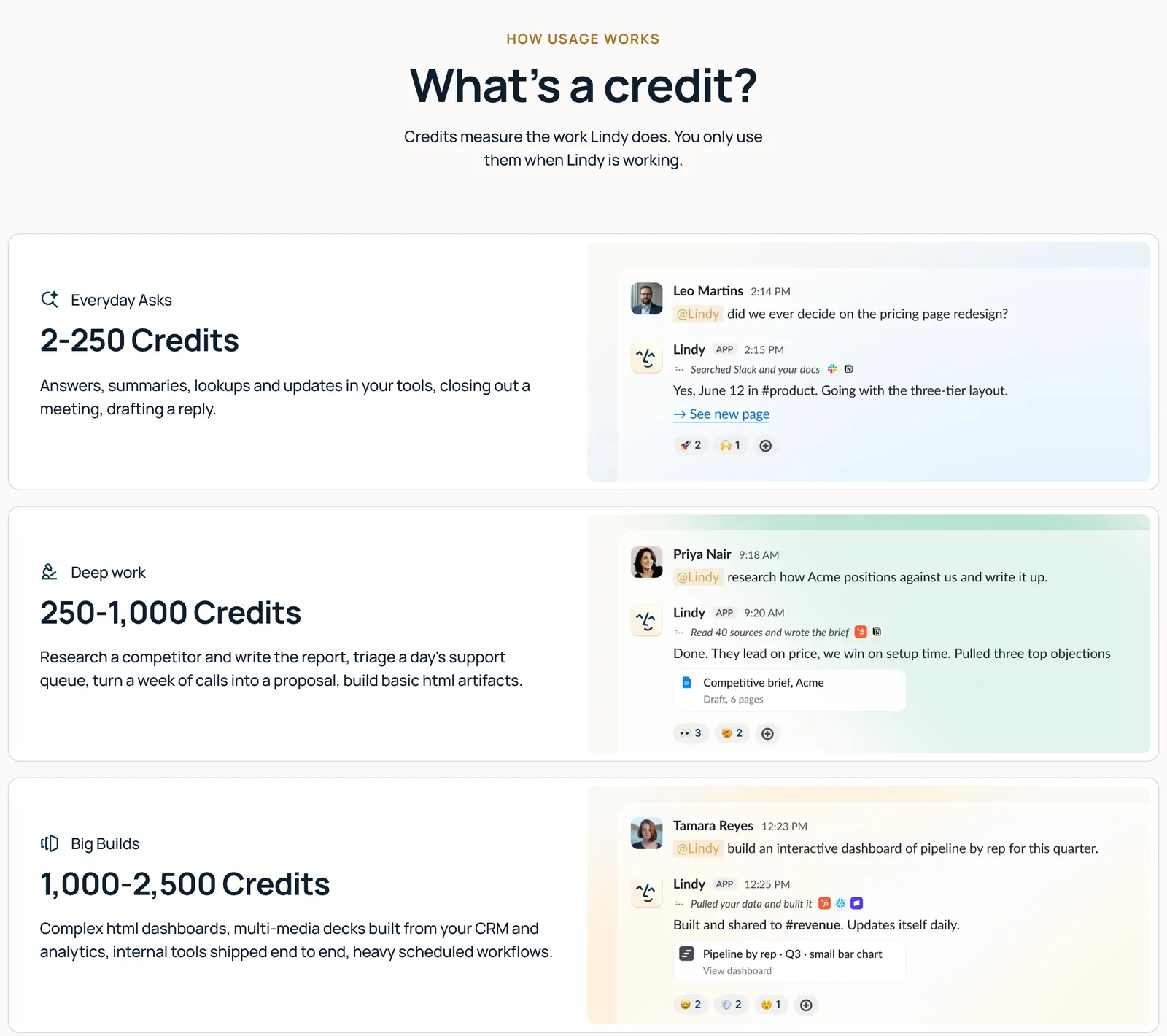
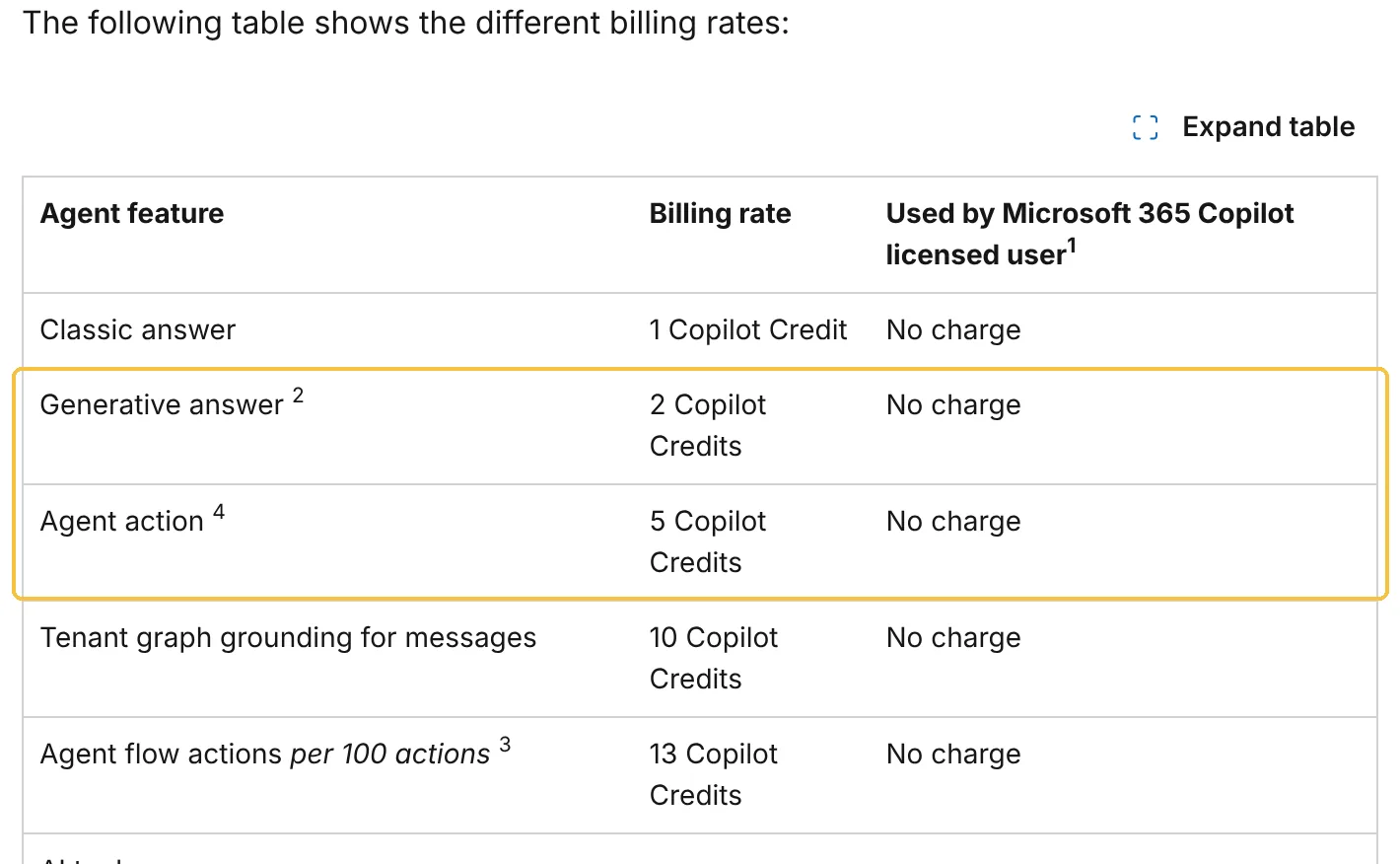
- The customer sees what an action costs before taking it. Lindy tiers usage by task: 2 to 250 credits for simple requests, 250 to 1,000 for deeper work, 1,000 to 2,500 for large jobs. When the limit is reached, the agent pauses. For Copilot Studio, Microsoft sticks with a single credit unit and weights it by type of work: A generative answer costs 2 credits, an agent action 5.
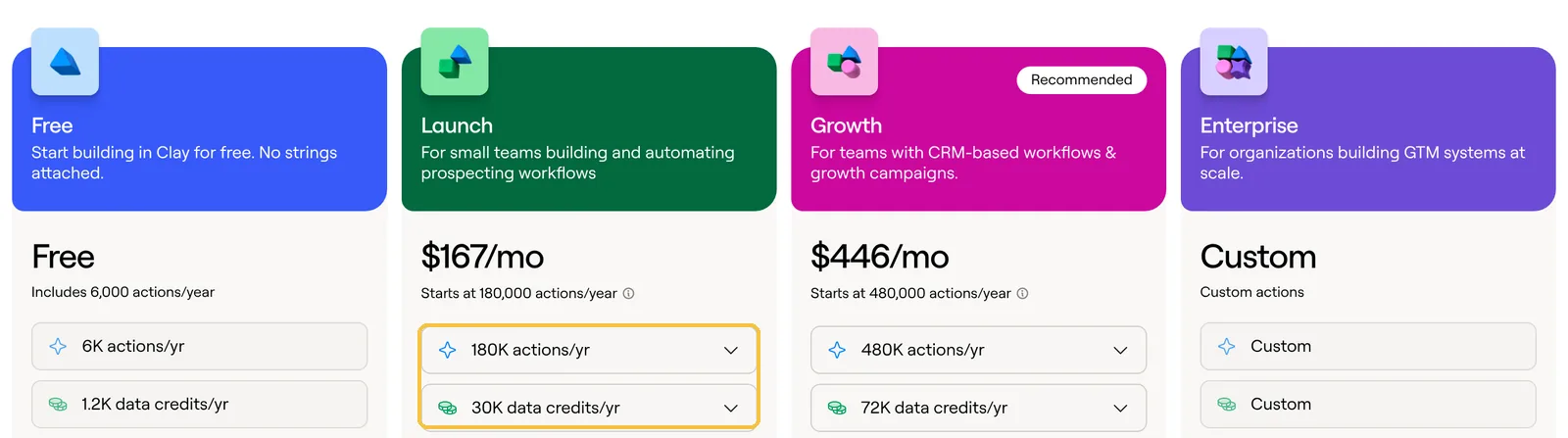
- Third-party costs are kept separate. Clay uses two currencies: Action Credits for workflows, prompts and data processing, and Data Credits for data from external providers. This protects the margin and makes compute-heavy workflows predictable for the customer.
When credits confuse
When usage isn't predictable. As Mariella Knospe points out, a credit on its own doesn't tell the customer whether they'll have used 3,000 or 10,000 by the end of the month. Hard-to-predict usage and fluctuating AI costs are the hurdle for credit models.
When users save credits instead of working. Users then hesitate to enter anything at all so they don't waste credits. For a product that depends on daily use, that's the wrong incentive. In its AI pricing playbook, the investor Bessemer Venture Partners describes exactly this case: Leena AI initially charged by usage, customers grew cautious about using it, and revenue only grew faster once it moved to an outcome-based model.
When the invoice is a surprise. Customers can't budget for variable costs without a cap. Anyone who has received an unexpectedly high invoice will ask at the next purchase whether to take that risk again. A cost cap, above which you keep delivering without charging, removes that worry.
When credits expire without anyone noticing. Prepaid credits often expire after a set period. That secures revenue for you, but only once. A customer who has to write off unused credits buys less next time. According to its annual report, Snowflake handles this differently: If a customer stays below its committed amount, it can often roll the unused capacity over into later periods, usually when buying additional capacity. So the remainder doesn't expire. It becomes part of the next order.
Worked example: the coverage table
The most effective fix for confusion is a table on the pricing page that translates credits into work. Using the weights above, here's what it looks like for a plan with 500 credits a month:
| Service | Credits per unit | With 500 credits a month |
|---|---|---|
| Text response | 1 | 500 responses |
| Image | 10 | 50 images |
| Minute of audio | 25 | 20 minutes |
| Second of video | 50 | 10 seconds |
Add a top-up price that rewards commitment. Example: Bought individually, 1,000 credits cost €15. A customer who commits to 10,000 credits a month for a year pays €12 per 1,000, which is 20% less. I recommend this pattern all the time: Customers who know their usage and commit get the discount, spontaneous top-ups don't. The prices are made up; the weights come from the report.
My hypothesis: credits are an intermediate stage
I have a firm hypothesis that token pricing will develop the way telecom pricing has over the past 30 years. Local calls used to be charged per call. Then came the eight-minute unit, then the minute, then minute bundles in the mobile era, then texts and data, and finally the flat rate. If that's right, credits today are roughly at the minute-bundle stage. Mariella Knospe sees it similarly: The clearer usage, prices and costs become, the more attractive inclusive models with a fixed allowance get.
For you, that means building your credit model so you can enlarge the allowance later without changing the unit. Introduce five credit types today, and you'll have to change five prices tomorrow.
Credits can also be combined with a fixed base fee. Whether they fit your AI offering at all, or a price per task or per outcome fits better, comes down to four questions in a fixed order. In our approach, this is the question of billing model and pricing metric.
Bottom line: Credits need a translation into work
Credits work when they bundle very different costs into one unit, sit inside a predictable budget and let the customer see what each action costs before taking it. They confuse when the customer can't predict usage or gets surprised by the invoice. A coverage table on the pricing page and a discount for commitment solve most of these problems.
You can see how your pricing page presents your pricing model, plans and price points today in about a minute with the free pricing audit on pricing-friends.de. It reads your pricing page live, gives it a score from 0 to 100 and lists the key findings. The check follows the approach hy Consulting Group has developed in more than 600 pricing projects.
Sources
- SaaS & AI Pricing Report 2027 by hy, pp. 21, 32, 38, 39, 40, 41, 42, 43, 49, 51, 59
- Pricing Friends, episode 142: SaaS- und AI-Pricing mit Mariella Knospe und Felix Rahlmeyer: Wie bepreist man Software und AI im Jahr 2027?
- Pricing Friends, episode 147: AI Value Creation im Private Equity: Wie wird aus KI-Effizienz echter Umsatz?
- Bessemer Venture Partners: The AI pricing and monetization playbook, February 2026
- Snowflake Inc.: Annual report (Form 10-K) for the fiscal year ended January 31, 2026
Quotes are translated from German. The podcast episodes are in German.