
Price increases · 7 min read
How to raise prices for existing customers without losing them

Key points
- After a price increase, software vendors often keep more than 90 to 95% of existing customers. The fear of a wave of cancellations is usually bigger than the risk.
- A price increase for existing software customers holds if the customer sees the value and isn't caught off guard. So the list price and time-limited discounts belong in the first contract.
- For a price increase, software vendors split existing customers into groups, each with its own increase and its own messaging. Customers already at risk are left out.
- Before raising prices for existing customers, a software vendor calculates how much churn it can absorb and briefs sales before the first customer hears about it.
If you sell subscription software to businesses and haven't touched your prices in years, the fear of a wave of cancellations is usually bigger than the risk. Existing customers stay through a price increase when two conditions are met: They see the value, and they aren't caught off guard. A plan that doesn't treat every customer the same takes care of the rest.
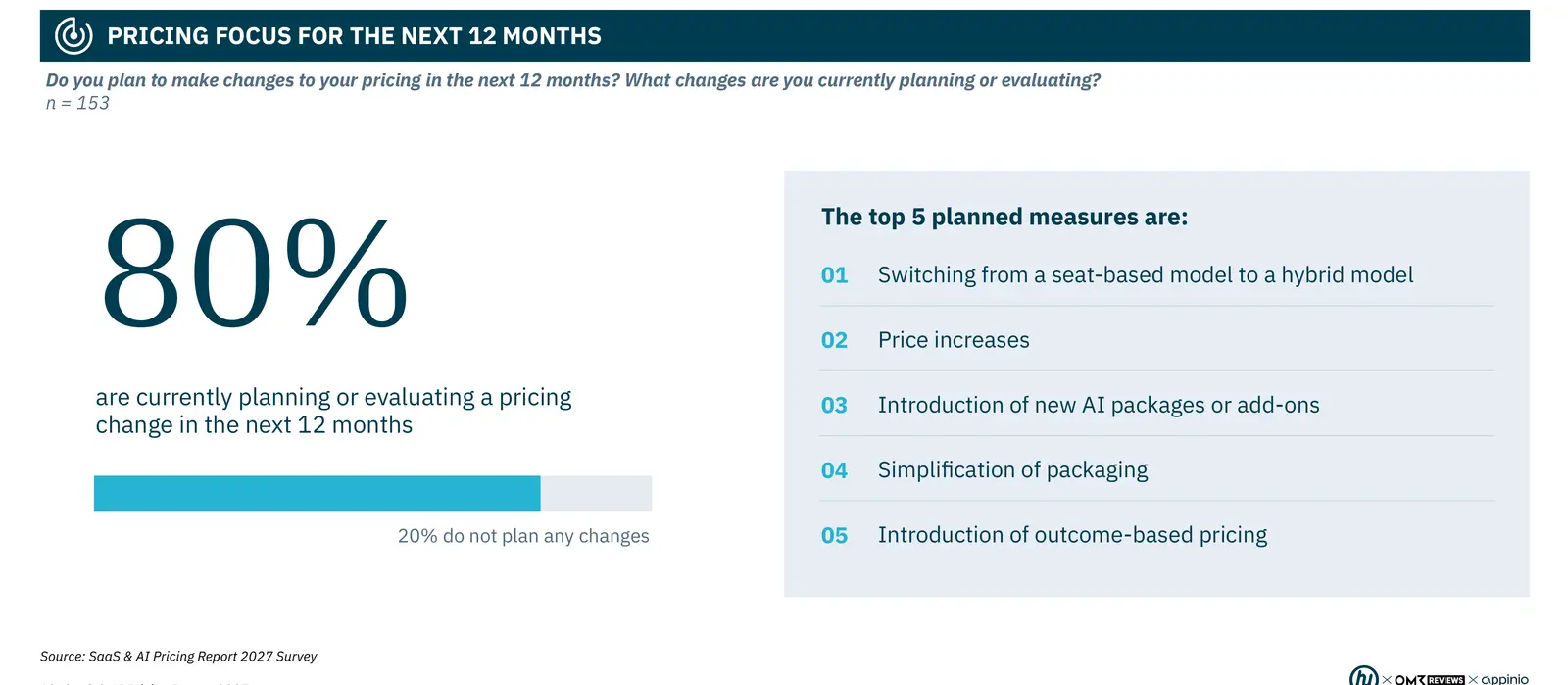
The fear usually sounds like this: “Then all my customers will run away. We're already the most expensive in the market. No, not gonna happen.” In software, we very often see retention above 90 to 95% after a price increase. For our SaaS & AI Pricing Report 2027, we surveyed 153 software and AI vendors. 80% of them plan to change their pricing in the next 12 months, and a price increase is the second most common planned move. So plenty of companies intend to do it. The question is how.
Two conditions every increase needs
Robert Kaiser, managing director at Tacto, put it this way: “Of course you only ever have a basis for a price increase when two things have happened. First, when you create value for the customer, and second, when the customer isn't completely surprised and caught off guard by it.”
For the first condition, you need evidence for each customer, not a general press release. What has the customer received since the last price point? Which features do they use, and how much time or money do those save them? If you can answer these questions in writing for your 50 largest customers, you already have the argument for the conversation.
The second condition is often decided when the contract is signed, long before the increase. Kaiser describes the most common mistake: If the contract shows only the negotiated price and the list price appears nowhere, it's later “extremely hard” to push through an increase. If you mark discounts as time-limited from the start, you can phase them out later without it feeling like a break.
Not every customer gets the same increase
A uniform increase for everyone is the simplest plan. It leaves money on the table where customers would pay more, and it risks cancellations where they'd pay less. Timo Müller explained it like this: “We just know that customers are willing to pay different prices.” Once you have hundreds of customers, you can't simulate this customer by customer anymore. So you form groups of customers who behave similarly and give each group its own increase and its own messaging.
The data for this is almost always already in-house: contract data, the customer's price history, usage and an estimate of how costly switching would be for them. The higher those switching costs, the lower the risk. According to Timo Müller, there's almost always one group you leave alone: “Just don't touch the sleeping dogs.”
Here's what a segmentation can look like. The groups are an example; the right criteria depend on your product.
| Customer group | Characteristic | Action |
|---|---|---|
| Heavy users on an old price | high usage, price far below list | significant increase, personal conversation |
| Growing customers | more users or locations | upgrade to a higher tier instead of a pure increase |
| Average | normal usage, price close to list | moderate increase, in writing with a rationale |
| Unhappy customers | complaints, declining usage | improve service first, then raise prices |
| Sleeping dogs | little contact, high churn risk | don't touch |
For some groups, an increase isn't the best move at all. An upsell, a cross-sell or a switch to a new pricing model often brings in more there. If your tiers are built with the right price gaps, moving up to the next tier is the most natural path.
How big the increase can be
There's no standard rate. Our SaaS & AI Pricing Report 2026 offers a reference point: In a sample of 100 software profiles on the German software review platform OMR Reviews, 67% of price increases were between 0 and 20%. Those are list prices. For existing customers who haven't seen an increase in years, the gap to the current list is often larger. On top of that comes inflation. According to the Federal Statistical Office of Germany (Destatis), consumer prices in Germany rose 6.9% in 2022, 5.9% in 2023 and 2.2% each in 2024 and 2025, about 18% in total. If you haven't adjusted anything since 2021, you're selling for considerably less in real terms today. In cases like this, it pays to close the gap in two or three steps. For the steps after that, it helps to look at what's typical per year.
Before you settle on a number, calculate how much churn you can afford.
Worked example: Your customer base brings in €2,000,000 in recurring revenue a year. You raise prices by 8% on average. If every customer keeps their contract, that's €2,160,000. You end up with the same revenue as before if customers representing 7.4% of revenue cancel, because 92.6% of €2,160,000 is €2,000,000 again. The formula behind it: tolerable revenue loss equals the increase divided by one plus the increase. At a 10% increase, it's 9.1%; at 20%, it's 16.7%. Since departing customers also take their support costs with them, the threshold for profit is a bit higher still.
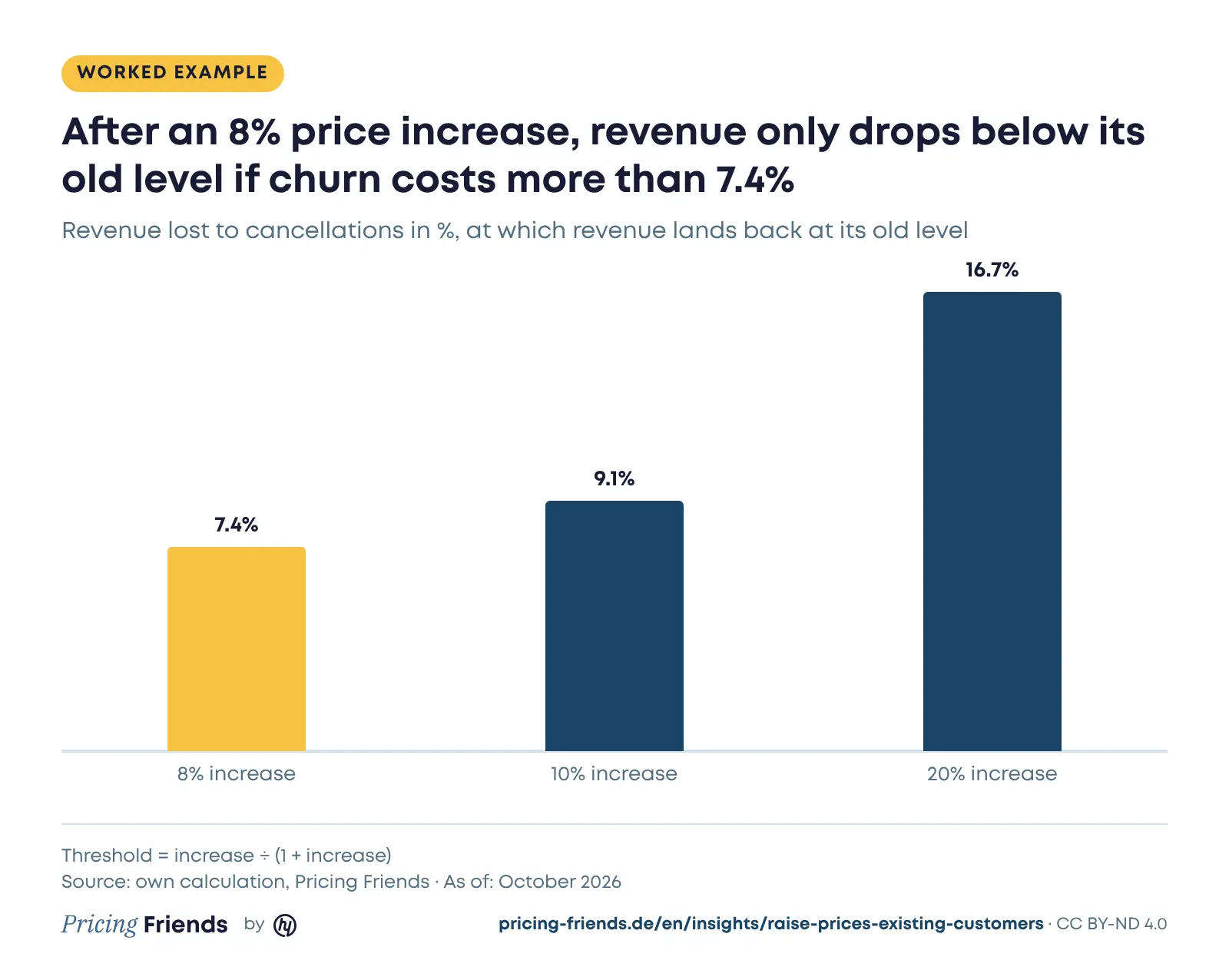
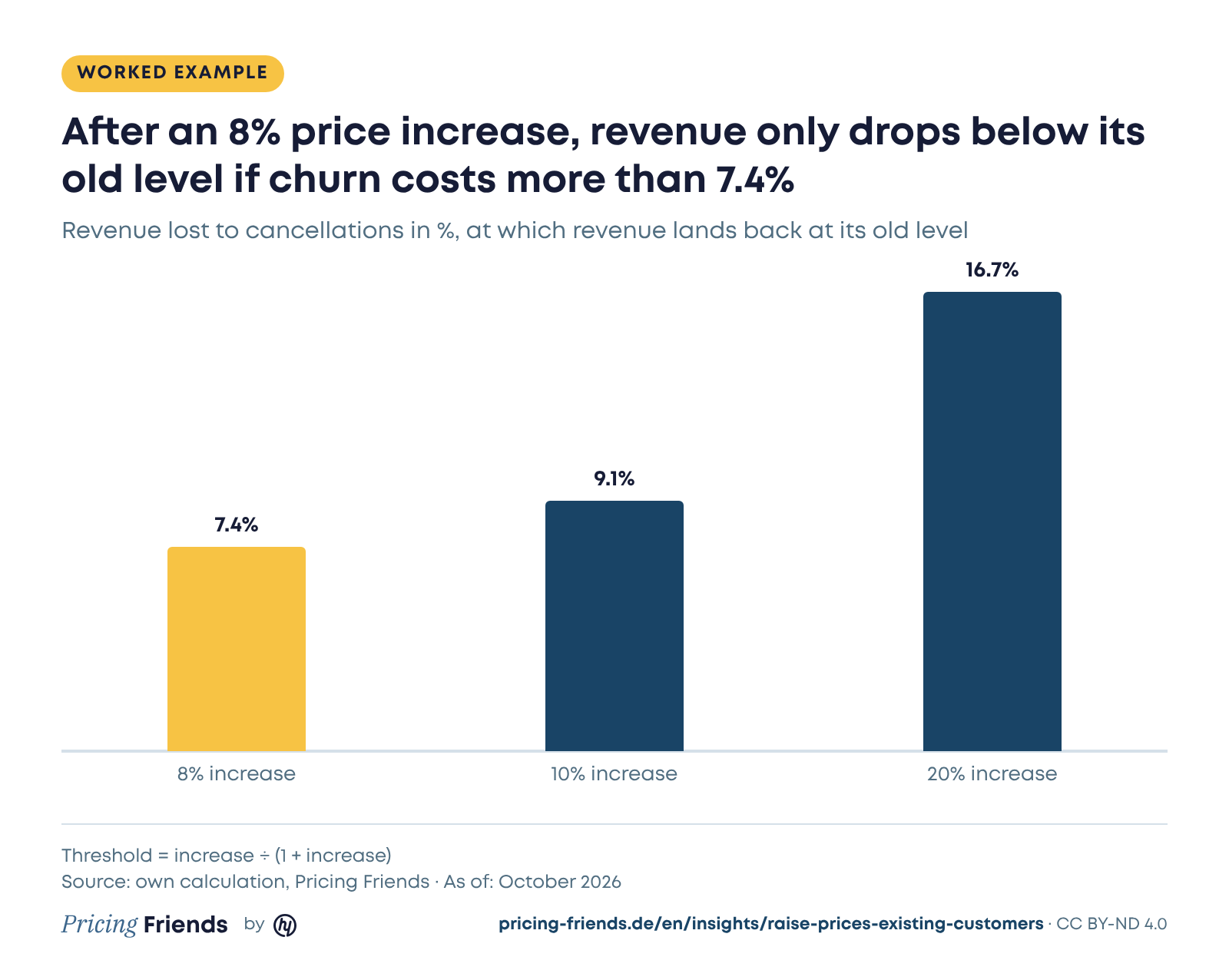
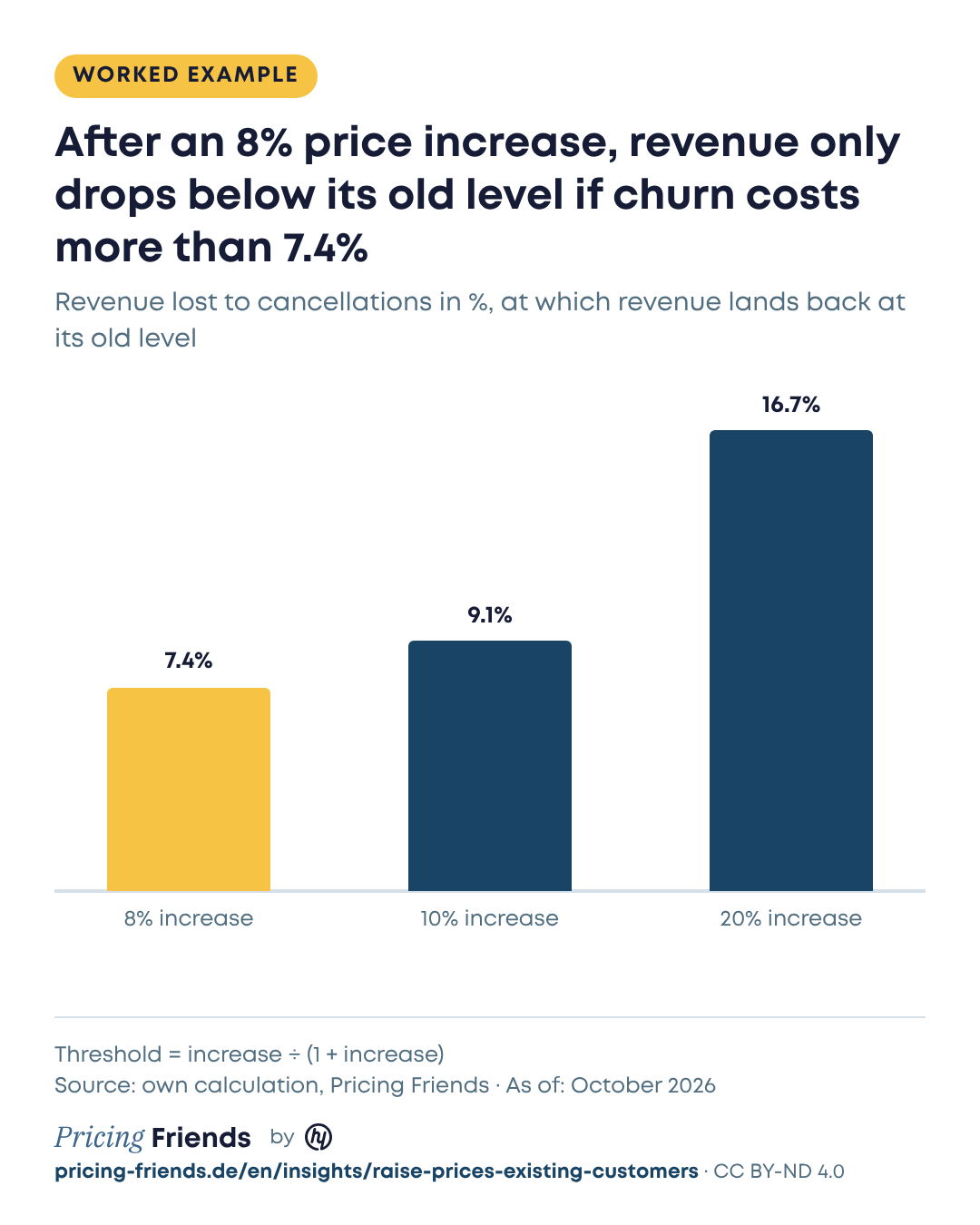
This calculation takes the fear out of the discussion. Compare the threshold with your normal churn rate: The increase only has to cover the additional loss it causes itself. Customers who would have left anyway will leave without an increase too.
Sales carries the increase
A new price list alone won't convince a single customer. The people who talk to customers have to carry out the increase. Boy Hengstmann described how his company moved its customer base to a new model. The salespeople responsible for existing customers were “involved from the start.” The team worked with nine customer groups and didn't communicate to everyone in a single step: “Instead, we went through cohort by cohort, also based on the contract terms and durations we have with our customers.”
That leads to a simple division of labor. Large customers get a conversation before any letter goes out. Mid-size customers get a written announcement with a rationale and a contact person. Small customers get a clear message in the product and by email. The written announcement needs clear wording and enough lead time.
Unhappy customers easily take an increase as their cue to leave for good. That's why this group belongs at the back of every plan.
What you can do on Monday
- Pull a list of all existing customers with their current price, list price and date of the last increase.
- Mark where the gap to the list price is largest and who uses your product heavily.
- Form three to five groups and set an action and an increase for each, including the group you won't touch.
- Calculate for each group how much churn you can afford.
- Review your contracts: Where is the list price, where are the time-limited discounts, and when do the contracts expire?
- Brief your account managers before the first customer hears anything.
For an increase across a large customer base that affects contracts, sales and customer communication at the same time, a specialized pricing consultancy such as hy can help you structure it, down to the approval rules in sales.
Bottom line: Group first, then calculate, then talk
A price increase for existing customers works when the customer knows the value and the increase doesn't come out of nowhere. Split your customer base into groups, give each its own increase and leave alone the customers who are already at risk. Calculate in advance how much churn you can absorb, and bring sales in before the first letter goes out.
Before you bring old prices up to the current list, it's worth looking at the list itself. You get a first read in about a minute with the free pricing audit on pricing-friends.de. It reads your pricing page live, checks your pricing model, packaging, price points and entry offer, and gives you a score from 0 to 100 with findings. The review follows the approach hy Consulting Group has developed in more than 600 pricing projects.
Sources
- SaaS & AI Pricing Report 2027 by hy, p. 13
- SaaS & AI Pricing Report 2026 by hy, p. 41
- Federal Statistical Office of Germany (Destatis): Inflationsrate im Jahr 2025 bei +2,2 % (Annual inflation rate at +2.2%), press release no. 019, Jan. 16, 2026
- Pricing Friends, episode 5: Private Equity und Pricing mit Andreas Spiegel: Wie revolutioniert effektives Pricing den Wert von Softwareunternehmen?
- Pricing Friends, episode 7: Softwarelizenzen und Pricing mit Timo Müller: Wie beeinflusst die Preisgestaltung das Softwaregeschäft?
- Pricing Friends, episode 99: Sonderfolge: SaaS-Pricing, AI und die Zukunft der Preismodelle, Dr. Sebastian Voigt bei Julius Göllner
- Pricing Friends, episode 102: Software-Abos und Pricing mit Boy Hengstmann: Wie verbindet evasys Kundentreue und Transformation?
- Pricing Friends, episode 137: Procurement Intelligence und Pricing mit Robert Kaiser: Wo findet KI im Einkauf den größten Hebel?
Quotes are translated from German. The podcast episodes are in German.