
Price increases · 8 min read
Announcing a price increase for B2B software: lead time and content

Key points
- The contract sets the minimum lead time for a price increase on B2B software. Large customers sometimes need twelve months because of budget planning.
- Before announcing a price increase, software vendors should have their adjustment clause and deadlines reviewed by a lawyer: under German law, price clauses in standard terms face a fairness review even with business customers.
- A software price increase announcement states the date, the old and new price, the customer benefit and a contact person. The order: internal teams first, large customers in person, then everyone in writing.
- Software vendors should also announce a price increase on their own website. Otherwise AI search shows old and new prices from third-party sources as a contradiction.
If you sell software to business customers, there's no fixed industry standard for announcing a price increase. Your contract sets the minimum lead time: The announcement has to come early enough for the customer to decide before their notice period ends. Your customer's budget sets the lead time that makes sense, and for large customers that's sometimes twelve months.
This article is for leadership, sales and customer success teams at software companies that have decided on an increase for their existing customers and are now planning how to communicate it. By this point, the size of the increase for each customer group should already be settled.
The contract sets the floor
Before you think about wording, read your contracts. Three questions determine the earliest possible date: Are you allowed to adjust the price during the term at all, and within what limits? When does the contract renew? By when can the customer cancel? Whether you can adjust the price without the customer's consent depends on the clause in the contract. If it sits in your standard terms and conditions, the fairness review of standard terms under German law (§ 307 BGB) applies to business customers too: A clause is invalid if it unreasonably disadvantages the customer, and that can follow simply from it not being clear and understandable. Have the clause and deadlines reviewed by a lawyer before the first email goes out.
Zoë Andreae, CEO of a legal tech vendor, explained why her company has to be especially careful here. It uses data to check where increases are possible and within what limits, “because the moment you go beyond that, you immediately have a legal question from a legal customer who says: ‘Hold on, that’s not allowed.’” With corporate customers that have their own legal department, expect the same scrutiny.
The customer's budget sets the lead time that makes sense
The contractual deadline is the minimum. For large customers it's rarely enough, because procurement plans next year's money well in advance. Looking back, Boy Hengstmann described what he'd do differently when moving his customer base over: “We should have started conversations even earlier and even more proactively, and above all supported our customers’ processes better, especially budget planning on their side.” Some customers, he said, need “sometimes 12 months” of lead time “just to put the budget together properly.”
An increase that arrives after the budget decision hits a buyer who has no money left. They'll negotiate, even if they see the value.
Lead time by contract type
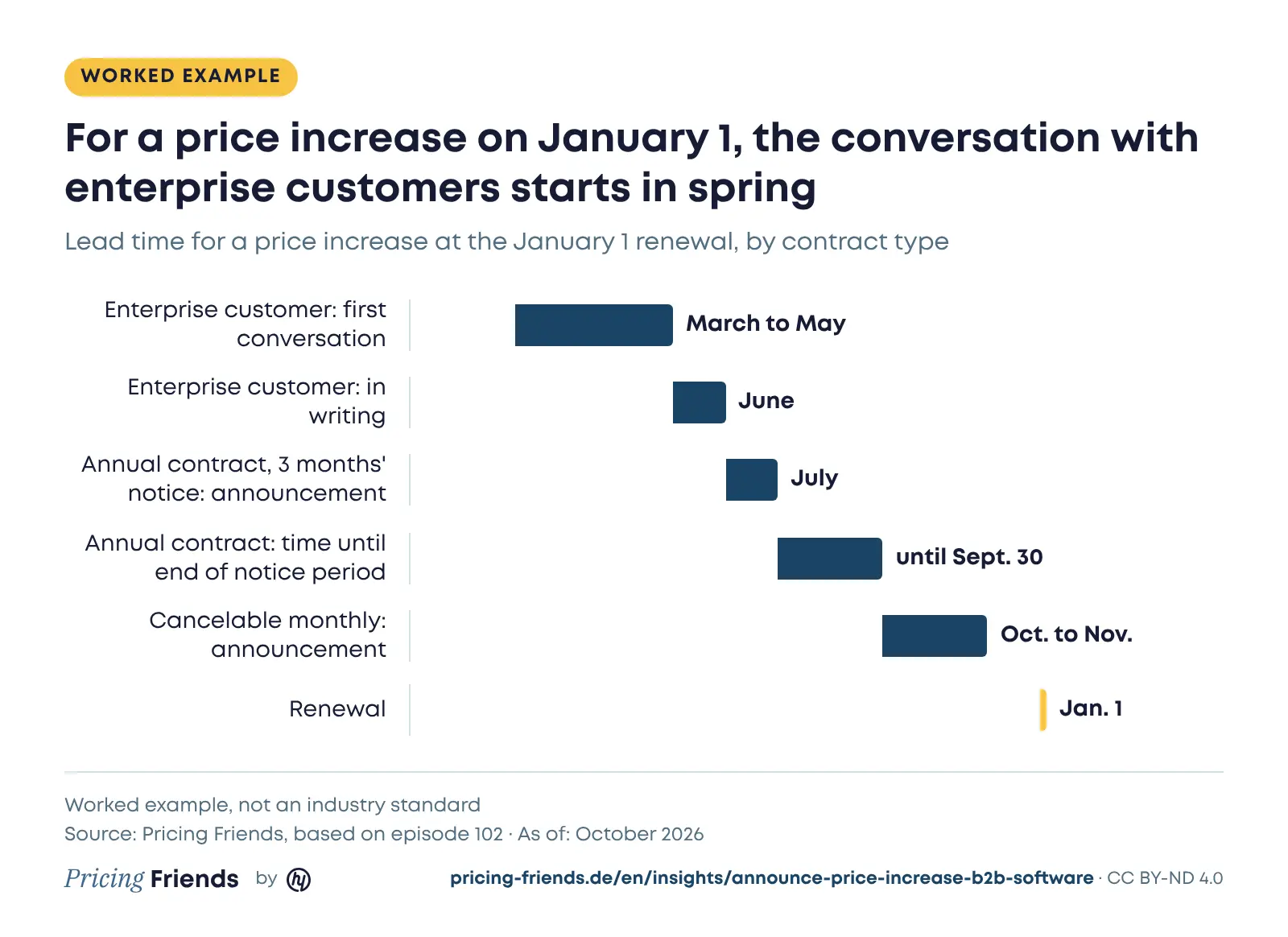
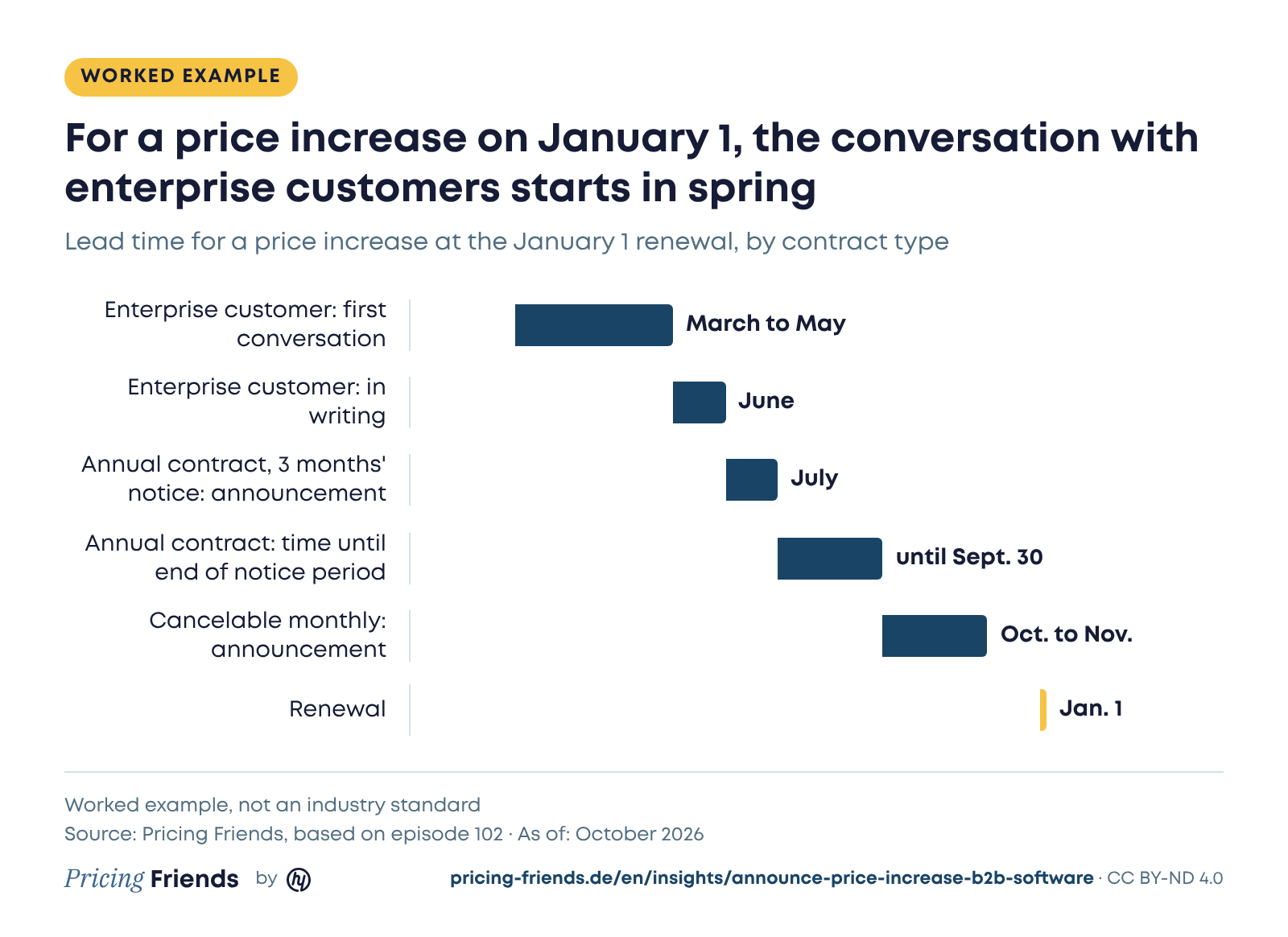
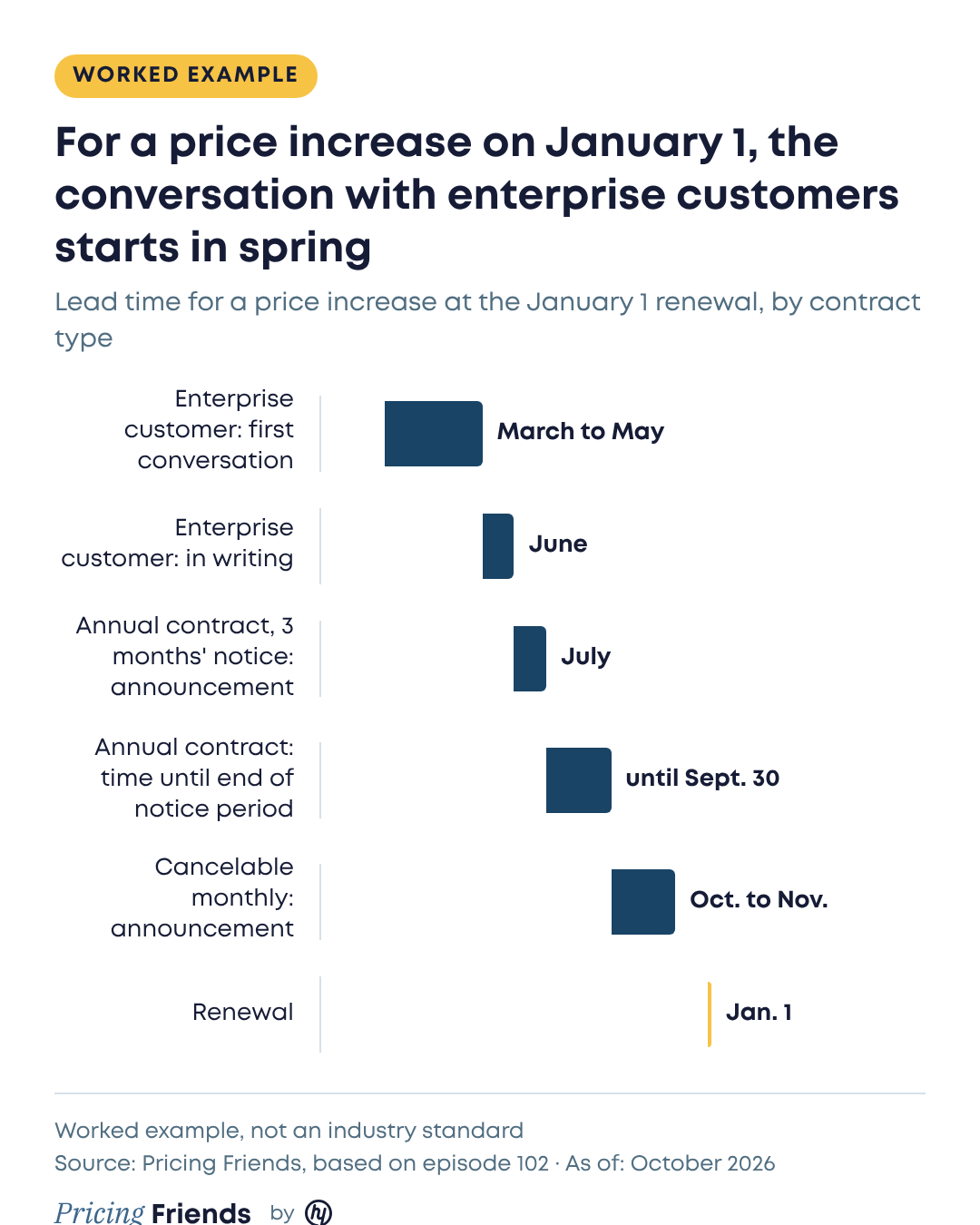
These two limits give you a simple plan. The values in the table are a worked example for a contract renewing on January 1, not an industry norm.
| Contract type | What sets the date | Worked example for a January 1 renewal |
|---|---|---|
| Monthly cancellation, self-service | Notice period plus time for questions | Announce in October or November |
| Annual contract, three-month notice period | Notice period ends September 30 | Announce by July at the latest |
| Annual contract with a corporate customer | Customer's budget planning | First conversation in spring, in writing before summer |
| Multi-year contract | Price adjustment clause or next renewal | Raise it in the renewal conversation, with budget lead time |
If your contracts have different terms, don't send everything on one day. Hengstmann moved his customer base over “cohort by cohort,” based on contract terms. That also spreads the workload in sales.
What goes into the announcement
Robert Kaiser of Tacto describes the mistake he stamped out in his sales team: hiding the increase somewhere, in the footer or not on the slide at all. His conclusion: “I simply have to make it very, very transparent and show it to the customer from the start.” So a good announcement contains seven things:
- The date the new price takes effect, and the deadline by which the customer can respond.
- The old and new price in euros, net of VAT, per unit and for the customer's contract.
- The value-based rationale: what the customer has received since the last adjustment, ideally with their own usage data.
- What stays the same: scope, term, conditions.
- A choice, where one exists: for example, a smaller plan or a longer term in exchange for a fixed price.
- A named contact person, not a generic support address.
- Confirmation of the framework: which contract provision the adjustment rests on.
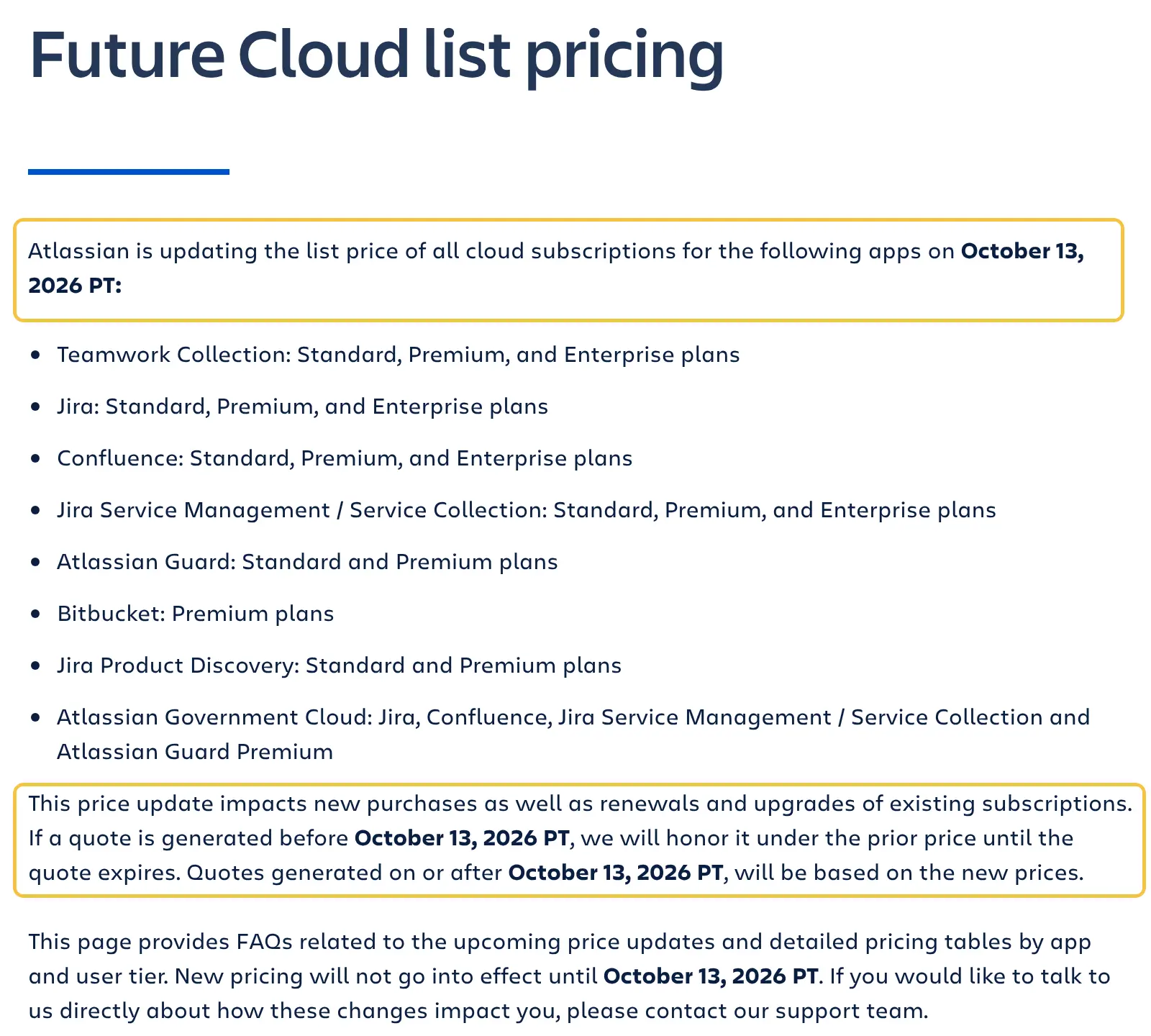
Cost arguments such as staff or infrastructure can appear, because people see them as a fair motive. In telephone surveys by Daniel Kahneman, Jack Knetsch and Richard Thaler, respondents considered it acceptable for a company to raise prices when its profit was threatened, for example by higher costs. Exploiting increased demand to raise prices was seen as unfair. On their own, though, cost arguments rarely carry the case. The customer pays for what the software does for them.
The order: internal first, then in person, then in writing
The announcement starts inside your own company. Account managers and support need to know the new prices, the reasoning and their room to negotiate before any customer asks. Then come the large customers: a conversation before the letter arrives. Only then does the written announcement go to everyone else. When the whole customer base is being moved over, a specialized pricing consultancy such as hy plans this sequence together with sales, customer success and the legal department.
The public page comes last, and it's often forgotten. If the new price is already in the contract but not yet on the website, prospects and existing customers see two different numbers.
AI search reads the announcement too
Until now, price increases followed an unwritten rule, which I described on the podcast like this: Most vendors “all try to keep it under the radar as much as possible.” In the same conversation, Malte Landwehr explained why that no longer works. When AI search tools are asked for a product's price, they draw on other vendor pages besides the pricing page, such as a “blog post announcing the pricing” or help articles about the price. If you don't write anything yourself, you leave the field to listings on comparison sites and forums.
The SaaS & AI Pricing Report 2027 reaches the same conclusion: If you hide your prices, you still end up in comparisons, just with the price others spread about you. That matters because, according to a study by Google and Bain, 92% of B2B buyers end up buying a product that was already on their first list.
In the episode, I summed up Malte's point this way: With the new buyer journey through AI search, you “simply have to announce it firmly.” The silent price increase is getting more expensive. AI search puts old and new numbers side by side, and if you don't explain your increase yourself, you'll find it as a contradiction in third-party sources. You can systematically check what ChatGPT, Claude and Gemini say about your prices today.
What you can do on Monday
- Export all contracts with renewal date, notice period and price adjustment clause.
- Sort them by the latest date by which you have to announce.
- Flag the customers whose budget is decided in the fall, and plan the first conversation with them in spring.
- Write a template with the seven components above and have a lawyer review it.
- Plan when the website, help articles and announcement post will show the new price.
Bottom line: The contract sets the minimum, the budget sets the timing
Announce a price increase early enough for the customer to decide before their notice period ends, and for large customers early enough that it lands in their budget. The announcement states the old and new price, makes the case based on value and names a contact person. It also belongs on your own website, because AI search reads it there.
Whether AI systems quote your new price after the increase, you'll see in about a minute with the free pricing audit on pricing-friends.de. It reads your pricing page live, asks ChatGPT, Claude and Gemini about your prices and gives you a score from 0 to 100. The check follows the approach hy Consulting Group developed in more than 600 pricing projects.
Sources
- SaaS & AI Pricing Report 2027 by hy, pp. 76, 80
- German Civil Code (Bürgerliches Gesetzbuch), § 307 fairness review of standard terms and § 310 scope of application
- Daniel Kahneman, Jack L. Knetsch and Richard Thaler: Fairness as a Constraint on Profit Seeking: Entitlements in the Market, American Economic Review 76 (4), 1986
- Pricing Friends, episode 101: Legal Tech, Rechtsabteilungen und Pricing mit Zoë Andreae: Wie verändert KI eine Branche, in der On-Premise wieder zurückkommt?
- Pricing Friends, episode 102: Software-Abos und Pricing mit Boy Hengstmann: Wie verbindet evasys Kundentreue und Transformation?
- Pricing Friends, episode 137: Procurement Intelligence und Pricing mit Robert Kaiser: Wo findet KI im Einkauf den größten Hebel?
- Pricing Friends, episode 145: LLM-Sichtbarkeit und Pricing mit Malte Landwehr: Warum gewinnt transparentes Pricing in der KI-Suche?
Quotes are translated from German. The podcast episodes are in German.