
Price increases · 8 min read
How much do SaaS companies typically raise prices each year?

Key points
- There's no fixed rate for an annual SaaS price increase. Across 100 software profiles, two-thirds of list price increases fell between 0 and 20%.
- In a SaaS price increase, the new list price and the price for existing customers are two separate questions. For existing customers, an annual step of a few percent is usually enough.
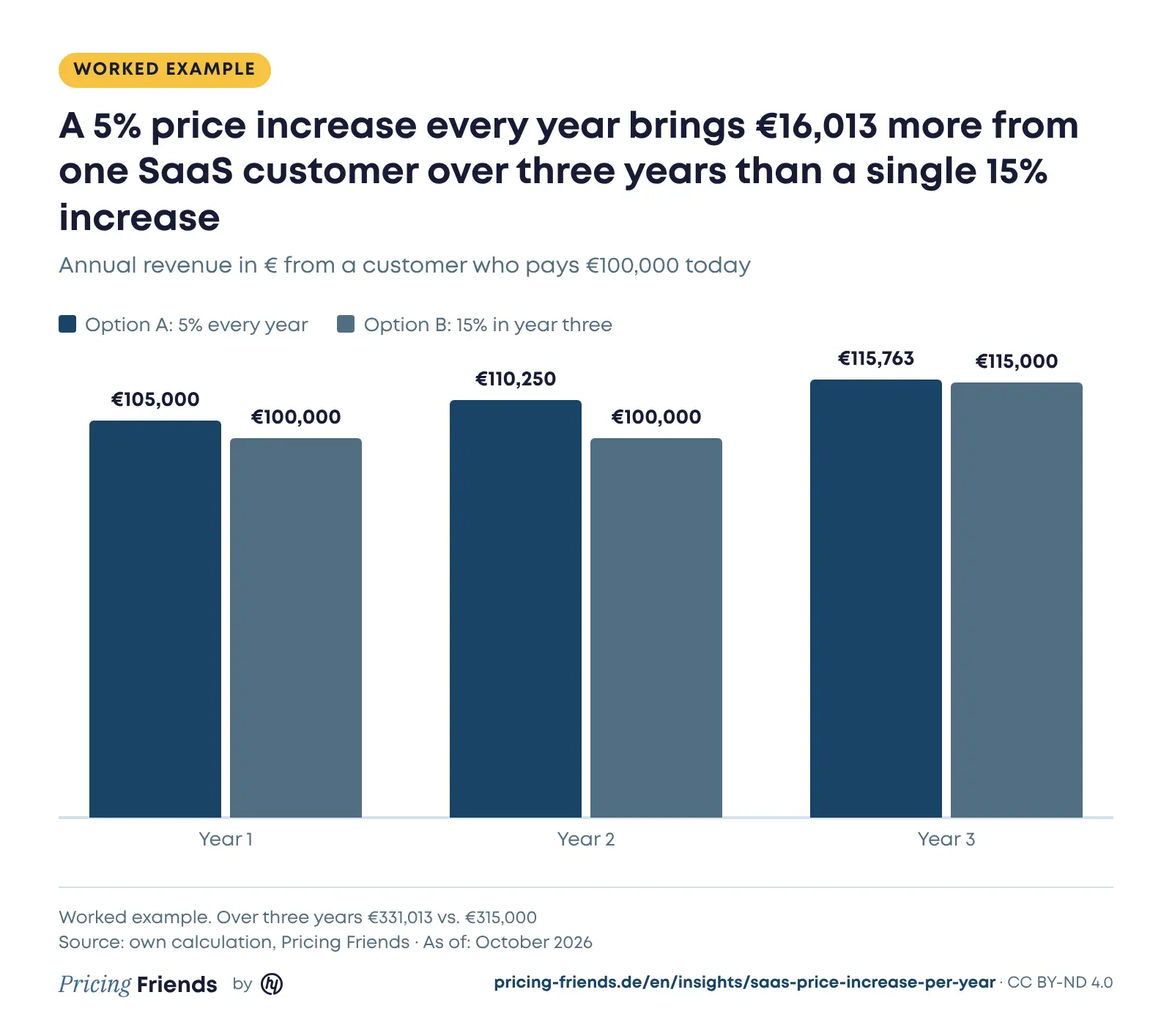
- In SaaS, three annual price increases of 5% each on €100,000 in annual revenue bring in €16,013 more over three years than a single 15% increase.
- An index clause in a SaaS contract only covers inflation. A price increase for more customer value needs its own justification and its own number.
If you sell a SaaS product and you're planning your annual pricing round, there's no fixed rate, but there is a clear corridor. In a sample of 100 software profiles on the German software review platform OMR Reviews, which we analyzed for our report, two-thirds of price increases fell between 0 and 20%. The most common range was 10 to 20%. For an annual adjustment for existing customers, we're usually talking about a few percent, though double digits aren't unusual in software.
This article is for executives, CFOs and revenue leaders at software companies. It shows what our data says, why list price and existing customers are two different questions, and when a small annual increase earns more than a big step every few years.
What the data shows
For our SaaS & AI Pricing Report 2026, we worked with OMR Reviews to analyze 100 software profiles as of June 30, 2025. The question was how much vendors had raised their prices over the previous year, measured by the cheapest plan. Our current edition doesn't include a new analysis of this question.
| Size of price increase | Share of vendors |
|---|---|
| 0 to 10% | 24% |
| 10 to 20% | 43% |
| 21 to 30% | 14% |
| over 30% | 20% |
Source: SaaS & AI Pricing Report 2026, p. 41. The values above 30% are four bars of 5% each.
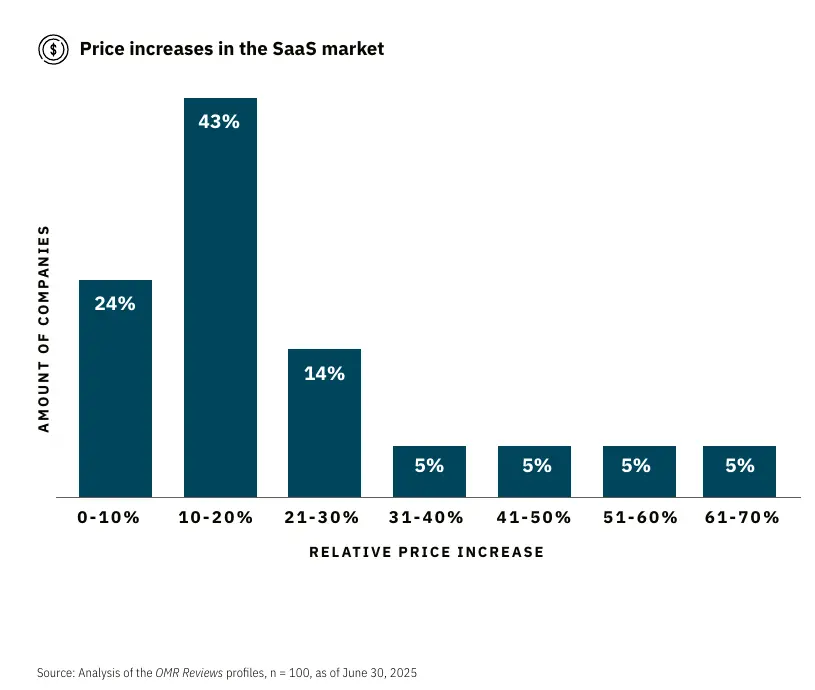
I take three things from this. First, increases of up to 20% are standard, and they're the easiest to explain. Second, there are outliers at the top, which we mainly attribute to clear product improvements, higher costs, a strong brand or strong customer loyalty. Third, prices don't only go up: of all price changes, 63% were increases and 37% were lower entry prices, mostly through revised packaging or a new starter plan.
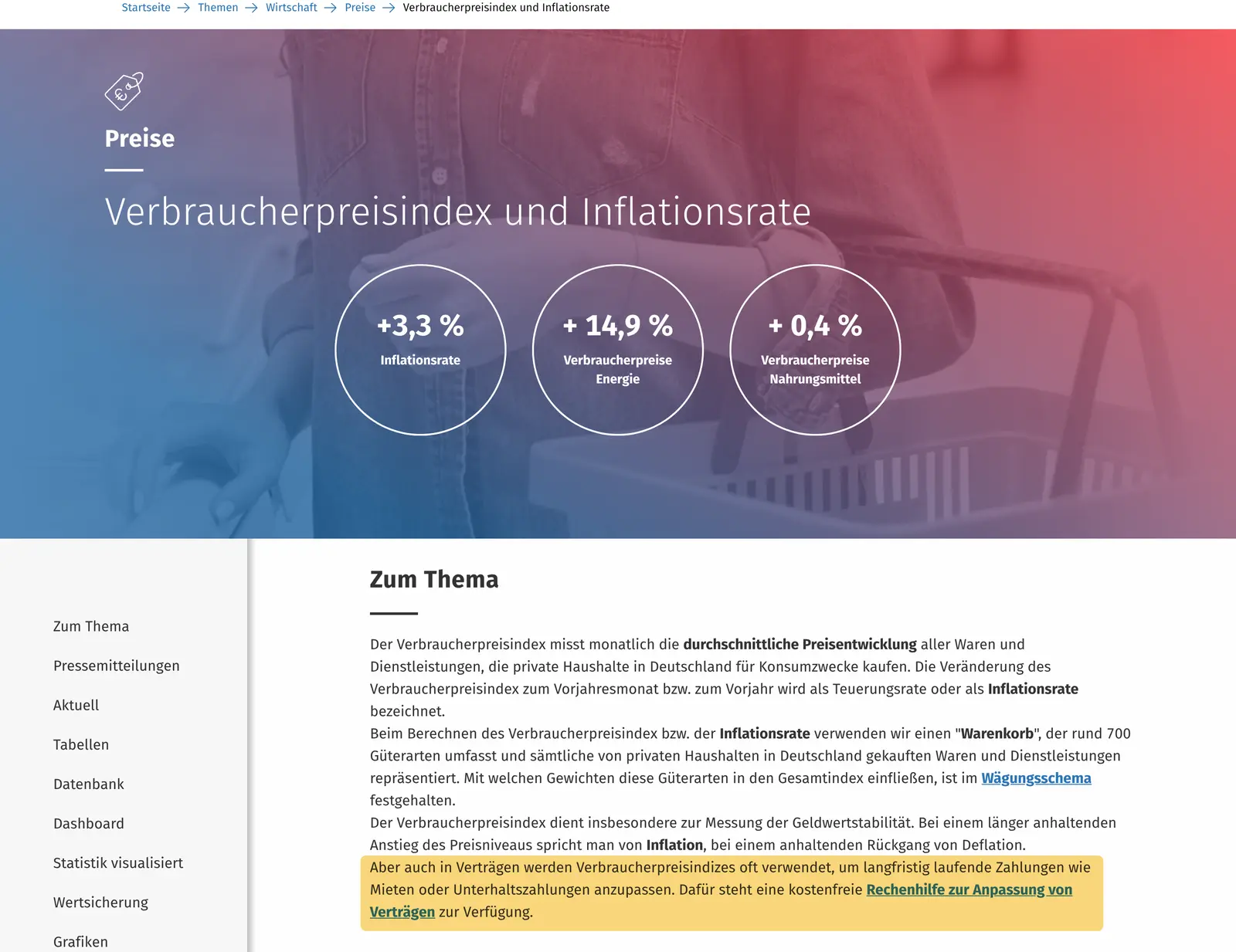
There's also this: most SaaS vendors regularly adjust their prices by around 10%, often well above inflation. For comparison, consumer prices in Germany rose by an annual average of 2.2% in 2024, according to the Federal Statistical Office of Germany (Destatis).
List price and existing customers are two different questions
The figures above describe list prices: what a new customer sees on the website. Your existing customers follow a different calculation. In my conversation with Boy Hengstmann, I summed it up like this: if you run price increase programs annually, “then you’re usually talking about a few percent. It can be double digits too, especially in software.” Major transitions, such as moving from a license model to a subscription, often involve much bigger jumps, especially for customers coming from a low price.
So you need to distinguish three cases:
| Situation | Typical size | What matters |
|---|---|---|
| Regular annual adjustment | a few percent to just under double digits | Rhythm, contract clause, short justification |
| New list price for new customers | usually up to 20% | Market comparison, plan logic |
| Catching up after years without an increase | often much more, in steps | Customer segments, personal conversation |
In the third case, it helps to split your existing customers into segments and address each segment separately.
Small every year or big once in a while
Some software companies don't raise prices for years and then catch up in a single step. That's the harder path, and it costs money.
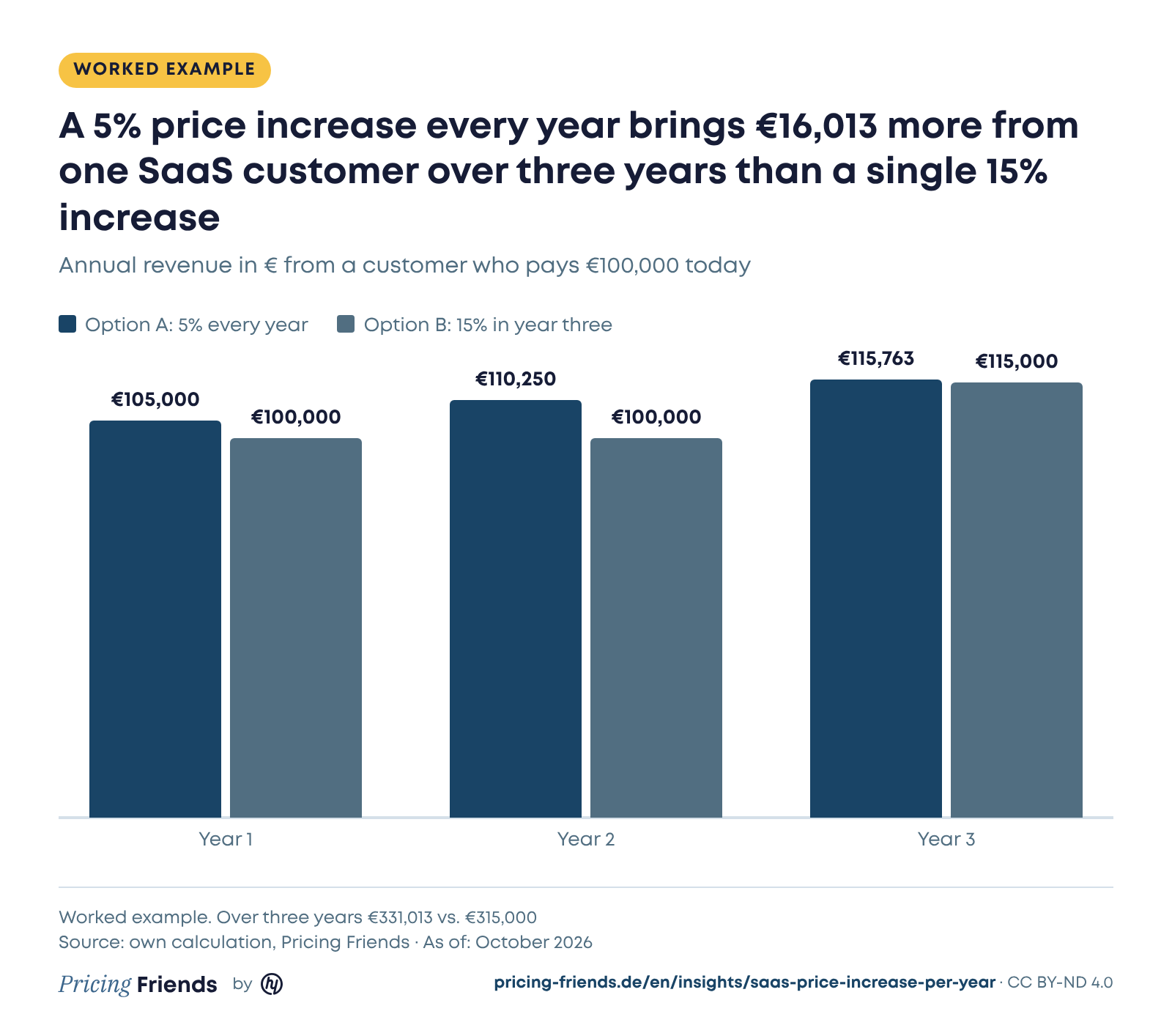
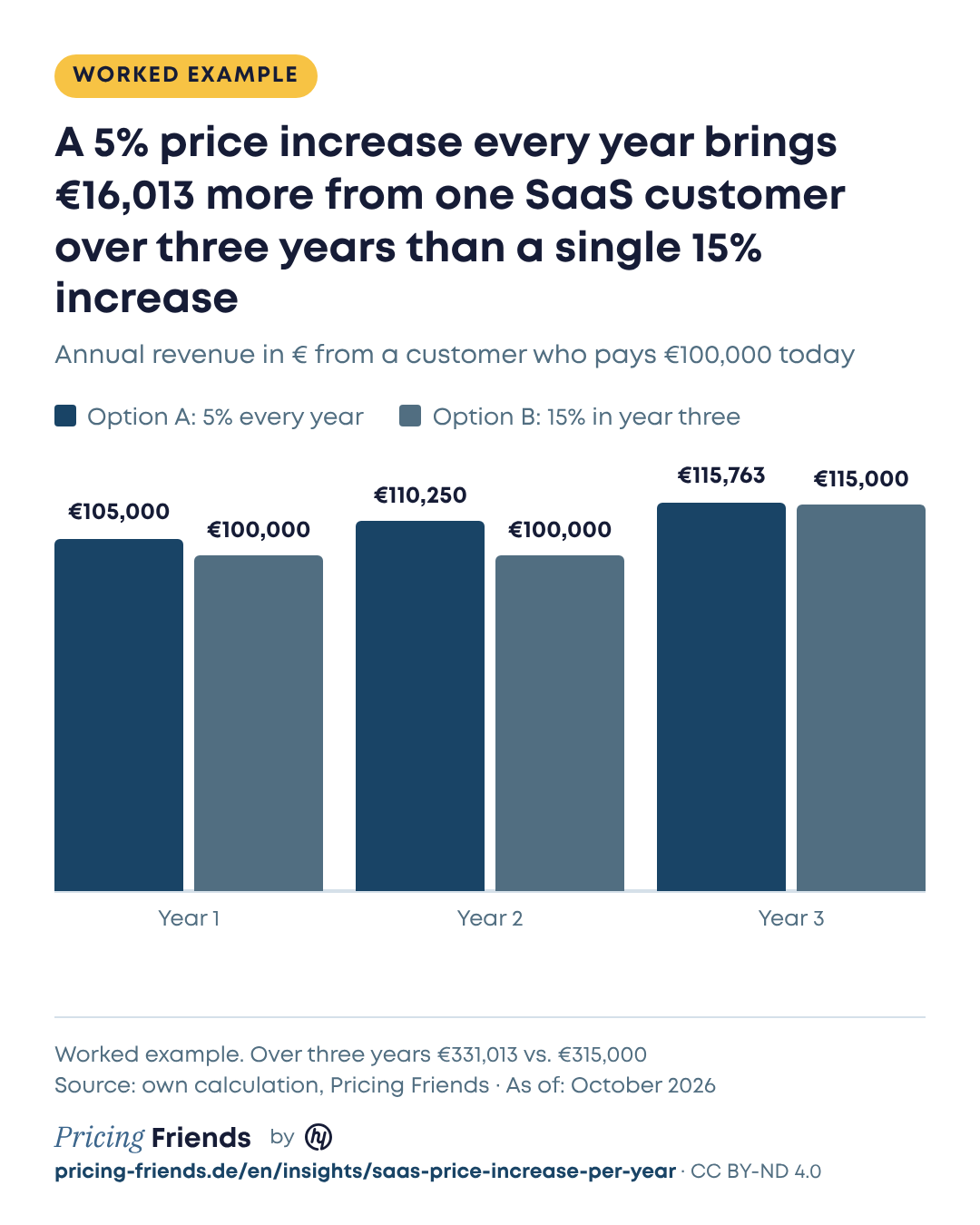
Example calculation: A customer pays €100,000 a year. Option A: You raise prices by 5% a year for three years. The customer then pays €105,000, €110,250 and €115,763, a total of €331,013. Option B: You wait two years and raise prices once by 15% in the third year. The customer pays €100,000, €100,000 and €115,000, a total of €315,000. Option A brings in €16,013 more over three years, ends at a higher price and asks the customer to take only a small step each year.
Then there's habit. Zoë Andreae described how, when she took over her role, she asked when existing customers' prices had last been raised: “And then there was a very long silence.” Today she says: “And now it’s a routine cycle for all existing customers.” A fixed rhythm takes the drama out of each individual round.
Large vendors move on shorter cycles too. Salesforce raised its list prices by an average of 9% in August 2023, which by its own account was its first increase in seven years. Two years later, in August 2025, it followed with an average of 6% for the Enterprise and Unlimited editions of several products.
And the fear of losing customers is usually overblown. After price increases in software, we very often see retention of over 90 to 95%.
Index clauses only protect you against inflation
A contractual adjustment tied to a price index is often the simplest framework for existing customers. Timo Müller says of such price adjustment clauses: “They’re actually quite common in software too.” But he also sees customers attacking these very clauses in negotiations.
An index clause protects you against inflation. It doesn't reflect added value for the customer. If you've improved the product significantly over the year, that improvement needs its own justification and its own number. The clause is the floor; the pricing round is the decision you make on top of it.
Why the question comes up more often now
In the SaaS & AI Pricing Report 2027, 80% of the 153 software and AI vendors surveyed are planning or considering a change to their pricing in the next 12 months. Among the five most common measures, price increases rank second, behind the move from per-user pricing to a hybrid model. I notice this personally too, and once put it this way: “I used to get a call from a company maybe every 3 years, and now suddenly it’s every year.”
Whether the current room to maneuver will last remains to be seen. Last year, we put forward the hypothesis that many vendors use AI features to justify existing prices and to make the case for the next increase. In the long run, we argued, that won't be enough, because autonomous AI agents handle parts of many products far more cheaply. Our conclusion: blanket increases of around 10% a year will get harder, while increases with clearly visible added value remain possible. That's an argument for offering AI features at their own price rather than using them only to justify the next increase.
What you can do on Monday
- Check when you last raised prices for existing customers, broken down by customer segment.
- Compare your list prices with the corridor above: Was your last increase below 10%, above 20%, or did you not raise prices at all?
- Check which contracts have a price adjustment clause and which index it refers to.
- Set a fixed month for your annual pricing round and plan the lead time for the announcement backward from it.
- Write down, for each year, what added value customers received. That's your justification for the next round.
Bottom line: Take a small step every year
In SaaS, increases of up to 20% are typical; in our last analysis of list prices, the most common range was 10 to 20%. For existing customers, a regular step of a few percent is enough if it comes every year and is justified by value. If you wait for years, you'll have to jump higher later and still lose revenue over time.
You can get a first read on the list prices on your pricing page in about a minute with the free pricing audit on pricing-friends.de. It reads your pricing page live, checks pricing model, packaging, price points and entry offer, and gives a score from 0 to 100 with findings. It follows the approach hy Consulting Group has developed in more than 600 pricing projects.
Sources
- SaaS & AI Pricing Report 2027 by hy, p. 13
- SaaS & AI Pricing Report 2026 by hy, pp. 41, 42, 46
- Pricing Friends, episode 5: Private Equity und Pricing mit Andreas Spiegel: Wie revolutioniert effektives Pricing den Wert von Softwareunternehmen?
- Pricing Friends, episode 7: Softwarelizenzen und Pricing mit Timo Müller: Wie beeinflusst die Preisgestaltung das Softwaregeschäft?
- Pricing Friends, episode 101: Legal Tech, Rechtsabteilungen und Pricing mit Zoë Andreae: Wie verändert KI eine Branche, in der On-Premise wieder zurückkommt?
- Pricing Friends, episode 102: Software-Abos und Pricing mit Boy Hengstmann: Wie verbindet evasys Kundentreue und Transformation?
- Pricing Friends, episode 142: SaaS- und AI-Pricing mit Mariella Knospe und Felix Rahlmeyer: Wie bepreist man Software und AI im Jahr 2027?
- Federal Statistical Office of Germany (Destatis): Inflationsrate im Jahr 2024 bei +2.2%, press release of Jan. 16, 2025
- Salesforce: New List Pricing for Salesforce Products, July 11, 2023
- Salesforce: Salesforce Announces Pricing Update, June 17, 2025
Quotes are translated from German. The podcast episodes are in German.