
Packaging · 8 min read
How cheap can your smallest plan be? Setting the entry price

Key points
- You derive a software entry price from the middle tier. A gap of 15–30% works well. Across software vendors, the median jump is 80%.
- The floor for a software entry price is your variable cost per customer, including the cost of every request for AI features.
- A low software entry price comes from a smaller plan scope. Deep price cuts and introductory discounts are the wrong way to get there.
- AI assistants also rank software vendors by entry price. If you only show anchor prices, you drop out of the shortlist early.
If you sell software in several plans, your smallest plan can be cheap enough that new customers without a big budget can get in. But the middle tier should cost only 15–30% more, and the entry price must not fall below your variable cost per customer. You make the entry plan cheap by giving it a smaller scope. A deep price cut is the wrong way to do it.
The job of the smallest plan
The entry plan is rarely the plan you want to sell. Here's how we describe its role in good-better-best packaging: The good tier lowers the barrier for price-sensitive customers, the best tier works as a price anchor, and most customers choose the profitable middle tier. On the podcast I put it this way: “And that's why, I'd say, this entry point should be cheap, fairly small, then migrating to the middle, and the other one is simply the price anchor.”
The pull of the middle is well researched. In 1992, Itamar Simonson and Amos Tversky showed that an option becomes more attractive when it sits in the middle of a choice set and loses appeal when it's an extreme.
That leads to the most important rule. You don't set the entry price on its own. It's the first step of a price ladder, and its main job is to make the step to the middle look small.
Three limits for the entry price
- Floor: your variable costs. Hosting, support, payment fees and, for AI features, the cost of every request. Traditional software scaled with almost no added cost. With AI, every interaction costs real money. Anthropic, for example, charges $2 per million input tokens and $10 per million output tokens for its Claude Sonnet 5.5 model, according to its price list (as of October 2026). That hits the smallest plan hardest. For our SaaS & AI Pricing Report 2026, we analyzed 4,197 software profiles with the German software review platform OMR Reviews: 65% of vendors with an AI feature already offer it in the smallest plan, and from the second-cheapest plan up it's 90%.
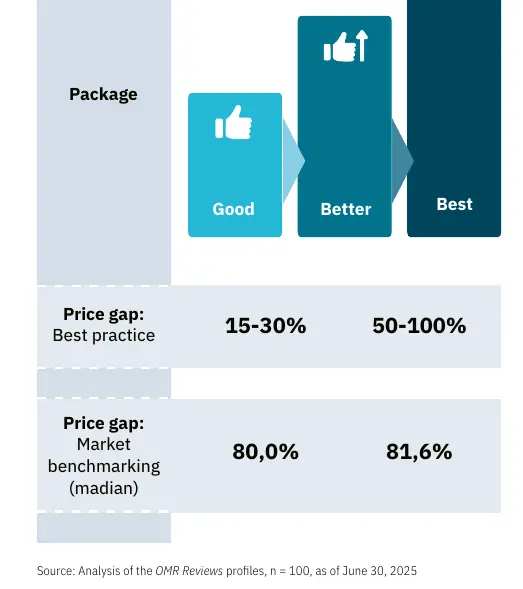
- Ceiling: the gap to the middle. In our projects, a gap of 15–30% from the entry plan to the middle tier works well, and 50–100% from the middle to the premium tier. If the gap is too small, it devalues the middle. If it's too large, it scares buyers off. In a sample of 100 of these profiles, the median first jump in the market is 80%. So for more than half of these vendors, the step to the middle is much larger than what works.
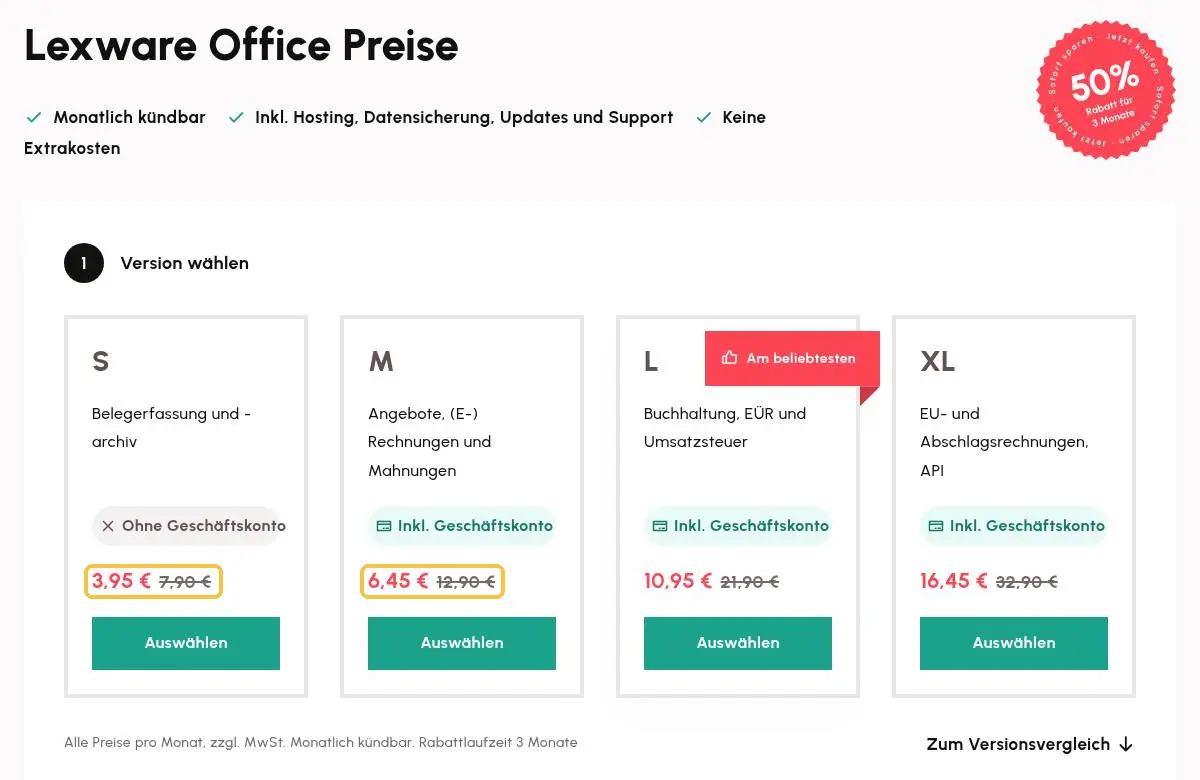
- Starting point: your market. There's no general benchmark. My colleague Charlotte Pohlmann put it this way: “You won't find a market standard there.” So there's no range like €100–200 where the small plan always sits. For ERP or CRM vendors, the largest plan sometimes costs five to ten times the entry price. Even within one category, prices spread widely. In accounting and finance software, entry prices last year ranged from €0 to €649.
The order matters. First you fix the price of the middle tier, because that's where most customers should land. Then you derive the entry price from the top down and check it against your costs.
Worked example: two price ladders
Worked example: The middle tier costs €59 per user per month, the premium tier €109. Variable costs per user, including AI features, are €6 a month.
| Option A | Option B | |
|---|---|---|
| Entry plan | €49 | €19 |
| Gap to middle | 20% | 211% |
| Gap from middle to premium | 85% | 85% |
| Gross margin in entry plan | 88% | 68% |
| What the buyer sees | the whole middle tier for €10 more | the middle costs three times as much |
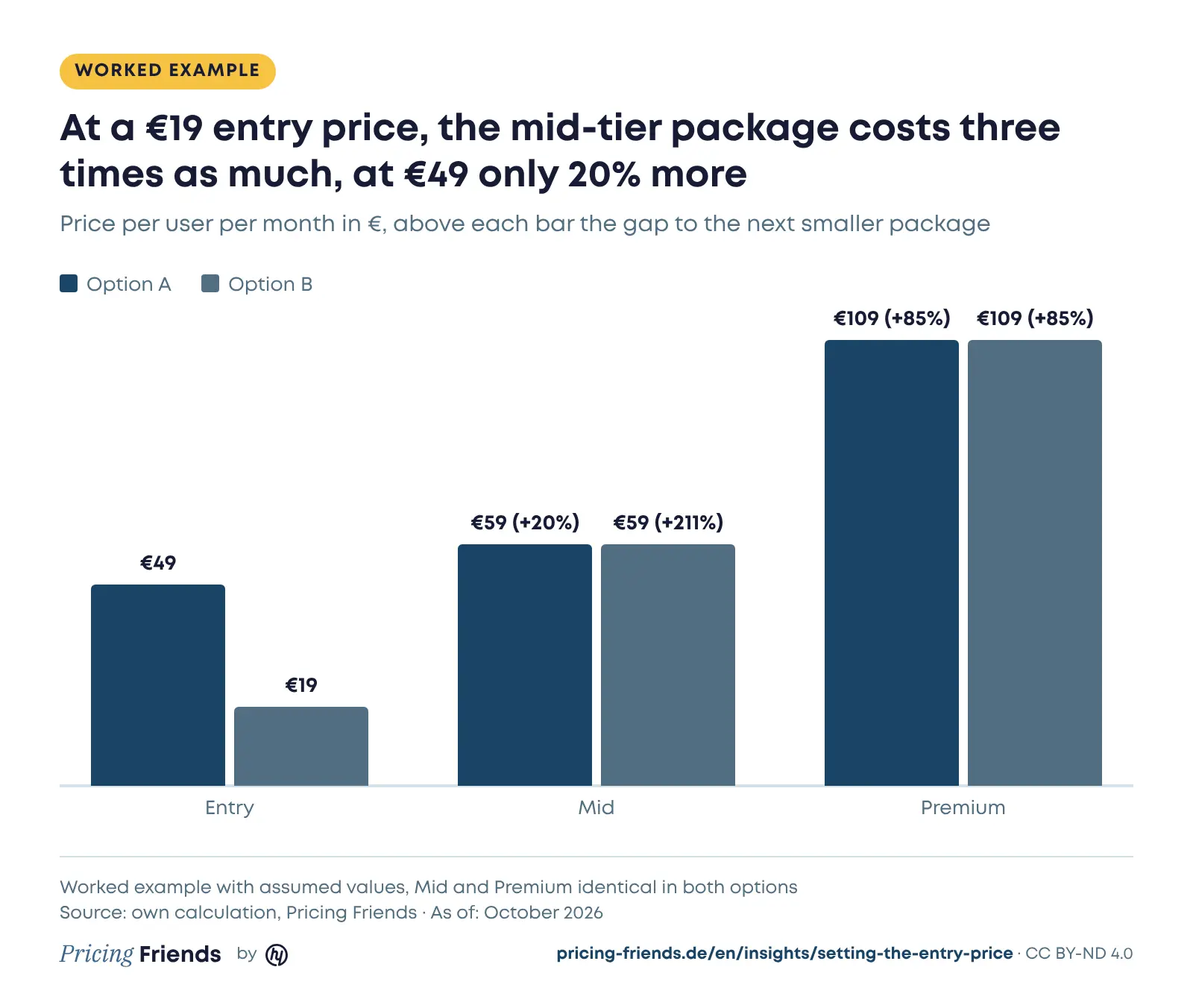
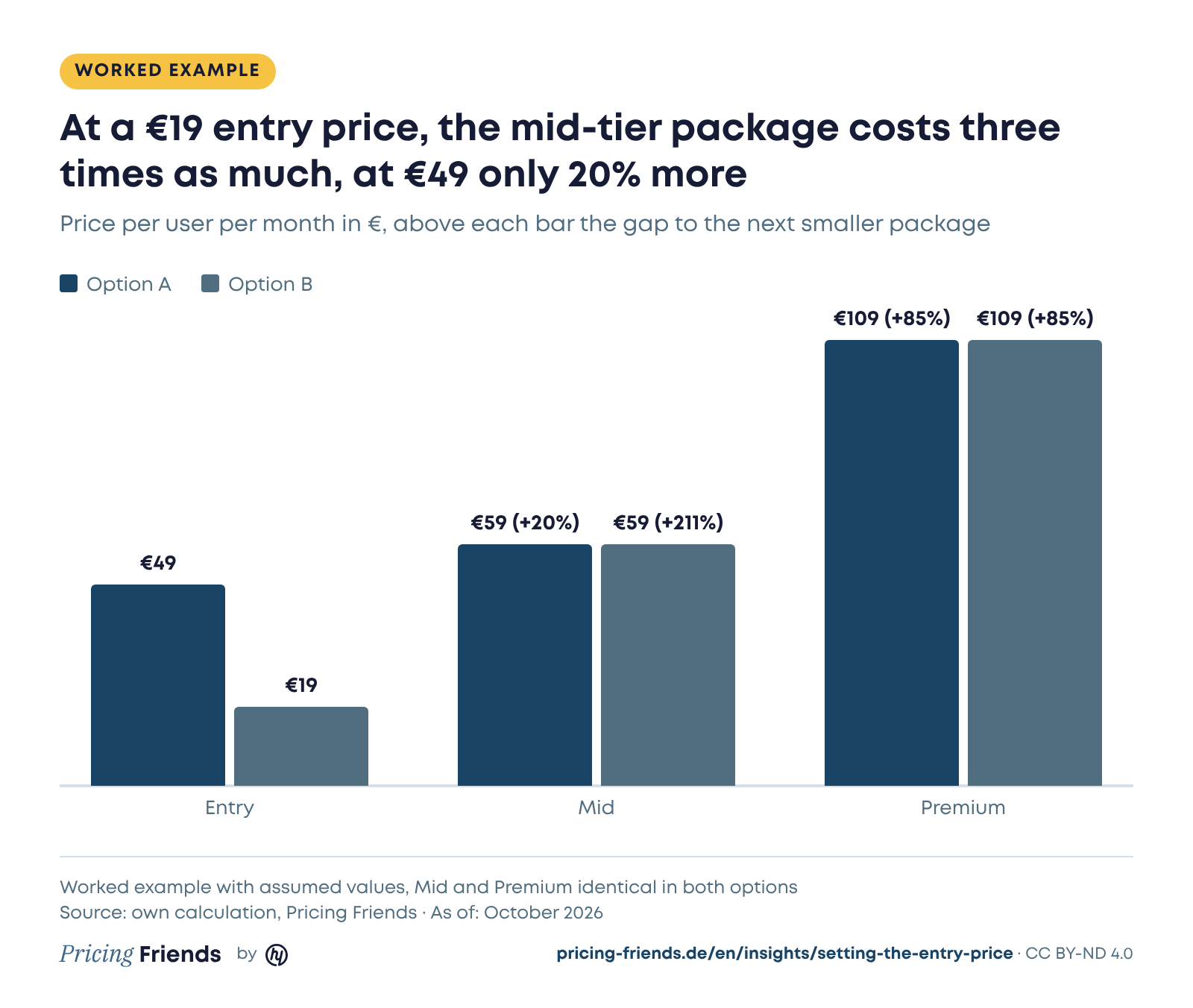
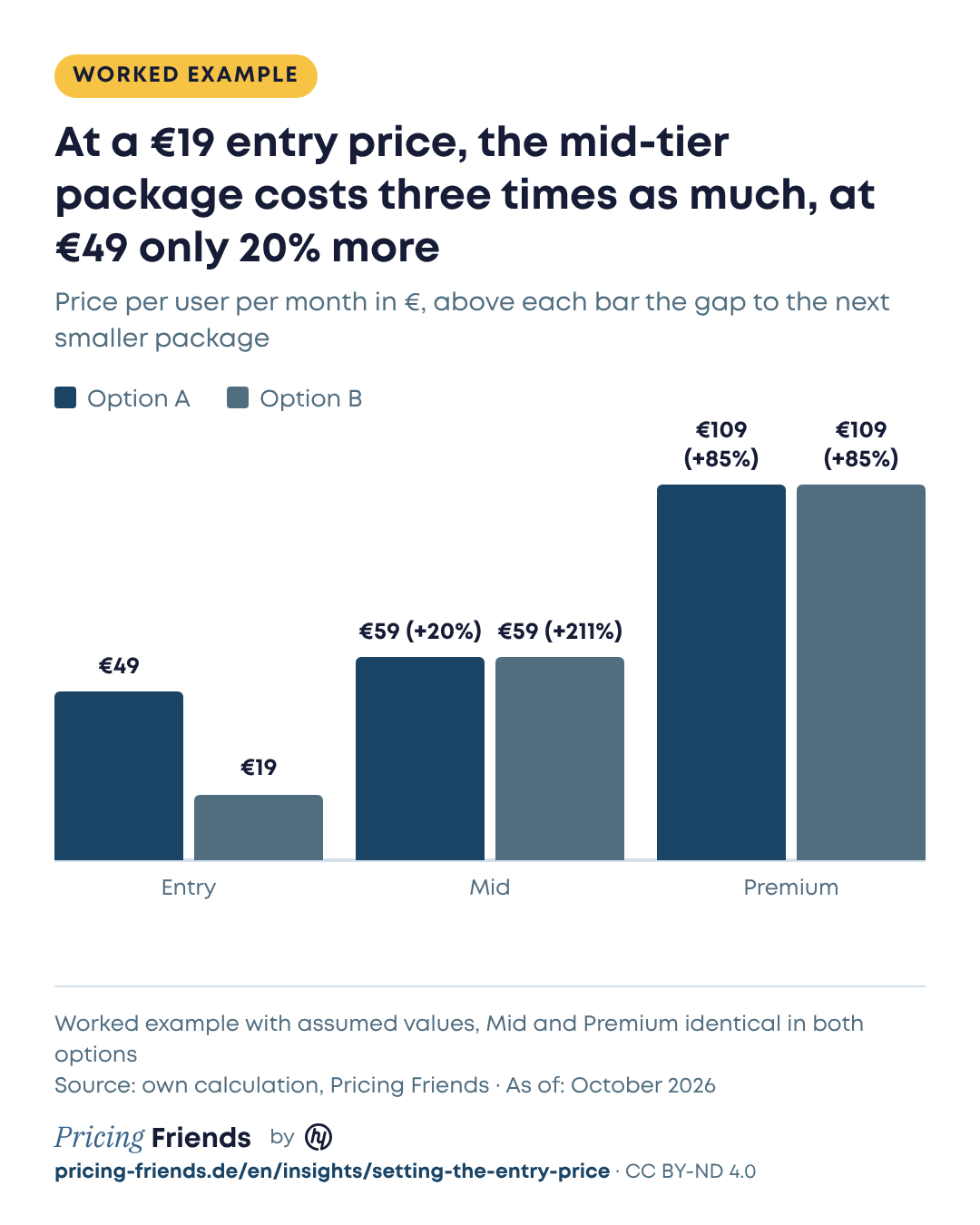
In Option A, the middle tier almost sells itself because the upcharge is small. In Option B, the buyer anchors on €19, and every step up feels expensive. If you want to stay at €19, you have to cut the plan so hard that it isn't enough for most customers, and make the middle tier much better to match.
For price endings, the data helps. Under €30, 72% of vendors round to whole euro amounts. Above €30, 54% of prices end in 9. €49 and €59 fit that pattern.
What the market is doing with entry prices
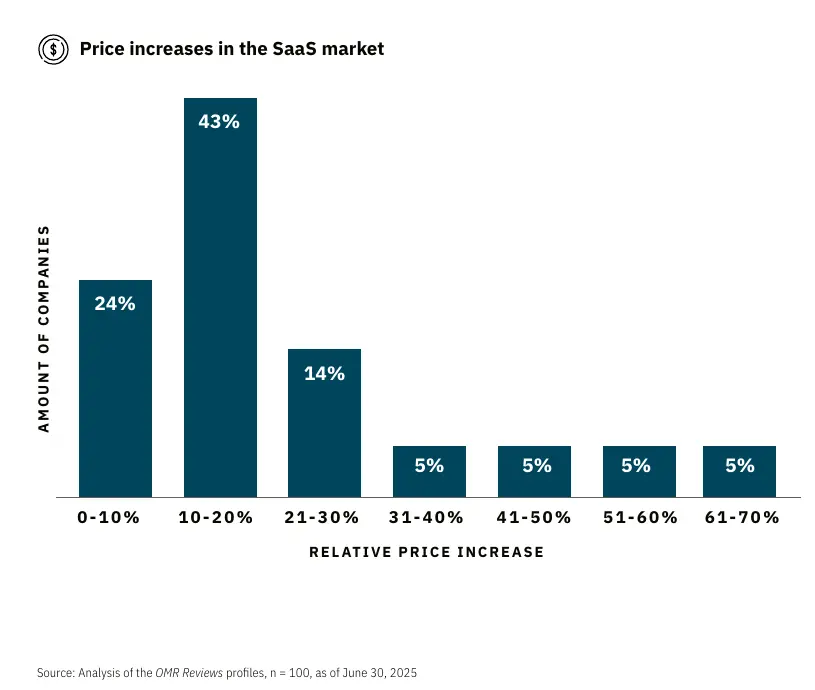
The market is moving in two directions. Vendors with three or four plans raised the price of their cheapest offer by 10% in the 12 months before the analysis. At the same time, 37% of the price changes analyzed were lower entry prices. Of those, 38% came from completely new packaging, 31% from a new starter plan and 13% from a changed pricing model. About 10% of the vendors analyzed introduced a free version in the same period.
A new starter plan is the cleaner solution if you want to reach a new, price-sensitive audience. Your existing entry plan stays the path to the middle, and the starter plan opens an extra door without shifting the price ladder above it.
Entry plan or introductory discount
Two things often get confused: a permanently cheap entry plan with a small scope, and a temporarily cheap price for the same product. The introductory discount carries its own risk. Lennart Schneider describes it for subscriptions: “So if you've paid just one euro for half a year and suddenly it jumps to €20 a month, that's obviously a moment where people might cancel.”
In B2B software, a permanently small scope is almost always the better choice. If you want people to try the product, do it with a free trial and leave the list price alone. What matters is which plan the customer lands on after the trial. Once customers get used to a plan, they often stay on it for a few years.
The entry price in AI search
Now that buyers compare software in chat, the entry price has a second job. It places you before anyone visits your site. I once described it like this: if you only work with anchor prices up front and don't have a smart entry price, “the AI says right away: Wow, poor value for money.” Once you drop out of the shortlist that early, you don't get back in. Our SaaS & AI Pricing Report 2027 expects vendors, even in enterprise sales, to publish entry prices and plan logic in machine-readable form.
What you can do on Monday
- Calculate the gap. Divide the middle-tier price by the entry price and subtract one. If the result is above 30%, check whether the middle is too expensive or the entry is too cheap.
- Work out the cost per user in the entry plan. Include all variable costs, especially AI requests.
- Look at how new customers are distributed. If too many land in the entry plan, it's cut too generously or the step to the middle is too big.
- Adjust scope, not price. What makes the middle tier indispensable for most customers? That's what doesn't belong in the smallest plan.
- Phase out introductory discounts. If you want to reach new audiences, consider a separate starter plan.
Price level is the sixth step in our eight-step approach. Packaging, billing model and pricing metric come before it. For the entry plan, that means cutting the scope first, then setting the price.
Bottom line: The entry plan is the first step to the middle
Your smallest plan can be cheap as long as it covers your variable costs and the gap to the middle is 15–30%. In the market, the median gap is 80%. If you're there, first check whether the entry is too cheap or the middle too expensive. Make the entry cheap through scope and keep the price close to the middle.
You'll get a first read in about a minute with the free pricing audit on pricing-friends.de. It reads your pricing page live and checks pricing model, packaging, price points and entry offer. The check follows the approach hy Consulting Group developed in more than 600 pricing projects.
Sources
- SaaS & AI Pricing Report 2027 by hy, pp. 12, 19, 83
- SaaS & AI Pricing Report 2026 by hy, pp. 31, 32, 34, 40, 41, 42, 45
- Itamar Simonson and Amos Tversky: Choice in Context: Tradeoff Contrast and Extremeness Aversion, Journal of Marketing Research 29 (3), 1992
- Anthropic: Claude model pricing, accessed October 17, 2026
- Pricing Friends, episode 77: Abos und Pricing mit Lennart Schneider: Was entscheidet über Abo-Treue: Preis, Timing oder Produkt?
- Pricing Friends, episode 82: Software Pricing 2025 mit Charlotte Pohlmann und Marvin Müller: Warum stellen 87 Prozent der SaaS-Anbieter ihr Preismodell um und was könnt ihr daraus lernen?
- Pricing Friends, episode 99: Sonderfolge: SaaS-Pricing, AI und die Zukunft der Preismodelle, Dr. Sebastian Voigt bei Julius Göllner
- Pricing Friends, episode 142: SaaS- und AI-Pricing mit Mariella Knospe und Felix Rahlmeyer: Wie bepreist man Software und AI im Jahr 2027?
Quotes are translated from German. The podcast episodes are in German.