
Packaging · 7 min read
Freemium or free trial: what fits B2B SaaS better

Key points
- For most B2B software tools, a 14-day free trial is the safe standard. Three out of four free trials on the German software review platform OMR Reviews last exactly that long.
- Freemium fits low-cost software that one person uses alone and whose value shows quickly. Keep AI tightly limited in freemium versions.
- A reverse trial gives new software users the large plan first, for a limited time. Because features go missing afterward, it has more upgrade potential than a standard free trial.
- Expensive, complex B2B software is better off starting with a demo or a pilot. Before you choose between freemium, a free trial and a demo, measure the days to first value.
If you sell B2B software and you're deciding how prospects should try it, a 14-day free trial or a reverse trial fits better than freemium in most cases. Freemium pays off mainly for low-cost tools that one person can use alone and whose value shows quickly. For complex or expensive software that needs setup first, a guided demo or a pilot is the better entry point.
What 100 vendors on OMR Reviews offer for trying their software
For the SaaS & AI Pricing Report 2026, we took a closer look at 100 software profiles on the German software review platform OMR Reviews. 44% offer no entry offer at all. 33% use a free trial, 12% freemium and 11% both, as of June 30, 2025. Reverse trials barely show up.
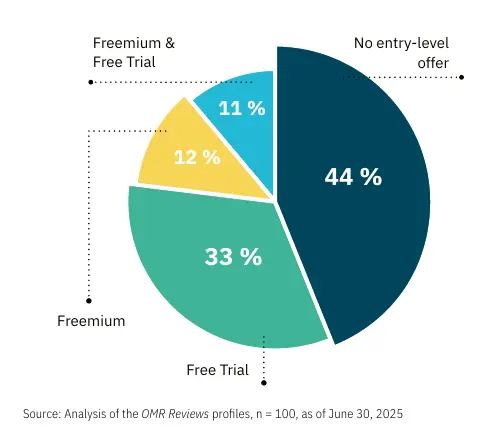
I think it's a shame that the largest group offers nothing to try. There are demos, but after that you have to buy. I understand the reasons for complex solutions, more on that below. For many standard products, though, vendors give away the moment when buyers experience the value themselves.
Four entry models compared
| Model | How it works | Fits when | Risk |
|---|---|---|---|
| Free trial | Full plan for 14 or 30 days, then pay or it ends | the value shows within two weeks | users don't reach the aha moment in time |
| Freemium | Permanently free, limited version | the product is low-cost and individuals use it alone | many users who never pay but still cause costs |
| Reverse trial | The large plan first for a limited time, then a fallback to a free or small version | you want to move customers into the middle or top tier | the limits of the free version are unclear |
| Demo or pilot | Guided demo or a pilot in the customer's environment | the product is expensive, complex or customer-specific | long sales cycles, high sales effort |
Descriptions based on the SaaS & AI Pricing Report 2026, pp. 49–53.
The decision in three questions
There's a decision tree for this choice that goes back to Productled.com. It asks how strong the product is compared with the market, how it's priced and how quickly customers experience the value. For a product that's functionally above the market standard, the result is:
| Price compared with the market | Time to first value | Entry model |
|---|---|---|
| expensive | short | Free trial |
| expensive | long | no free offer, demo |
| low-cost | short | Free trial and freemium |
| low-cost | long | Freemium |
A product that's functionally below the market standard gets by with a low price and freemium. According to the tree, it has no chance at a high price.
For AI products heavily tailored to each customer, a short free trial often isn't enough. Trust and reliability have to be demonstrated in real workflows. That's why AI-native vendors in particular rely on demos and pilots. Philipp Baumanns of telli describes how his product has to be trained at the customer's site. His team sorts out that effort in a pilot and doesn't offer free trials.
Why freemium rarely fits B2B
Most people know freemium from music streaming. I see it much less often in business software: “So, relatively rare here, and I'd say they tend to be more B2C-ish applications that you can also use on your own.” A project board that one person sets up for themselves works as a free version. HR software that only creates value with data from the whole company mostly doesn't.
Slack's 2019 IPO prospectus shows what the ratio looks like even for a well-known success story. At the end of January 2019, more than 88,000 organizations were paying, while more than 500,000 used the free version. Slack explicitly lists as a risk that it has to pay to run the free version, even though not all free users move to a paid plan.
AI adds a second argument. Traditional software scaled at almost no extra cost; with AI, every interaction costs real money. So free users are no longer free.
Worked example: Our SaaS & AI Pricing Report 2027 cites rough costs of about 0.2 cents per text response and about 2 cents per generated image. A tool has 2,000 free users. Each one asks the AI 50 questions a month and generates 20 images.
| Item | Volume per month | Cost per unit | Cost per month |
|---|---|---|---|
| Text responses | 100,000 | 0.2 cents | €200 |
| Images | 40,000 | 2 cents | €800 |
| Total | €1,000 |
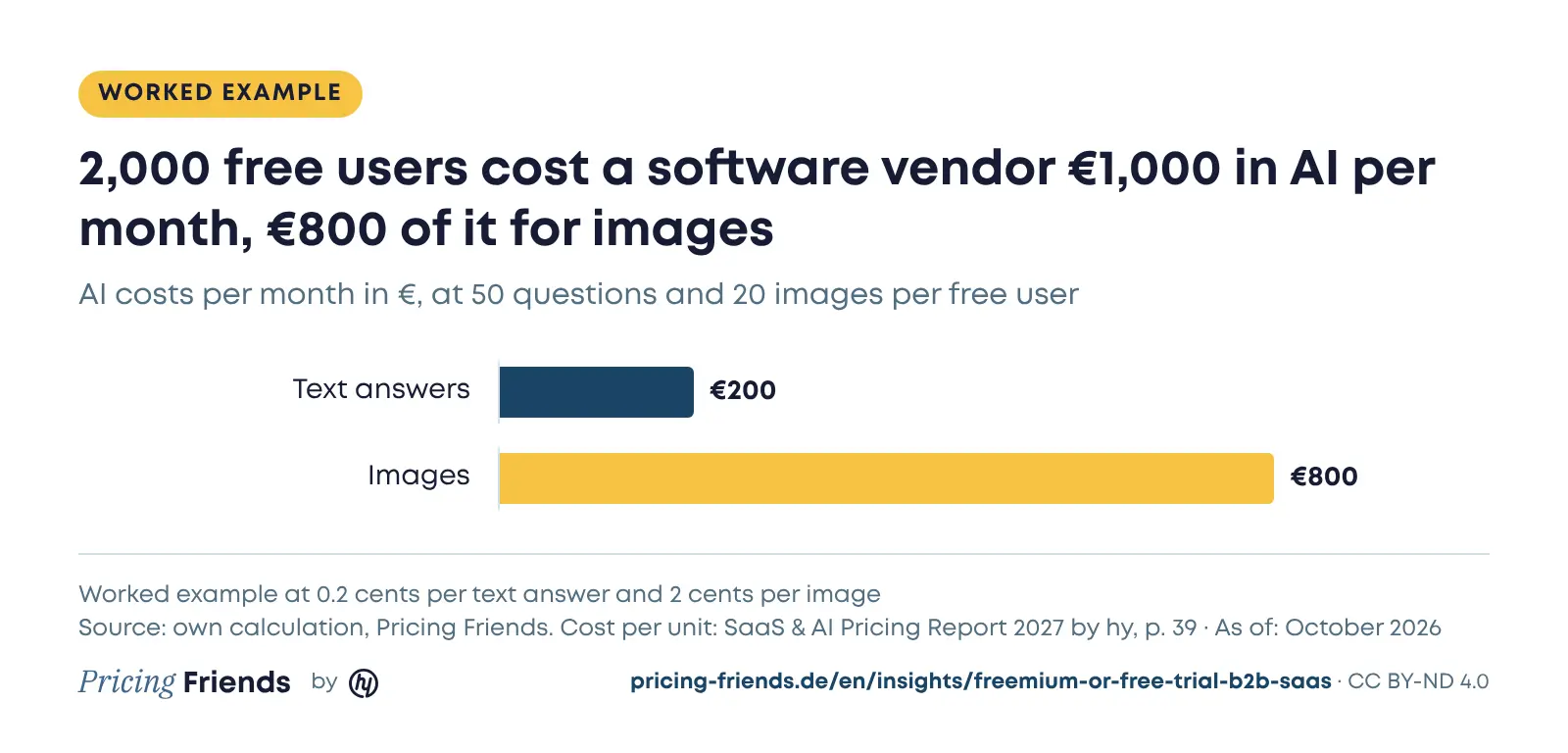
That's €12,000 a year for users who pay nothing. Whether that pays off depends on how many of them pay later. So if you offer freemium with AI features, keep the AI in the free version tightly limited, for example with a small allowance of credits.
Reverse trial: the large plan first
A reverse trial combines a free trial and freemium. New users start with full access to the premium plan and, when it ends, fall back to a permanently free, limited version. If you then lose features you've gotten used to, you feel the loss more strongly than you felt the gain before. I explained this principle with an ice cream in building good-better-best tiers.
The reverse trial has a second advantage. Once customers land in a tier, they often stay there for a few years. That's why I'd move customers to the larger tier during the free trial already, for example with the best tier at the price of the small one for a limited time. That beats “selling the small one on a 12-month contract at all costs and then never getting up into the middle one.”
There's hardly any solid data on this yet in the German-speaking market. In founder interviews last year, I had the impression that several of them wanted to run more reverse trials because they were seeing good conversion rates. I couldn't put a number on it back then. In episode 82, Marvin Müller of OMR Reviews talked about a deliberately small test in which customers on the smallest plan got all the data of the largest plan for 30 days: “Six of them took it up, and of those we actually upsold two.” Six customers is a small base, so test it with your own numbers.
How long the free trial should be
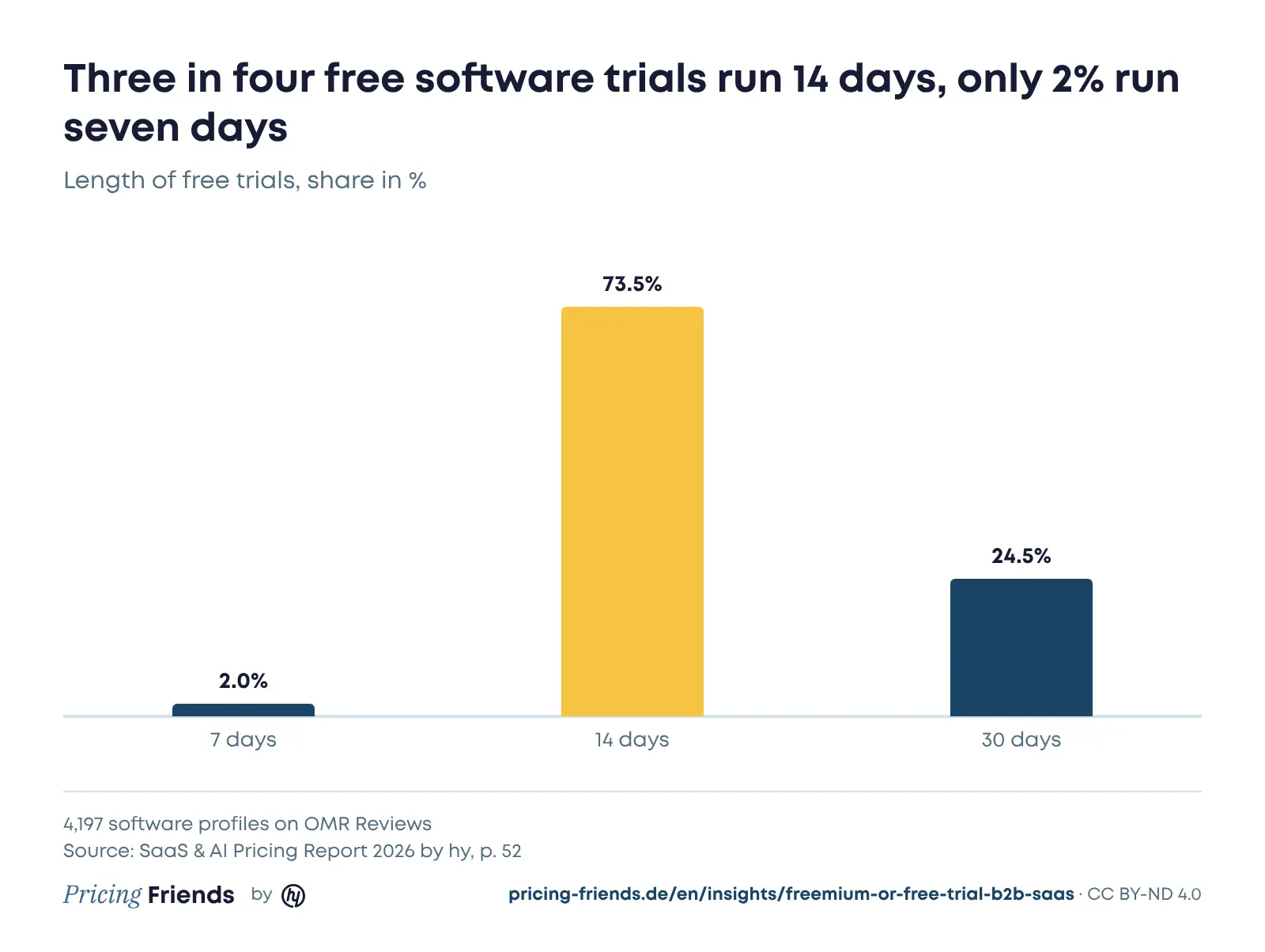
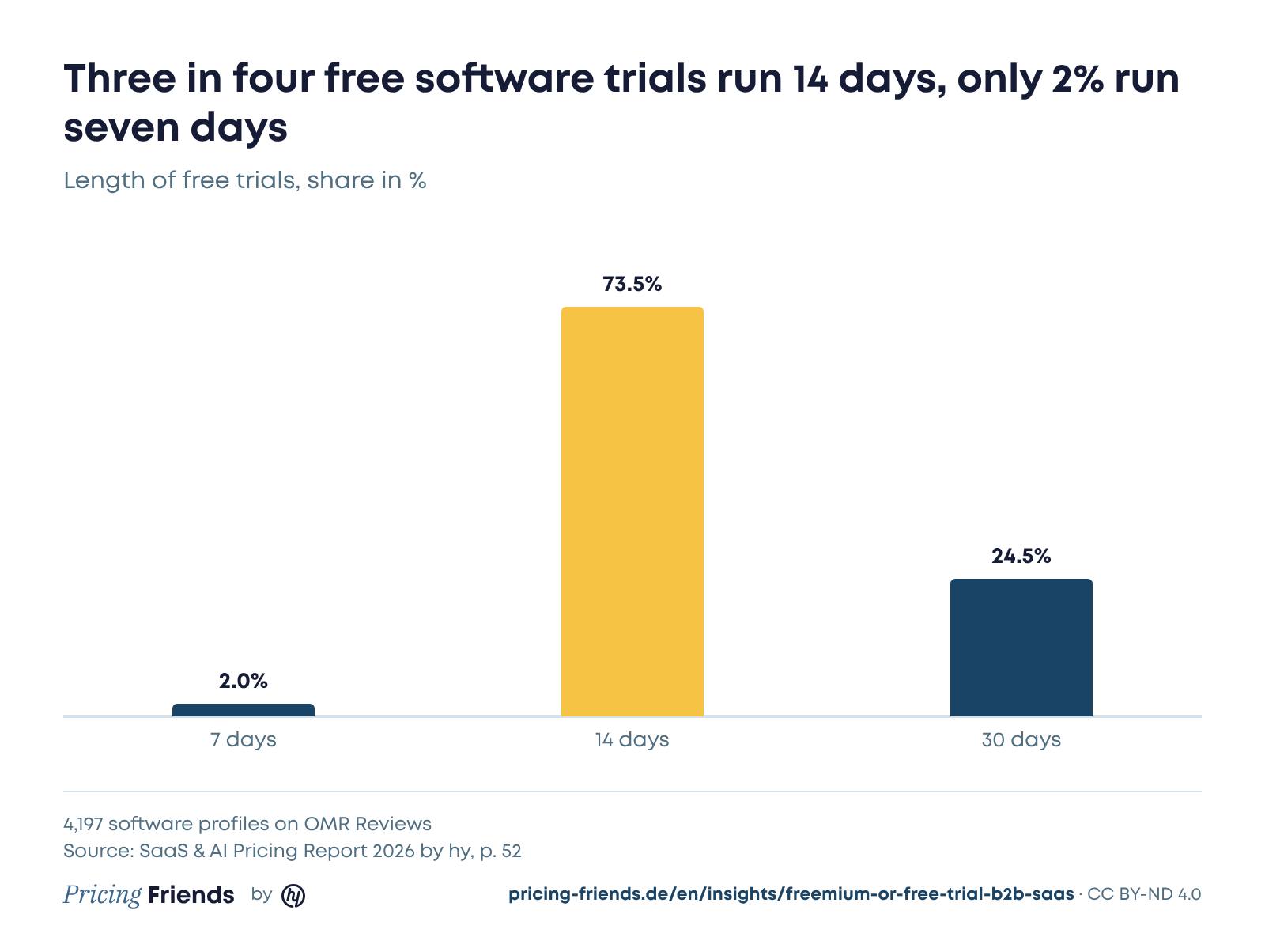
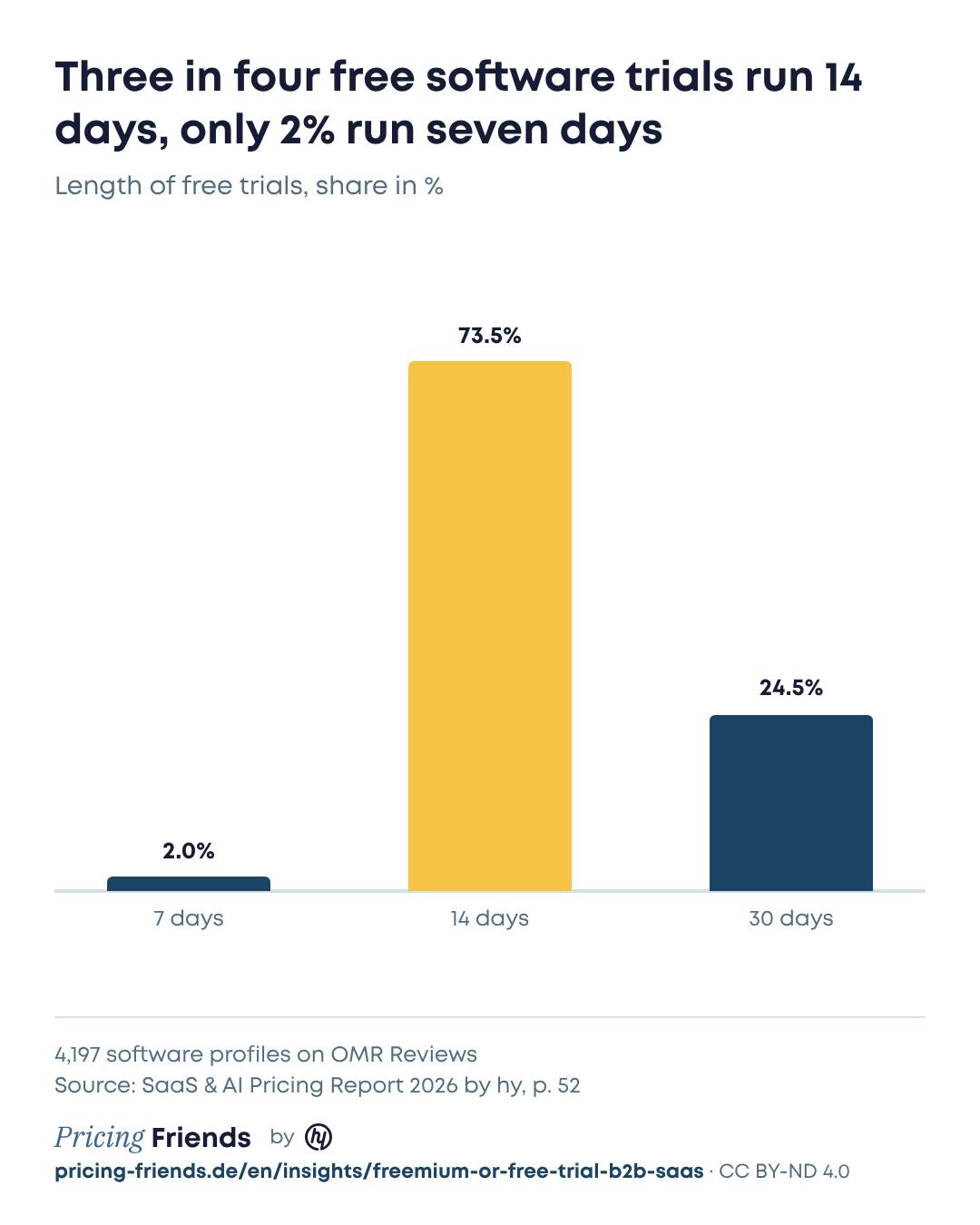
The market has settled on 14 days. Of the free trials on 4,197 profiles analyzed, 73.5% run 14 days, 24.5% 30 days and 2% seven days. A 30-day trial fits where setup is more involved or trust has to build first. Seven days are enough only for self-explanatory products. Tobias Hagenau of awork reports that his team tested different lengths. Seven days were too short to show the value; at 30 days, users put off the trial for too long. Today awork offers 14 days.
More important than the length is that users reach the moment within that time when the product solves their problem. If that doesn't happen, the chance of an upgrade drops sharply.
What you can do on Monday
- Measure time to first value. How many days does a new user need to use the core feature successfully once?
- Read your model off the table. Price compared with the market and time to value determine the entry model.
- Calculate the cost of free users. What does a free user cost per month, especially with AI features?
- Check which plan your free trial starts on. Are you testing the small or the large plan? You can try a reverse trial with the best tier on a share of new customers.
- Factor in the entry price. What happens after the free trial depends on the price of the smallest plan.
Bottom line: Free trial as the standard, freemium as the exception
For most B2B tools, a 14-day free trial is the safe standard, and a reverse trial is the variant with more upgrade potential. Freemium fits low-cost products that individuals use alone, and with AI features it gets more expensive than it used to be. For complex software, a guided demo or a pilot remains the right path, as long as you choose it deliberately.
The free pricing audit on pricing-friends.de shows you in about a minute what your pricing page offers new prospects today. It reads your pricing page live and checks your entry offer along with your pricing model, packaging and price points. It follows the approach hy Consulting Group developed in more than 600 pricing projects.
Sources
- SaaS & AI Pricing Report 2027 by hy, pp. 12, 39
- SaaS & AI Pricing Report 2026 by hy, pp. 49, 50, 51, 52, 53
- Slack Technologies: Registration Statement (Form S-1), April 26, 2019, SEC, figures on paying customers and the free version, risk factor on the free version
- Pricing Friends, episode 82: Software Pricing 2025 mit Charlotte Pohlmann und Marvin Müller
- Pricing Friends, episode 99: Sonderfolge: SaaS-Pricing, AI und die Zukunft der Preismodelle
Quotes are translated from German. The podcast episodes are in German.