
Packaging · 8 min read
Enterprise plan: what belongs in “on request” and how to price it

Key points
- A B2B software enterprise plan should hold what large customers need differently: volume, security, integrations, service and contract terms. Anything mid-sized customers also need stays in the list plans.
- The enterprise price of B2B software builds on the largest list plan, with fixed rules for volume tiers, contract term and price adjustments. Then “on request” isn't a matter of haggling.
- Enterprise services such as single sign-on need their own price. If you give them away, the price drops further with every deal.
- For a B2B software enterprise plan, sales first clarifies user count, current solution and budget, then names a price range. The first number mentioned becomes the anchor.
If you sell B2B software with fixed plans and also offer an enterprise plan “on request,” that plan should hold whatever differs from customer to customer: volume and contract term, security and data protection, integrations, service and contract terms. You build the price from your largest list plan. Volume discounts, contract term and price adjustments follow fixed rules. “On request” then means the total is set in conversation, but the logic behind it is fixed.
Why enterprise is almost always on request
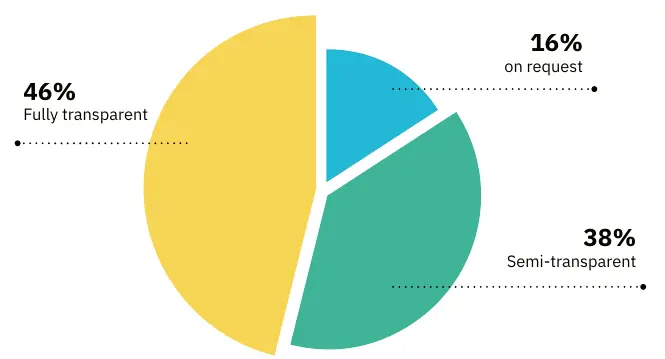
For our SaaS & AI Pricing Report 2026, we analyzed 4,197 software profiles on the German software review platform OMR Reviews. 46% show their prices in full, 38% partially and 16% only on request. Vendors that show only part of their pricing almost always hide the same thing. In episode 99, I put it this way: “And one thing is clear: The enterprise plans are basically always hidden.” The typical setup is fixed per-user prices for the smaller plans, with enterprise on request alongside them.
Marvin Müller of OMR Reviews has described where the line falls. Below an annual contract value of about €10,000, customers mostly buy on their own, and prices there are very transparent. From about €25,000, “price on request clearly dominates.” Above €100,000, in his view, there isn't a single example with a published price.
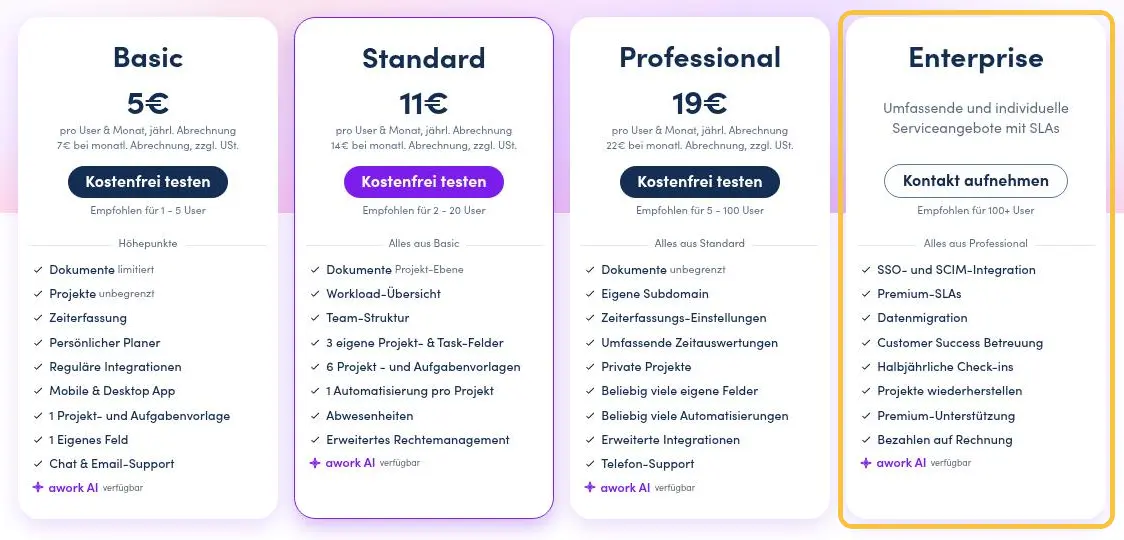
There are good reasons for this. With large customers, the price depends on volume, contract term and requirements nobody knows in advance. That doesn't apply to smaller customers. In the SMB segment, roughly anything up to 200 seats, I think clear plan pricing should be the standard. The enterprise plan is for the customers above that.
What belongs in the enterprise plan
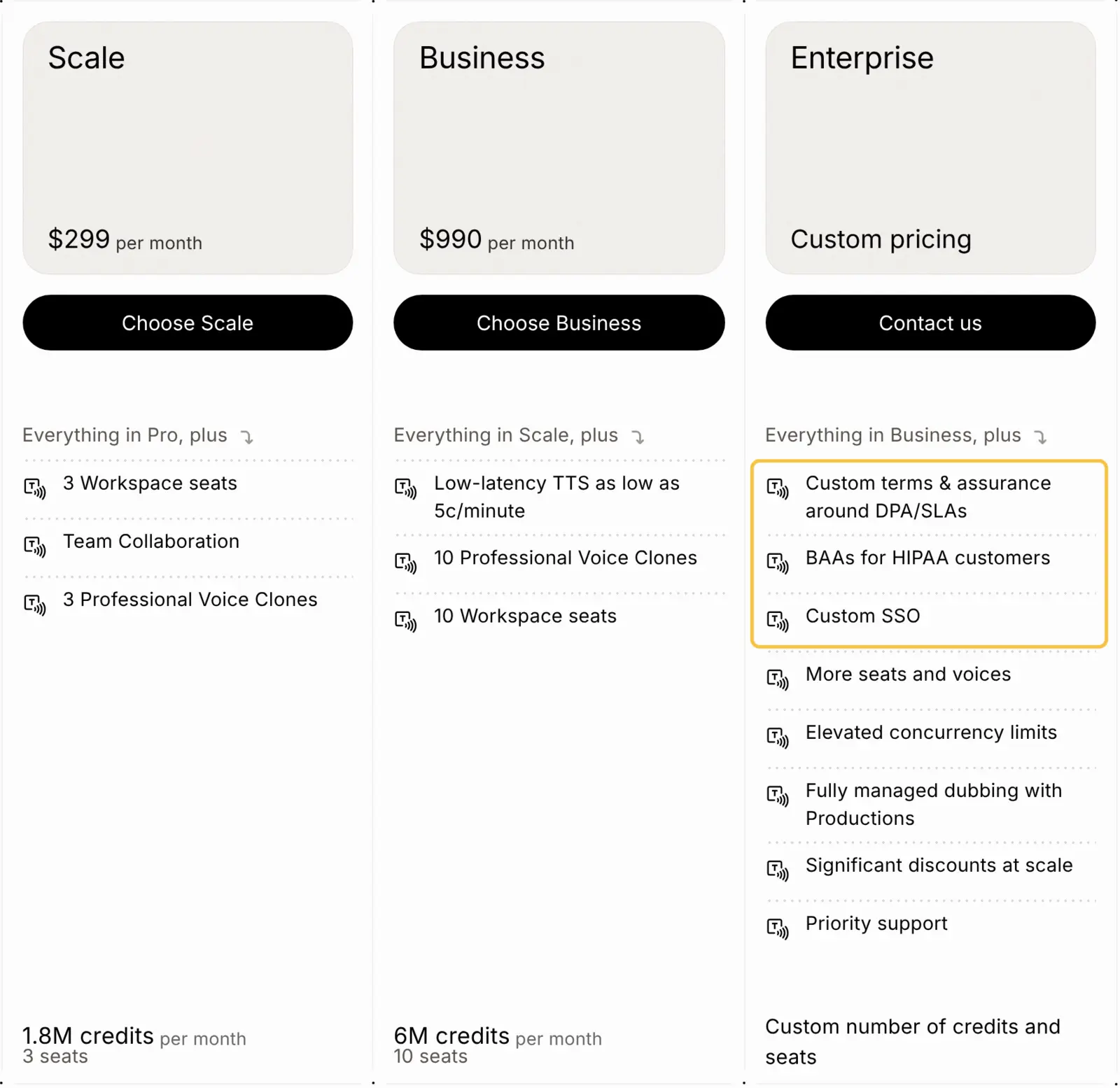
The enterprise plan collects what large customers need differently. More features than the best tier is rarely the reason. Yanek Brinkmann of ElevenLabs explained why his company has separate plans for large customers. These customers need extra work behind the scenes, “for example security, compliance, guardrails, GDPR compliance, the option to host in Europe and so on.” For that, the company invests in dedicated teams and customer success managers.
| Component | Why it differs by customer | Examples |
|---|---|---|
| Volume | User counts and usage vary widely | Tiered pricing, quotas, minimum commitment |
| Security and data protection | Procurement and IT review differently by industry | Single sign-on, roles and permissions, audit logs, data processing agreement, EU hosting |
| Integrations | System setups differ | ERP or CRM connection, API limits, custom interfaces |
| Service | Expectations on availability differ | Service level agreement, dedicated contact, training |
| Onboarding | Effort depends on the customer | Implementation, data migration, project support |
| Contract | Procurement negotiates term and conditions | Multi-year contract, payment terms, price adjustment rule |
Our own compilation, examples from episode 120 and the SaaS & AI Pricing Report 2027, pp. 40 and 59.
What doesn't belong: features mid-sized customers also need. If they move into the enterprise plan, your largest list plan loses its value as an anchor. Mid-sized customers then end up talking to sales even though they'd rather have bought on their own. Features with high value for a small group are more likely to belong in a separate add-on.
How the enterprise price comes together
The starting point is the largest plan with a list price. A volume discount and a price for the enterprise services are applied to it. A term discount and a one-time onboarding fee are added. Our SaaS & AI Pricing Report 2027 describes components from usage-based and outcome-based models that also suit enterprise contracts: a committed volume at a discount with pricier units above it, a minimum commitment instead of a base fee or a cost cap for the customer, prepayment with up to 20% off, and a capped price increase at renewal.
Snowflake shows what a minimum commitment looks like at scale. According to its annual report, customers mostly sign capacity contracts with terms of one to four years, or pay monthly for usage without a commitment. For most customers, consumption rises over the term and often exceeds the committed amount. They then buy more capacity or renew early.
Worked example: A customer wants 400 users. The largest list plan costs €39 per user per month.
| Component | Rule | Amount per year |
|---|---|---|
| List price | 400 × €39 × 12 | €187,200 |
| Volume tiers | 1 to 100 users €39, 101 to 300 users €33, 301+ users €29 | €160,800 |
| Enterprise services | Platform fee for single sign-on, SLA, dedicated contact | €12,000 |
| Subtotal | €172,800 | |
| Term discount | 5% for a three-year term | €164,160 |
| Onboarding | One-time, not discountable | €15,000 in the first year |
| Price adjustment | At most 5% per year from year two | In the contract |
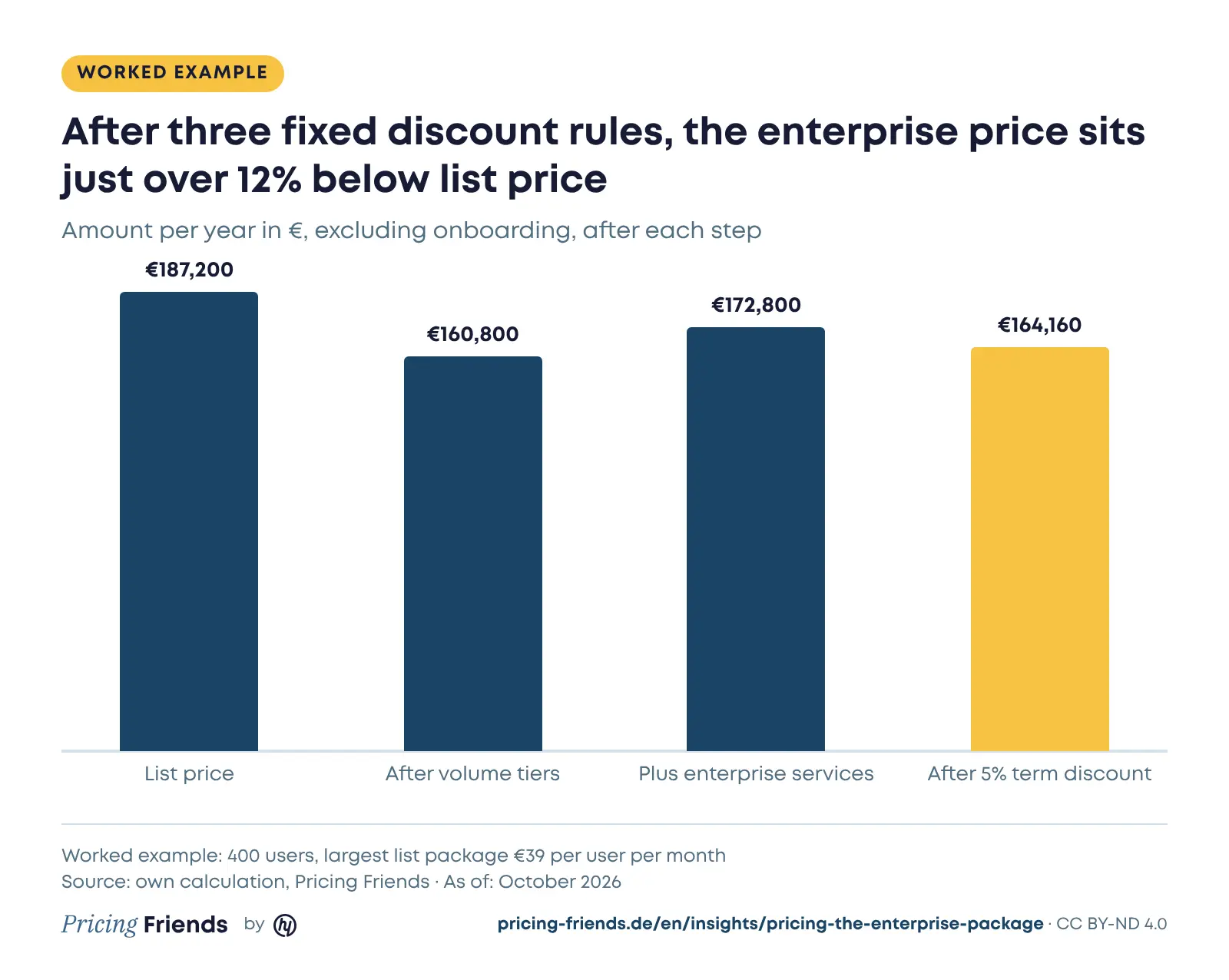
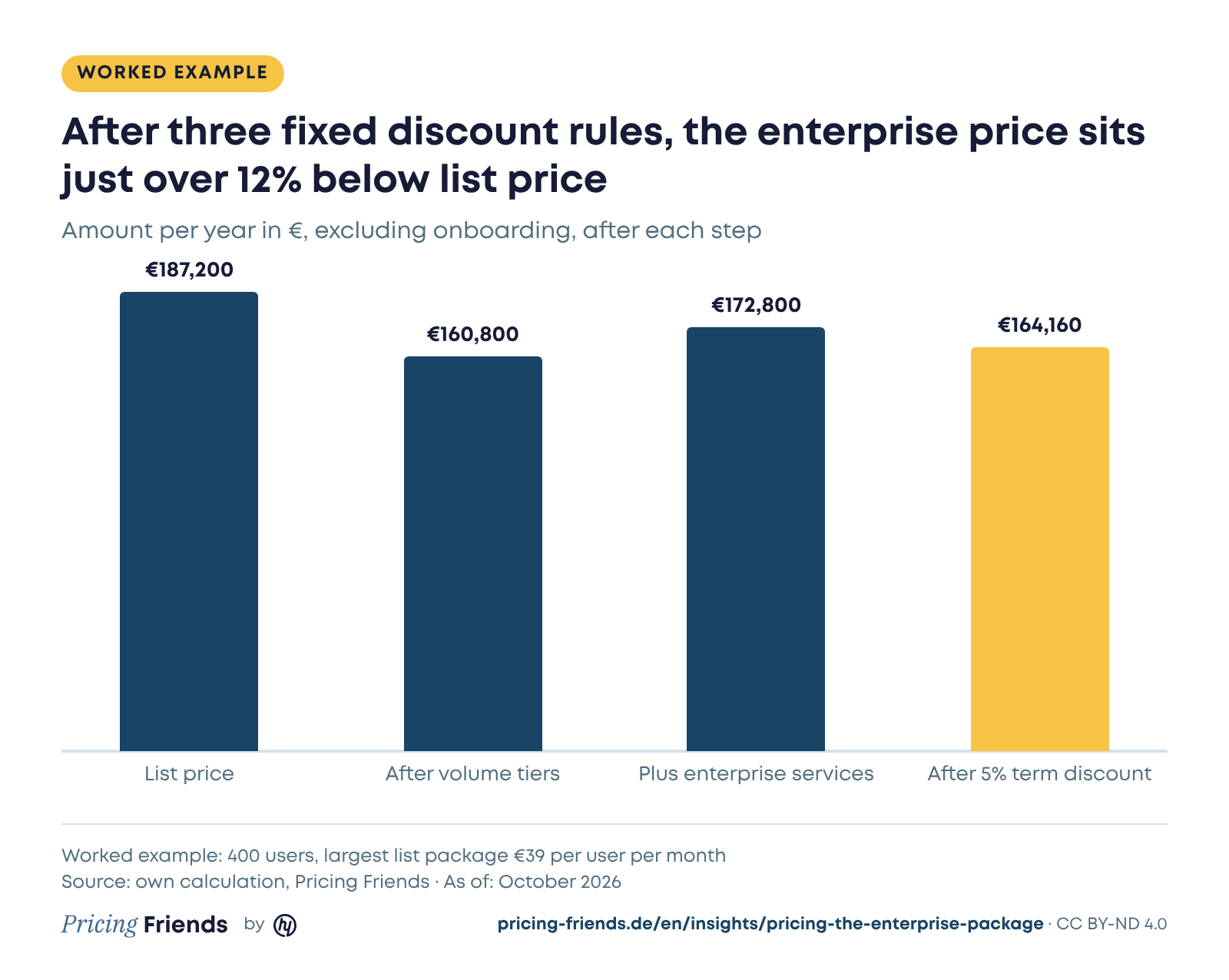
Excluding onboarding, the customer ends up paying €34.20 per user per month, just over 12% below list. Each step follows a rule your sales team knows and that applies to every customer. That's the difference between “on request” and “up for negotiation.”
Two limits belong firmly in the rules. The enterprise price per user may fall below the list price, but only as far as the tiers allow. And the services only enterprise customers get carry their own price. If you give them away, the price drops a little further with every deal, and the gap to the list plan becomes random.
Name the price in the first conversation
In the first conversation, sales often has no basis for a number yet. Still, the first amount mentioned sets everything that follows. I described it in the same episode: “And if it's completely custom, I don't want to misjudge it, because I can't get away from that anchor anymore.” Start too high and you're out of the running. Start too low and you can't get back up.
So I'd ask the usual two or three questions first: How many users? What solution do you use today? Is there a budget? Then sales names a range instead of an exact figure. No decision gets made in the first conversation anyway; the goal is to stay in the race. With the calculation above in mind, you can justify that range.
What still belongs on the pricing page
Even with “on request,” your pricing page can say a lot. Describe what's in the enterprise plan and state what the price depends on: users, volume, contract term, onboarding. We expect enterprise SaaS to publish prices, pricing metrics, entry prices and packaging logic in machine-readable form, too. That also counts in AI search, because if you don't name a price, you let others name it for you.
What you can do on Monday
- Check the contents. Does the enterprise plan include anything mid-sized customers also need? Then it belongs in the largest list plan.
- Set the tiers. Volume discounts by user count or volume, in writing and the same for everyone.
- Price the enterprise services. Security, service and integrations as a separate component.
- Settle the contract rules. Term discount, minimum commitment and a cap on price increases at renewal.
- Define approvals. Who may deviate from the tiers, and by how much? Sales needs clear approval levels for that.
In our approach, points two through five belong to price differentiation and price enforcement, steps seven and eight of eight. They decide whether the pricing logic actually reaches sales.
Bottom line: On request means with rules
The enterprise plan should hold what large customers need differently: volume, security, integrations, service and contract terms. The price comes from the largest list plan and fixed rules for tiers, services, contract term and price adjustments. Every enterprise deal stays custom, yet every price falls within a frame you can defend.
The free pricing audit on pricing-friends.de shows you in about a minute how your pricing page presents the enterprise plan today. It reads your pricing page live, checks pricing model, packaging, price points and entry offer, and gives a score from 0 to 100 with findings. The check follows the approach hy Consulting Group developed in more than 600 pricing projects.
Check your pricing page for free.
Sources
- SaaS & AI Pricing Report 2027 by hy, pp. 40, 49, 51, 59, 83
- SaaS & AI Pricing Report 2026 by hy, p. 43
- Pricing Friends, episode 82: Software Pricing 2025 mit Charlotte Pohlmann und Marvin Müller: Warum stellen 87 Prozent der SaaS-Anbieter ihr Preismodell um und was könnt ihr daraus lernen?
- Pricing Friends, episode 99: Sonderfolge: SaaS-Pricing, AI und die Zukunft der Preismodelle, Dr. Sebastian Voigt bei Julius Göllner
- Pricing Friends, episode 120: Voice AI und Pricing mit Yanek Brinkmann: Wer tippt denn noch auf einer Tastatur?
- Pricing Friends, episode 142: SaaS- und AI-Pricing mit Mariella Knospe und Felix Rahlmeyer: Wie bepreist man Software und AI im Jahr 2027?
- Snowflake Inc.: Annual report (Form 10-K) for the fiscal year ended January 31, 2026
Quotes are translated from German. The podcast episodes are in German.