
Packaging · 7 min read
How big should your SaaS annual discount be?
hy pricing teamReviewed by experts at hy
- Published
- Updated
Key points
- For subscription software, 10:1 is a good starting point for the annual discount: the annual price equals ten monthly prices, about a 17% discount.
- An annual discount above 10:1 only pays off if monthly customers cancel quickly. The annual price should contain as many monthly payments as monthly customers stay on average.
- In B2B software, the annual contract is often the standard. Instead of an annual discount, vendors then offer monthly payment as an option with a surcharge.
- An annual discount locks in the price for the customer for the contract term. How much the price may rise at renewal belongs in the contract as a rule.
If you sell subscription software and offer annual payment next to the monthly price, an annual discount of about 17% is a good starting point: the annual price equals ten monthly payments, so two months are free. Going above 20% only pays off if your monthly customers cancel quickly and the annual contract keeps them much longer. In B2B software, the question is often the other way around, because the annual contract is the default there anyway.
The 10:1 rule of thumb and what it costs
The rule we see most often is 10:1. An annual subscription costs roughly ten times the monthly price. That's a discount of 16.7%. Other examples sit close by. Lennart Schneider, who runs the podcast Subscribe Now, suggests moving monthly customers to an annual plan after one or two months with 20% savings. The SaaS & AI Pricing Report 2027 lists an AI sales agent at $3,750 per month or $36,000 on an annual plan. Twelve monthly payments would be $45,000, so the discount is 20%.
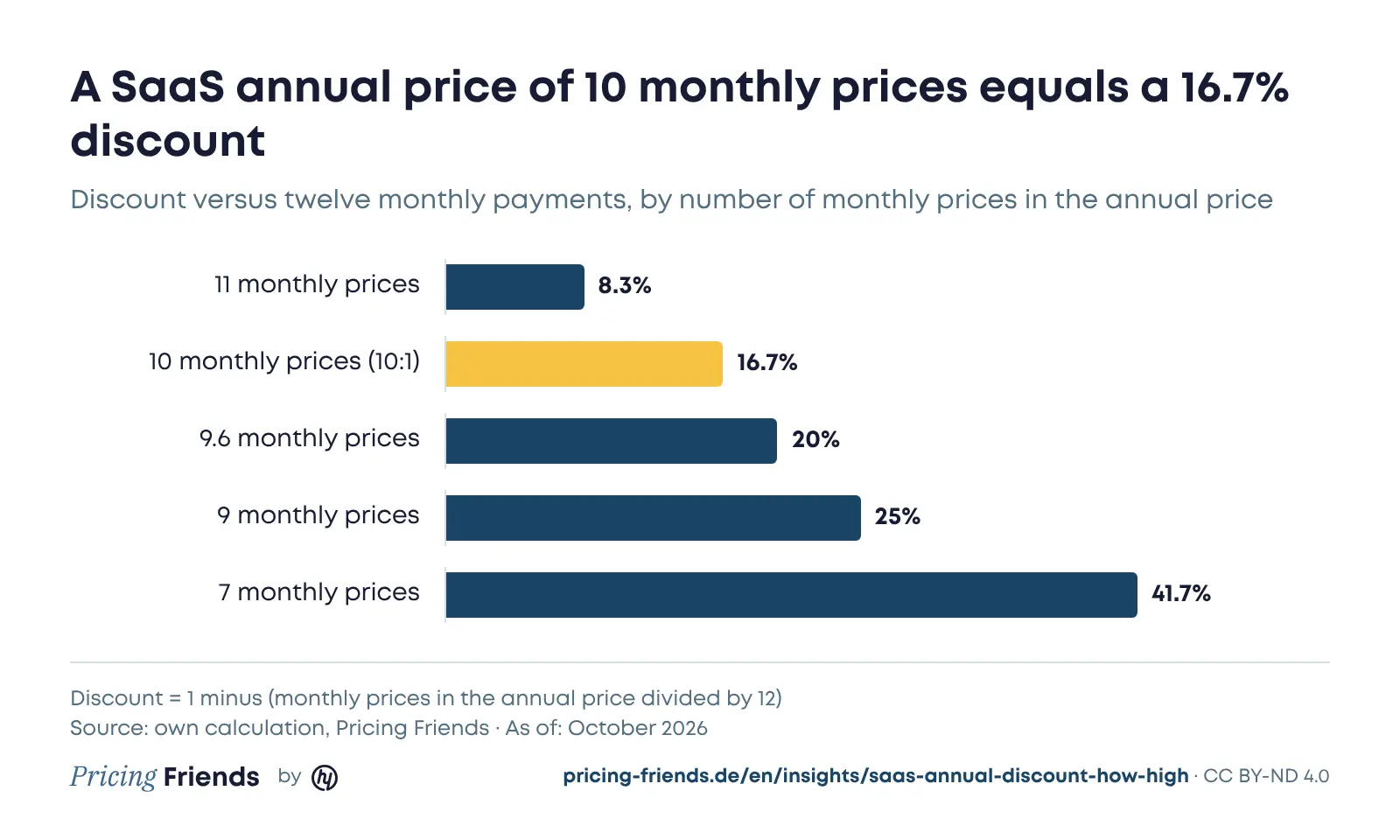
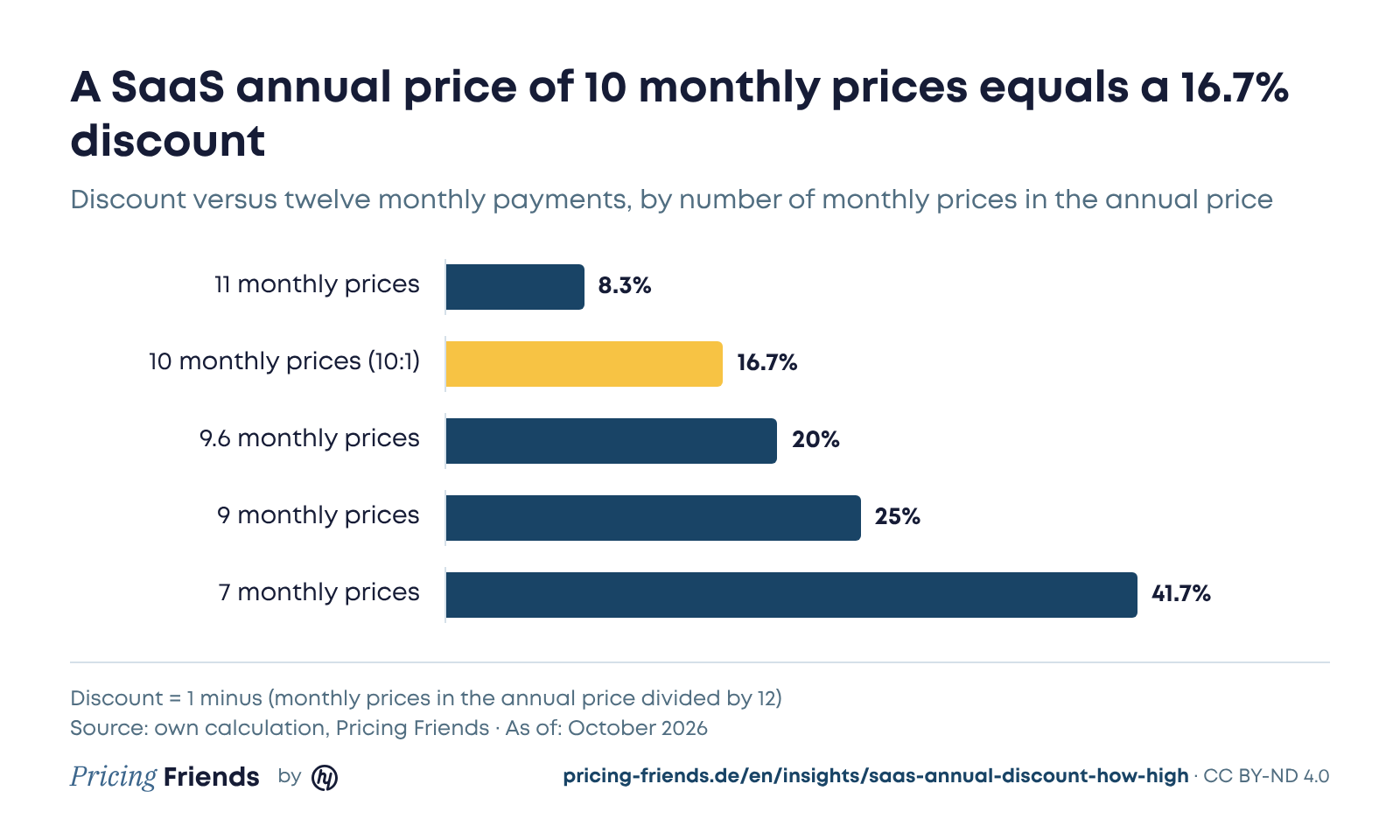
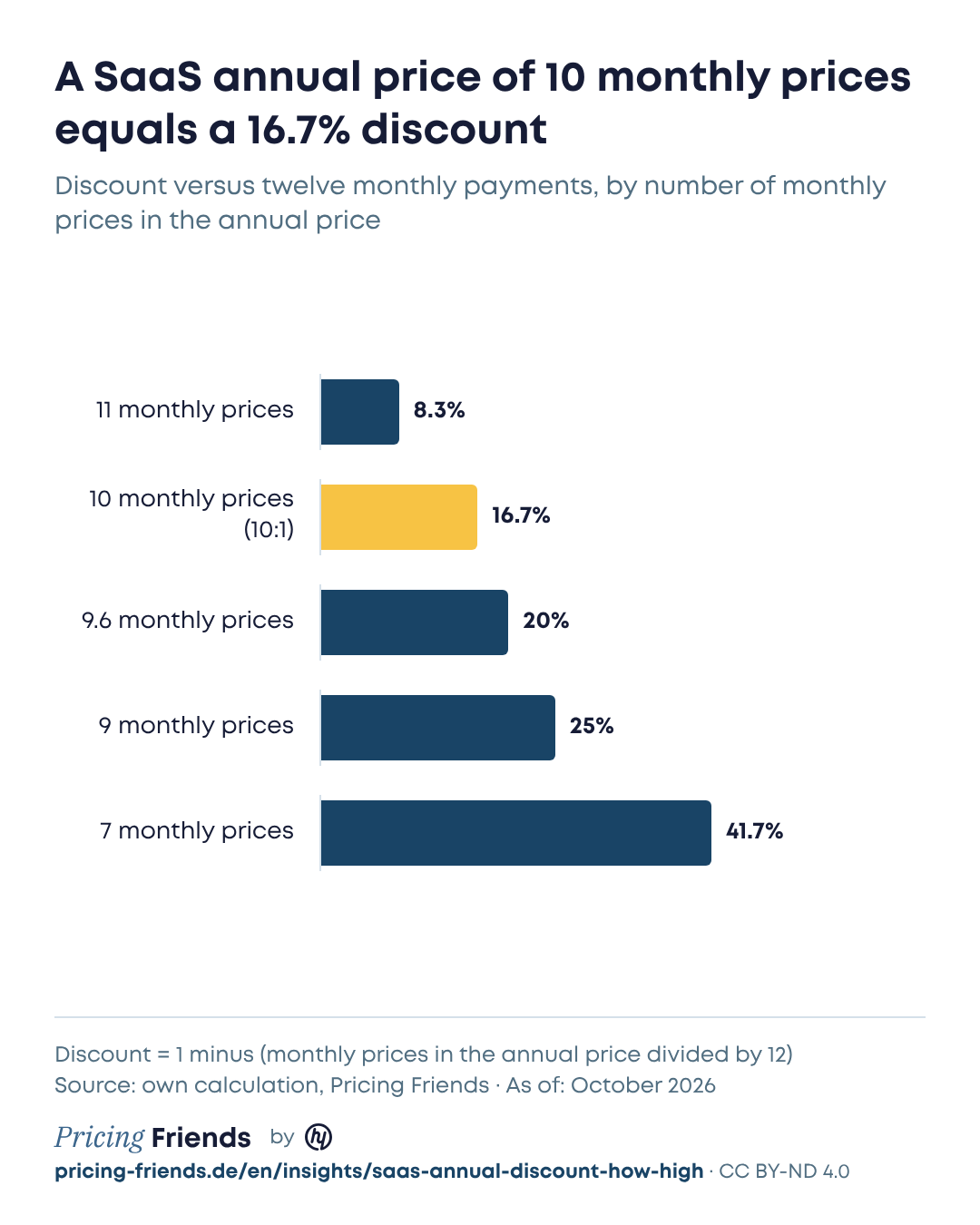
Here's how the annual price translates into a discount:
| Annual price equals | Discount | How the buyer reads it |
|---|---|---|
| 11 monthly prices | 8.3% | one month free |
| 10 monthly prices | 16.7% | two months free |
| 9.6 monthly prices | 20% | save 20% |
| 9 monthly prices | 25% | three months free |
| 7 monthly prices | 41.7% | five months free |
Our calculation: discount = 1 minus (monthly prices in the annual price divided by 12).
What the discount buys you
An annual discount buys three things: retention, predictability and cash in the bank.
- Retention. Lennart Schneider sees large differences in retention rates between annual and monthly subscriptions. A customer who has paid for twelve months can't cancel before renewal.
- Predictability. Prepaid volumes secure revenue and cash flow, and the risk of unused volume tends to sit with the customer. That's why one vendor also bundles its usage-based AI credits into fixed annual plans with monthly or annual allowances.
- Liquidity. The software companies we work with mostly have roughly €5–50 million in revenue. For them, money up front is a stronger incentive than for a large corporation, where cash flow and prepayments shouldn't be what drives the decision. Under German accounting rules (§ 250 (2) HGB), the part of the prepayment that falls after the balance sheet date goes into deferred income in the annual financial statements. So the cash is in your account right away, while the revenue is spread over the term.
The more of these three things you actually need, the more the discount can cost. A profitable company with low churn needs little of them and can make do with a small discount.
Worked example: how much discount pays off
In episode 77, Lennart Schneider described a simple test: “There’s a kind of rule of thumb where you look at how long people stay on average.” If most monthly customers stay only five months, a heavily discounted annual plan priced at seven or eight monthly payments can still increase customer lifetime value.
Worked example: A tool costs €49 per month. We compare first-year revenue.
| Avg. tenure of monthly customers | Monthly customer revenue in year 1 | Annual customer at 10:1 (€490) | Annual customer at 25% discount (€441) |
|---|---|---|---|
| 6 months | €294 | €490 | €441 |
| 10 months | €490 | €490 | €441 |
| 18 months | €588 | €490 | €441 |
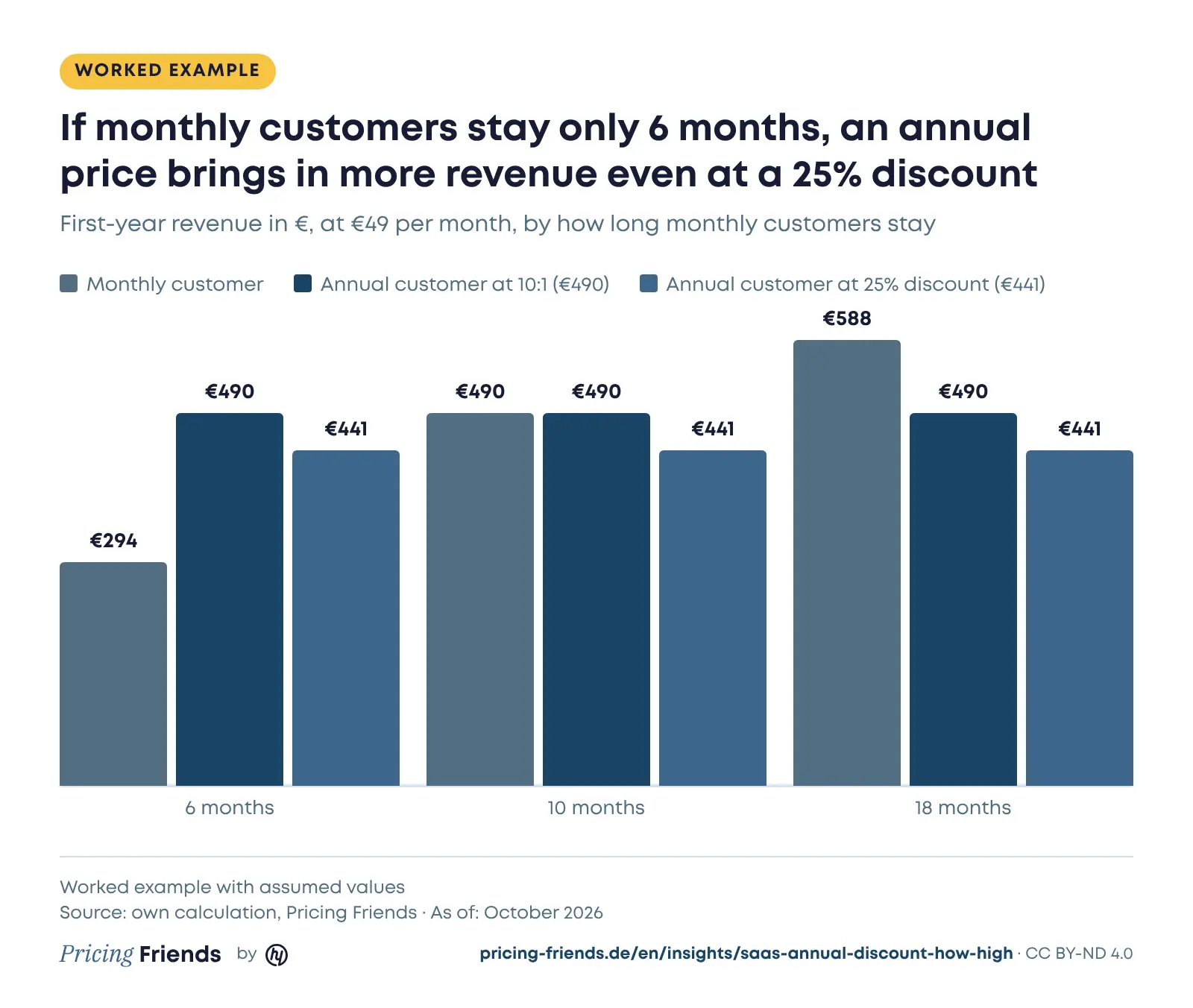
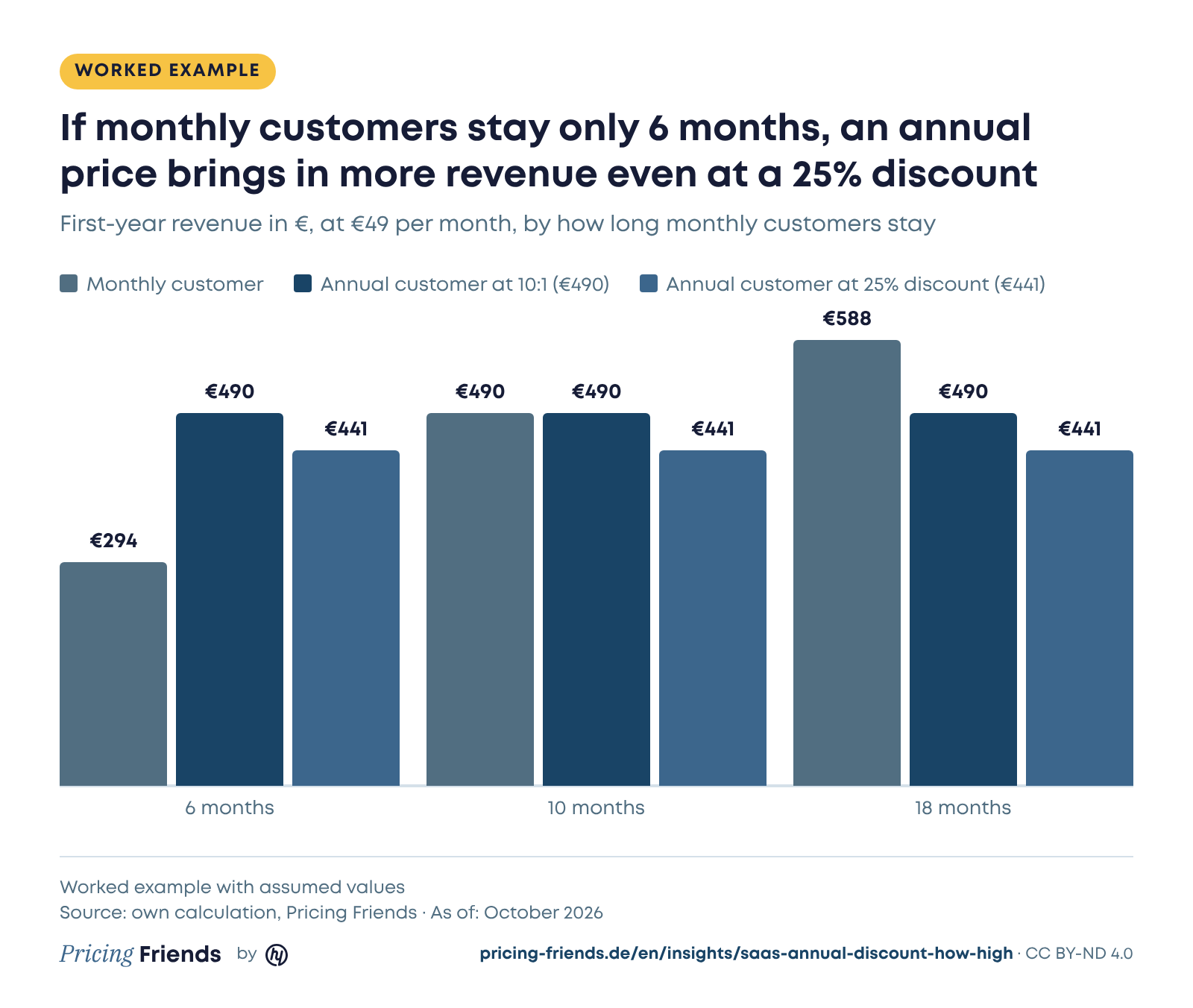
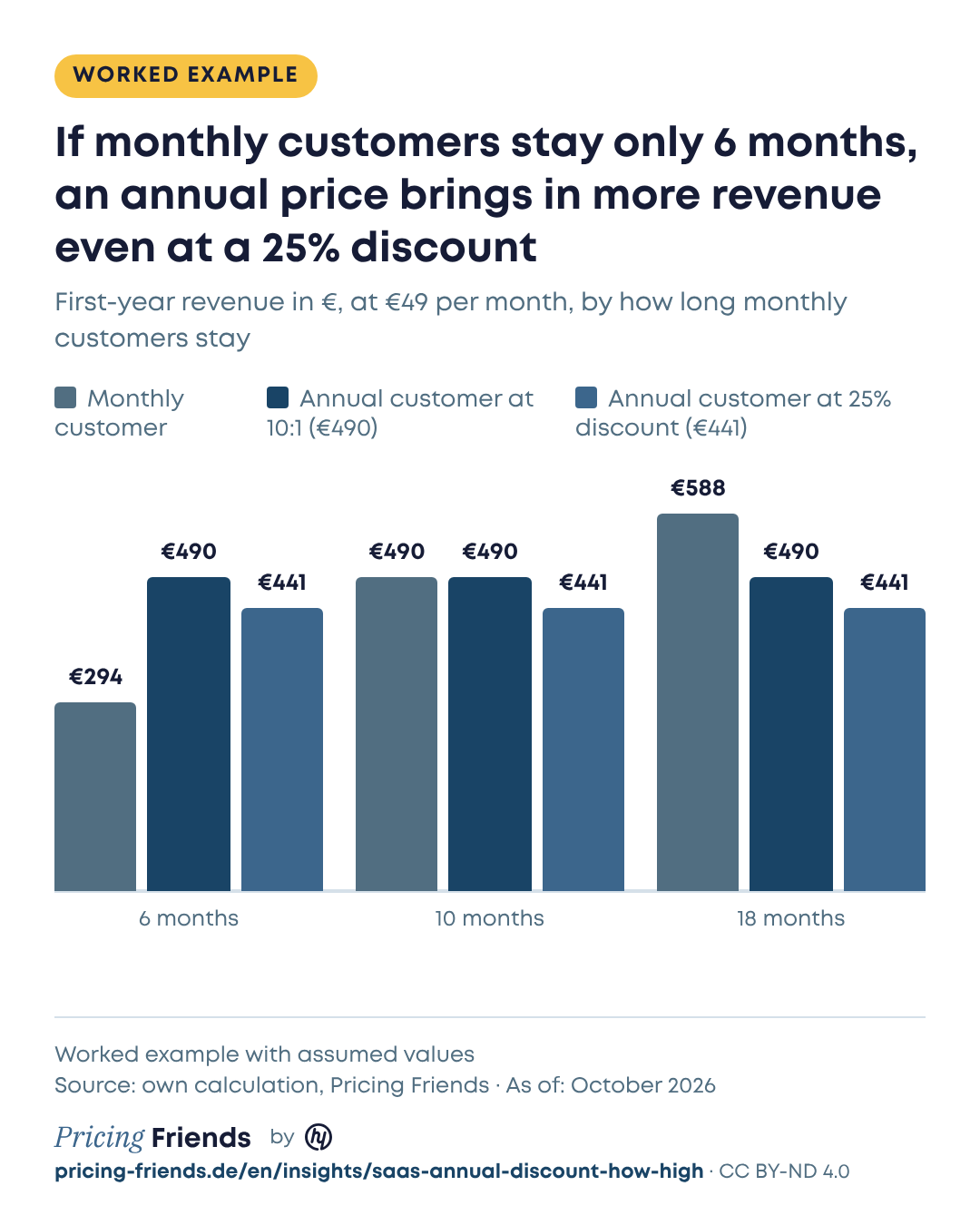
At six months of tenure, even the high discount brings in more than the monthly plan. At 18 months, every customer who switches to the annual plan costs you €98 (at 10:1) or €147 (at 25%) in the first year. You only win that back if annual customers churn less later on.
That leads to a simple rule: the annual price should contain at least as many monthly payments as your monthly customers stay on average, capped at twelve. If they stay longer than a year, the discount is purely a premium for retention and liquidity. In that case, we see 10:1 as the upper limit. In the same episode, Lennart Schneider warns against the opposite: “As so often with discounts, I’d say you shouldn’t overdo it.” If you permanently give away five months, you get customers used to a price that doesn't really exist.
In B2B, the annual contract is often the default
For business software, the starting point is often different. Jenny Podewils, co-CEO of Leapsome, described her model in episode 124 like this: “Per month is maybe a bit misleading, because our contracts are usually billed annually.” Nikolai Skatchkov of Circula says about his company in episode 113: “we really only have annual contracts.” For large amounts, multi-year contracts are common too, and payment is usually annual and up front.
If that's true for you as well, the question flips. You show a price per user per month, bill annually and offer monthly payment as the exception, with a surcharge. The math is the same, the message is different. An example from another industry shows this well: the sports streaming service Dyn sells its annual subscription for €12.50 per month and the monthly-cancellable subscription for €14.50. That's a 13.8% discount on the monthly plan or a 16% surcharge on the annual plan, depending on where you start.
In large deals, the term discount becomes part of the negotiation. Then it belongs in your discount rules, so it isn't granted on top of every other concession. One detail from the AI sales agent example above matters here: the price increase at renewal is capped. So the discount locks in the price for the customer for the term, and the contract states how much the price may rise afterward. Write this rule into your contracts the same way, or every renewal turns into a new negotiation over your existing customers' prices.
Showing the discount on your pricing page
Show both options for the same period. Someone who sees €49 a month next to €490 a year has to do the math first. Also pick the annual price so the monthly equivalent comes out even. At 10:1 and €49, the monthly equivalent is €40.83. An annual price of €468, by contrast, gives an even €39 a month and equals a 20.4% discount. Of the prices above €30 we analyzed on the German software review platform OMR Reviews for the SaaS & AI Pricing Report 2026, 54% end in 9; below €30, whole euro amounts dominate.
The savings also need a round number: “Two months free” or “Save 17%” reads better than “16.7%.”
What you can do on Monday
- Measure tenure. Pull from billing how long monthly customers stay on average and how often annual customers renew.
- Set the annual price accordingly. Start at 10:1. Only go lower if your monthly customers stay well under ten months on average.
- Check the presentation. Both prices for the same period, an even monthly equivalent, round savings.
- Check the contract. The discount applies for the term, and the rule for price adjustments at renewal is in the contract.
- Look at discounts together. Where sales negotiates, the term discount counts toward the total discount.
Bottom line: Two months free, more only for a good reason
With 10:1, about a 17% discount, you're close to the examples above, which range from just under 14% to 20%. Whether more makes sense depends on how long your monthly customers stay, and you know that from your own billing data. In B2B, it often pays to make the annual contract the standard and offer monthly payment as an option with a surcharge.
The free pricing audit on pricing-friends.de shows you in about a minute how your pricing page presents annual and monthly prices today. It reads your pricing page live, checks pricing model, packaging and price points, and gives a score from 0 to 100 with findings. The check follows the approach hy Consulting Group developed in more than 600 pricing projects.
Sources
- SaaS & AI Pricing Report 2027 by hy, pp. 40, 43, 49
- SaaS & AI Pricing Report 2026 by hy, p. 45
- German Commercial Code (Handelsgesetzbuch), § 250 Rechnungsabgrenzungsposten (deferred items)
- Pricing Friends, episode 48: Sportstreaming und Pricing mit Marcel Wontorra: Wie verschafft Dyn Handball, Basketball & Co. mehr Aufmerksamkeit?
- Pricing Friends, episode 77: Abos und Pricing mit Lennart Schneider: Was entscheidet über Abo-Treue: Preis, Timing oder Produkt?
- Pricing Friends, episode 97: Technologie und Pricing mit Alexander van der Steeg
- Pricing Friends, episode 113: Spend Management-Software und Pricing mit Nikolai Skatchkov: Wie skaliert man profitabel in einem Markt, der noch kaum digitalisiert ist?
- Pricing Friends, episode 124: HRtech und Pricing mit Jenny Podewils: Warum KI bei Leapsome kein eigenes Preisschild bekommt
Quotes are translated from German. The podcast episodes are in German.