
Private equity · 6 min read
Pricing in the value creation plan of a SaaS investment

Key points
- Pricing belongs in the value creation plan of a SaaS investment before signing. After closing, the investment team refines the pricing hypothesis with management.
- New software pricing models take two to four years to take hold. So they belong in the first year of the holding period in the value creation plan.
- A value creation plan for SaaS puts the pricing levers in order: first price adjustments for existing customers, then packaging and pricing model, then migrating existing customers.
- Every pricing initiative in the value creation plan needs one owner in management and one on the shareholder side. Without the founders and sales, it fails in execution.
Pricing belongs in the value creation plan (VCP) of a SaaS investment as soon as due diligence produces a pricing hypothesis, which means before signing. The plan lists it with a sequence, owners and metrics: first the quick adjustments for existing customers, then packaging and pricing model, then migrating existing customers. This article is for investment teams, operating partners and managing directors of a portfolio company who build the plan together.
The plan starts before signing
Dr. Stephan Schmid, partner at BU Bregal Unternehmerkapital, has described how this works at his firm. Pricing is already reviewed in due diligence. The value creation plan starts before the purchase agreement is signed, broken down into individual initiatives and measures. After closing, the investment team refines it with management over the first weeks and months. Every plan needs a timeline, and “every measure needs ownership,” both in management and on the shareholder side.
The reason to start early is time. Felicitas May, investment director and head of value creation at Beyond Capital Partners, does the math: New revenue models usually take two to four years until customers have fully adopted them. The average holding period is three to five years. If you only tackle the pricing model in year two, you show a half-finished transition at exit.
A few levers, clearly ranked
A VCP with 30 initiatives rarely delivers 30. Schmid thinks it's better “to identify three, four, five good levers and actually implement them,” ranked by impact, timeline and execution risk. Daniel Geiger, operating partner at Rivean Capital, said the same about AI projects: three to five concrete use cases beat a playbook with 30 measures.
In software companies, pricing often makes those three to five, because it rarely needs investment and hits the bottom line fast. You can put a number on the EBITDA in it for each investment upfront.
The five phases at a glance
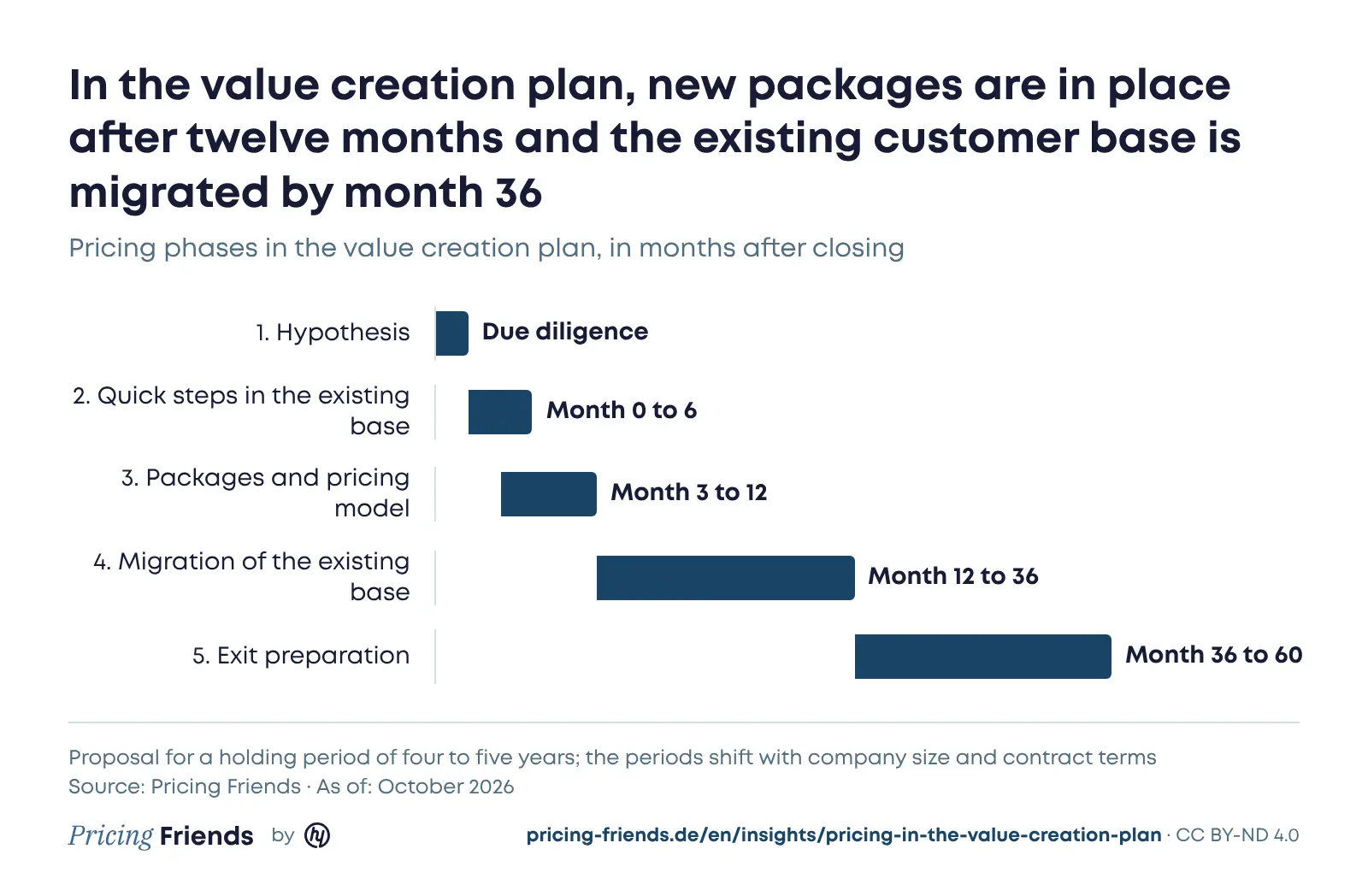
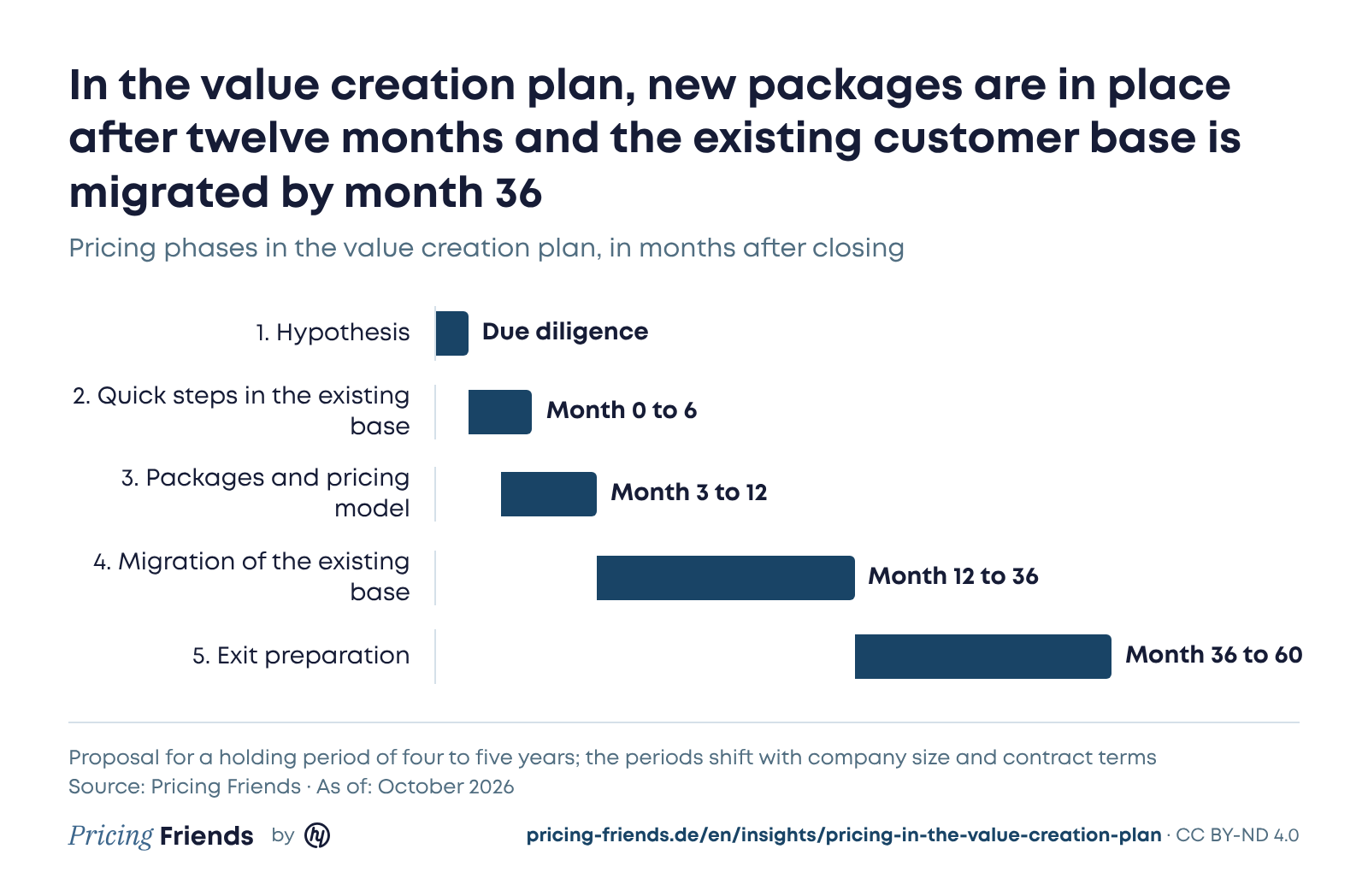
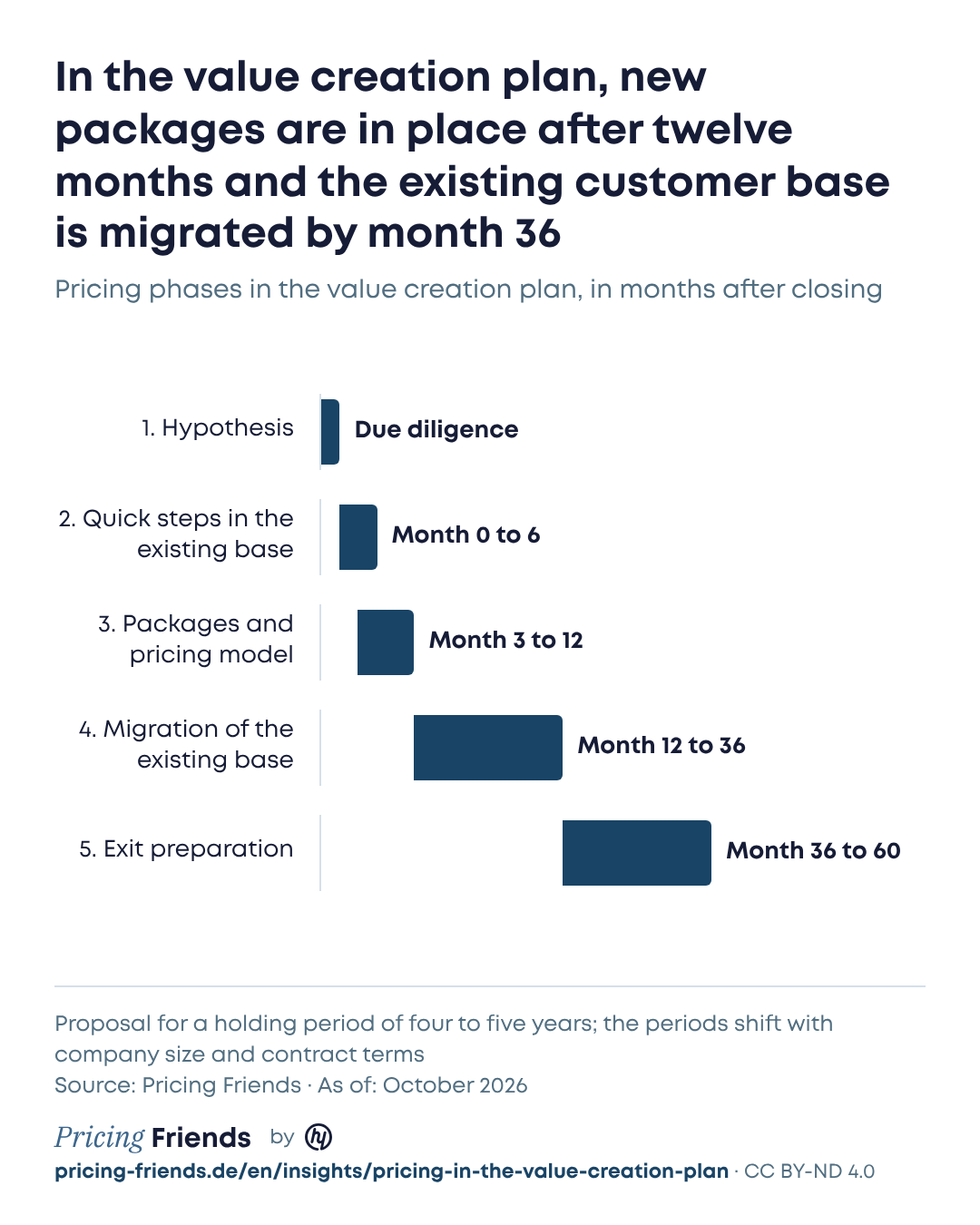
The time frames are our proposal for a holding period of four to five years. They shift with company size, contract terms and the number of existing customers.
| Phase | Time frame | Pricing components | Metric |
|---|---|---|---|
| 1. Hypothesis | Due diligence | Pricing headroom, model risk, initial range | Range in EBITDA points |
| 2. Quick steps with existing customers | First six months | Old prices moved to current lists, discount rules | Realized price per customer |
| 3. Packaging and pricing model | Months three to twelve | Packages, metric, offer for AI features | Package mix among new customers |
| 4. Migrating the base | Years one to three | Moving existing customers to the new model | Share of migrated revenue, gross revenue retention |
| 5. Exit preparation | From two years before exit | Evidence of revenue quality and pricing power | Net revenue retention, share of recurring revenue |
Start with quick steps for existing customers
Tactical adjustments come before any model change, because you can implement them quickly and with little risk. Typical cases are existing customers whose prices or maintenance contracts haven't been adjusted in years, and discounts that never expired. The best way to justify such an adjustment is with something new, such as a product roadmap that gets investment after the deal. For large customers, a phased plan over one to two years helps.
To lose as few customers as possible, you need customer segments with their own increase size and messaging.
Then the pricing model, and that takes time
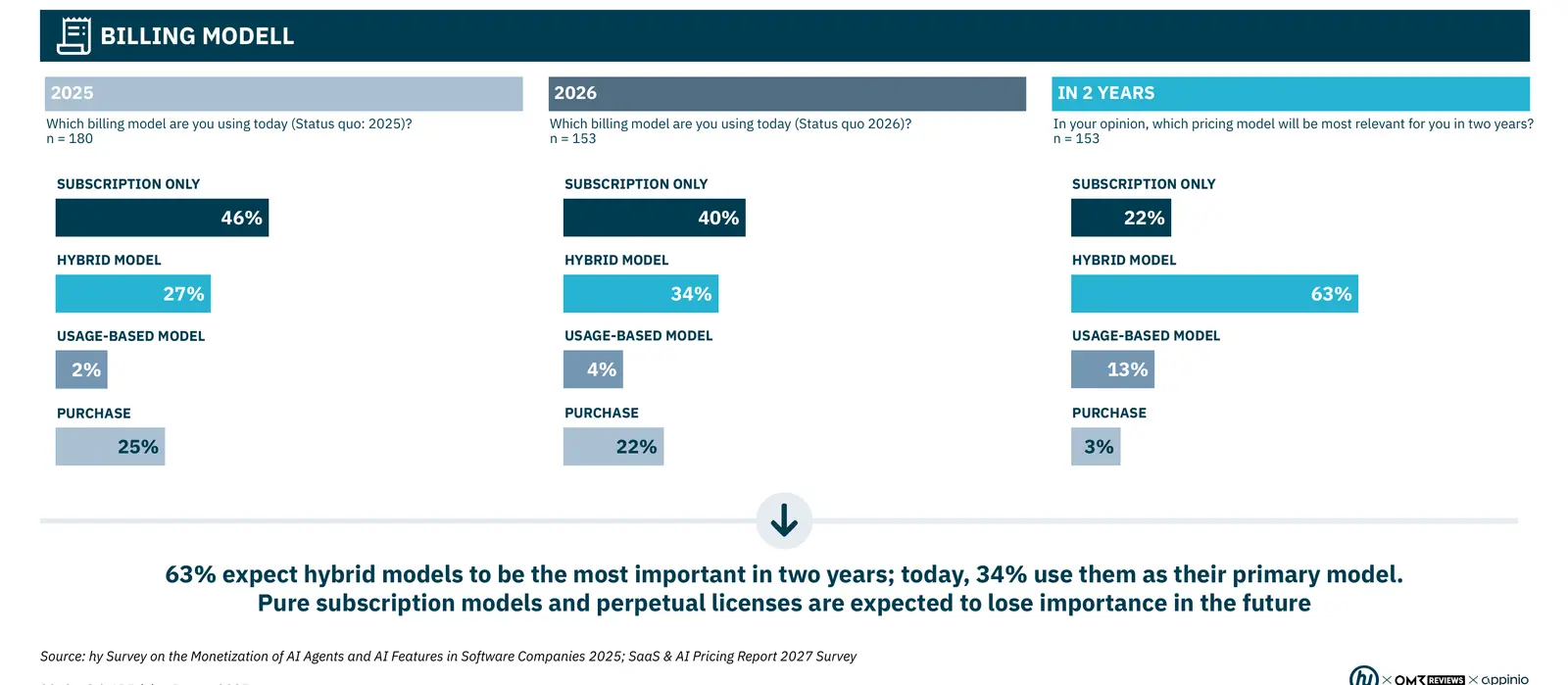
The bigger lever usually lies in the pricing model. For our SaaS & AI Pricing Report 2027, we surveyed 153 software and AI vendors. Hybrid models combining a base fee and usage are currently the main model for 34% of them; 63% expect them to be the most important model in two years. As the future main metric, the seat loses 31 percentage points. So a company whose revenue depends only on user counts needs an answer in the plan for how its price grows when its customers need fewer users because of AI.
Felicitas May advises adding rather than replacing: “let's add to it instead.” Cutting off recurring revenue to introduce a new model costs exactly the revenue quality buyers pay for at exit. Moving from license and maintenance to a subscription causes a revenue drop in year one, because license sales fall away. Adobe went through this after launching Creative Cloud in May 2012. In fiscal 2013, revenue fell 8% to $4.06 billion, according to its annual report. Product revenue fell 26%, subscription revenue rose 69%. So model the cash flows over several years and plan incentives for migrating existing customers, such as new features or credit for licenses already purchased.
Our approach takes you through eight stages to a new pricing model, from goals to price enforcement. In the VCP, stages three to five usually set the pace: packaging, billing model and pricing metric.
Who carries the plan
A pricing plan rarely fails on the math and often fails in execution. When prices go up, many customers first call the person they've known for years, often the founder. If the founder says it wasn't really meant that way, the increase has failed. So the strategy has to be aligned with the founder or whoever has been the face to the customer, and that person has to stand behind it.
The same goes for sales. A new price list alone won't convince a customer. Approvals, discount rules and targets have to fit the new model before it goes to market. That's why the last stage of our approach, price enforcement, belongs in the plan and doesn't come afterward. To keep management, shareholders, founders and sales working on one plan across the holding period, a specialized pricing consultancy like hy can coordinate the steps.
We expect that over the next few years, the timing of the model change will create more value in many investments than the size of the first price increase.
What you can do on Monday
- Write down the pricing hypothesis from due diligence. With range, time frame and risk, as a pricing due diligence delivers it.
- Rank pricing against the other levers. By impact, timeline and execution risk.
- Assign ownership. One person in management, one on the shareholder side.
- Schedule the model question. If it's due, its start belongs in the first year of the holding period.
- Pick three metrics per lever. For pricing, metrics like realized price and retention work well.
Bottom line: Pricing in the plan means sequence, ownership and early model decisions
In the value creation plan, pricing appears as a hypothesis from due diligence, with a clear sequence: quick steps with existing customers, then packaging and pricing model, then migration. Because new models take two to four years, the model question belongs in the first year of the holding period. Founders and sales have to back the plan, or it stays a calculation.
The portfolio check shows where the companies in your portfolio stand today: Enter up to ten domains and get a score from 0 to 100 for each company, its pricing model in one line and the key finding. The overview arrives by email.
Sources
Quotes are translated from German. The podcast episodes are in German.