
Private equity · 7 min read
Pricing due diligence: what buyers of a software company should check

Key points
- A pricing due diligence before buying a software company checks the pricing headroom in the installed base, how fast it can be captured and the revenue risk if AI shifts the pricing model.
- A pricing due diligence covers eight areas. The price history often delivers the fastest finding, for example when existing customers pay significantly less than new customers for the same software.
- If a software company's revenue depends only on seats, the pricing due diligence clarifies what happens when customers need fewer users thanks to AI.
- A pricing due diligence for a software company delivers a hypothesis and a range, not a finished price list. The pricing levers are ranked by headroom, time frame and implementation risk.
Before you buy a software company, a pricing due diligence checks whether its prices, contracts and pricing model support the value creation plan. It answers three questions: How much pricing headroom sits in the installed base, how fast can you capture it, and how secure is revenue if AI shifts the pricing model? This article is for private equity investors, deal teams and operating partners who are reviewing a software company now or will be soon.
Why pricing belongs on the table before signing
At hy, the pricing due diligence is a project format of its own with a fixed process. Dr. Stephan Schmid, partner at BU Bregal Unternehmerkapital, summed up in one sentence why investors need it: “Successful pricing of course feeds one-to-one into the first metric, into profit.” On top of that comes the multiple. According to him, it's driven by growth, profitability and risk profile. A better pricing model contributes to all three.
That's why BU starts looking at prices during the review itself. Schmid named the price history, the pricing mechanics, the pricing model, the contract templates and how pricing decisions are actually made in practice. There's also the outside view: Where does the price stand against competitors, and how do customers perceive it? I told him in the episode that this sounds exactly like a pricing due diligence the way we do it. In that moment, I couldn't say myself who had copied whom.
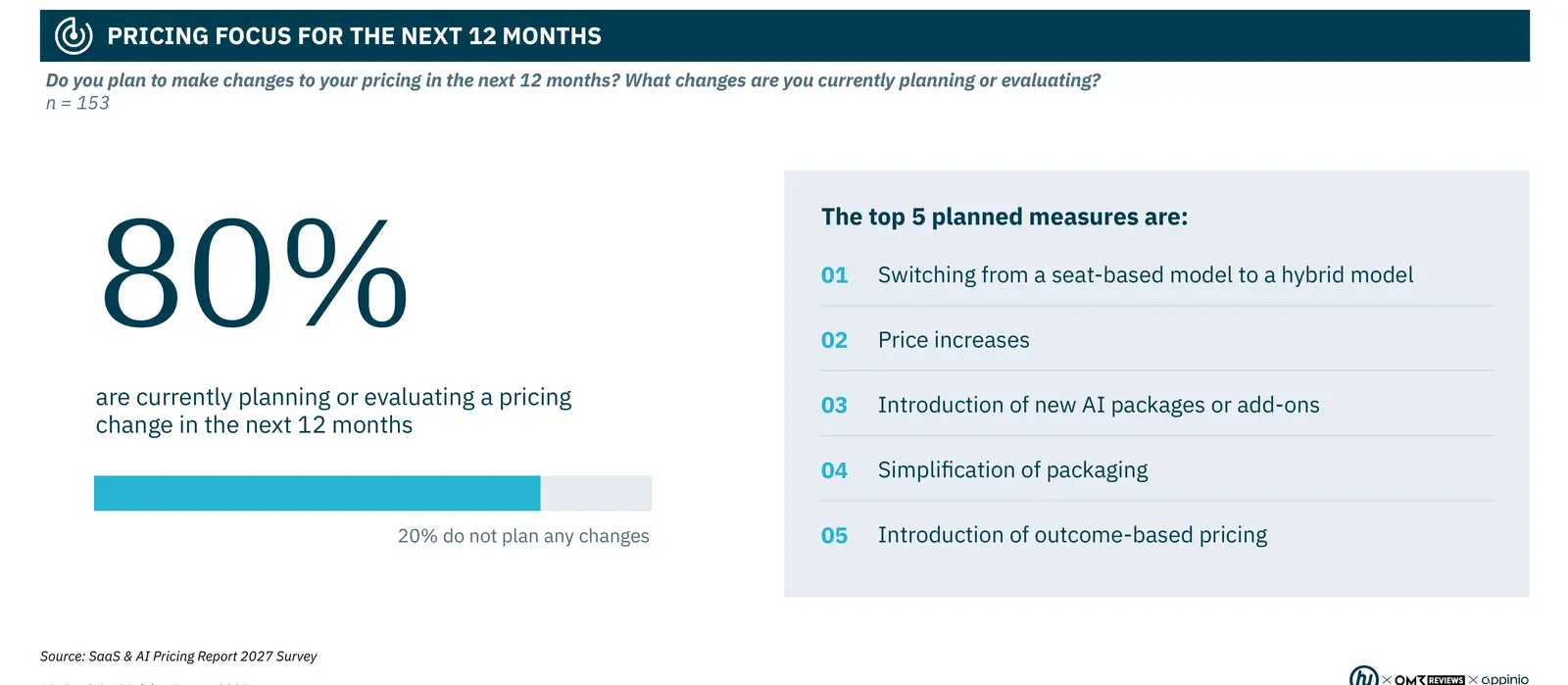
The timing makes the review more urgent. In our SaaS & AI Pricing Report 2027, 80% of the 153 SaaS and AI companies surveyed are planning or considering a change to their pricing in the next 12 months. The top planned measure is the switch from seats to a hybrid model, followed by a price increase. So if you buy a software company today, there's a fair chance you're buying a pricing model that will be rebuilt during the holding period.
The eight areas to review
The table shows what we review in a pricing due diligence, where the data comes from and which findings make us take notice.
| Area | What you clarify | Data source | Red flag |
|---|---|---|---|
| 1. Price history | When list prices were last adjusted, separately for new and existing customers | Price lists, invoice data over three years | Existing customers pay significantly less than new customers for the same service |
| 2. Contracts | Adjustment clauses, terms, notice periods, special terms | Contract templates, sample of the largest customers | No adjustment clause, long price commitments |
| 3. Discounts | Gap between list price and realized price, spread by sales rep | CRM, quotes, invoices | Same service, very different prices |
| 4. Plans | Distribution of customers across plans, gaps between tiers | Revenue by plan | Almost all customers in the smallest or the largest plan |
| 5. Pricing model and metric | Does the price grow with customer value, does the metric hold when AI takes over work | Revenue by metric, trend in user numbers | Revenue depends on seats, and customers' seat counts are shrinking |
| 6. AI | What AI costs and whether it brings in revenue | Cost per customer, revenue from add-ons | AI costs rise, revenue stays flat |
| 7. Retention | Net and gross revenue retention by cohort and segment | Revenue per customer and year | Net revenue retention depends on a few large customers |
| 8. Outside view | Price level against competitors, customer perception, pricing page | Customer interviews, surveys, pricing pages | Customers see the price as arbitrary or don't know it |
What the areas show in practice
The price history often delivers the fastest finding. A typical pattern: New customers pay the current list price, while long-standing customers pay significantly less for the same software because their contracts were never adjusted. Gaps like these are easy to justify and therefore easy to close, provided the contracts from area 2 allow an adjustment.
For discounts, it pays to count how many pricing approaches are in use. In its playbook on AI pricing, the investor Bessemer Venture Partners describes a trap for growing companies: nine different pricing approaches spread across contracts and a sales team that closes special deals at will. What won deals in the early stage becomes a burden as the customer count grows.
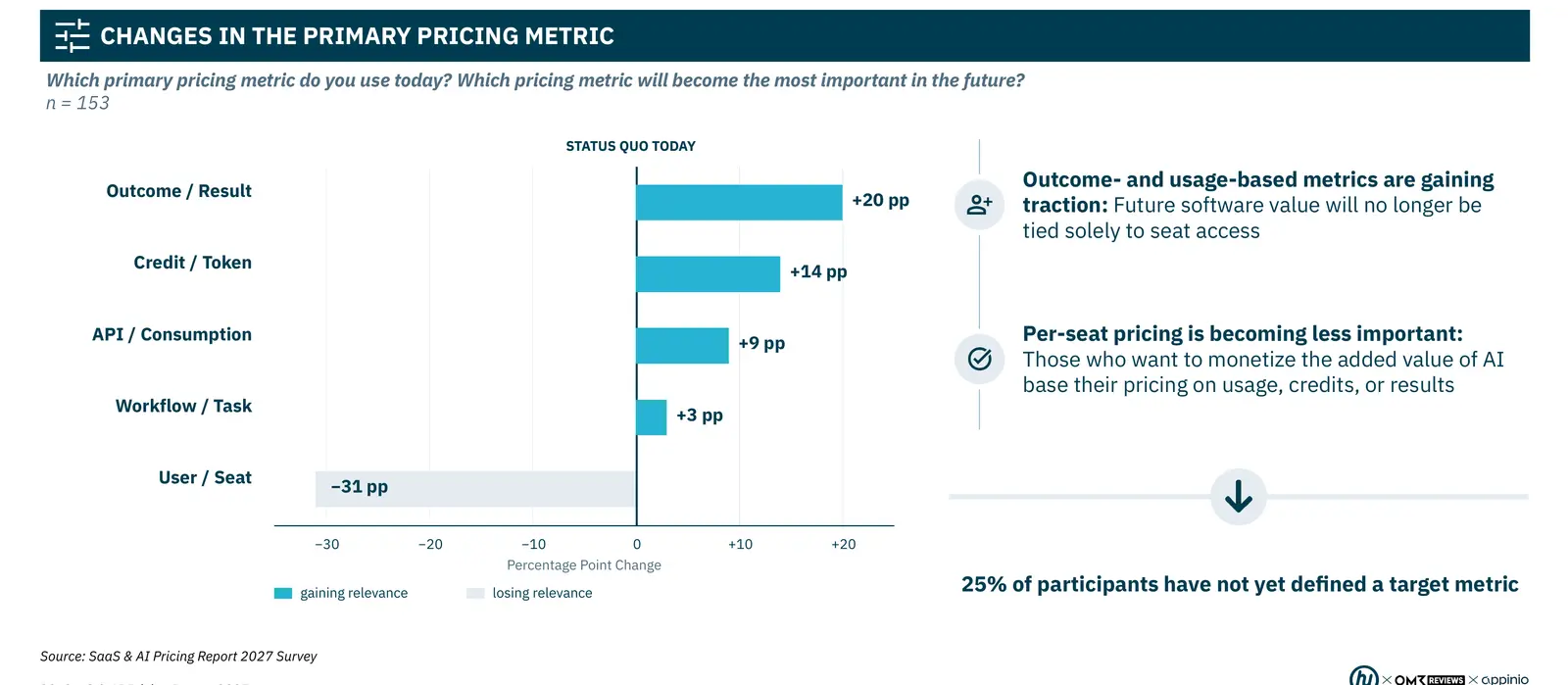
For the pricing model, look ahead. In our survey, the seat loses 31 percentage points as the future primary metric, while outcomes, credits and usage gain. Hybrid models combining a base fee and usage are the primary model for 34% today; 63% expect them to be the most important model in two years. Mark Miller of Carlsquare called transaction-based pricing “the new darling of investors,” because it's unclear how many seats will remain once work is automated. So a company whose revenue depends only on user numbers needs an honest answer in the review: What happens when its customers need fewer users because of AI?
With AI, cost and revenue matter at the same time. 50% of the vendors surveyed integrate AI into the core product, and 22% don't monetize it at all yet. That isn't a mistake in itself. It becomes one when cost per customer rises and the plan shows not a single euro of revenue against it. Bessemer expects many AI products to reach their first renewal in 2026, when their price will have to reflect actual value instead of a promise. That's why the question of whether the target company is pricing its AI features and agents appropriately belongs in this area.
Pricing pages alone aren't enough for the outside view. During the review, BU talks to customers in a structured way, through surveys and one-on-one conversations. The pricing page still belongs in the review, because buyers and AI systems read it. What it costs today to hide prices on the page is therefore part of the outside view.
What a due diligence can't clarify
A review over a few weeks delivers a hypothesis and a range, not a finished price list. Schmid says so openly about the target company's management: “ultimately they know their customers and their market better than we can know them after a few weeks of due diligence.” So the results need a format that investor and management can keep working with: How large is the headroom, over what time frame can it be captured, and what's the implementation risk? BU ranks the levers in the value creation plan by exactly these three criteria. That's how you get the pricing part of the value creation plan.
Our hypothesis: In upcoming transactions, whether the pricing model survives the holding period will carry more weight than the price level. You can adjust the level within a year or two. A metric that shrinks along with customer value slows down the entire plan.
What you can do on Monday
- Expand the data request. Request customer-level invoice data for three years, with list price, realized price and plan.
- Read 10 contracts. Take the 10 largest customers and check adjustment clauses, terms and special terms.
- Plot price against customer age. If the realized price per customer drops clearly for old contracts, that's your first lever.
- Hold five customer conversations. Ask about value, alternatives and price perception, separately from the target company's sales team.
- Test the pricing model against the AI question. Calculate what happens to revenue if customers need 20% fewer users.
For a new pricing model after closing, see our eight-step approach.
Bottom line: The pricing due diligence delivers the first line of the value creation plan
A good pricing due diligence quantifies the pricing headroom, the time frame and the implementation risk before the purchase price is set. It checks the price level and whether the pricing model can withstand the change driven by AI. If you clarify this before signing, you start after closing with a plan instead of an analysis.
For holdings you already own, there's the portfolio check: You enter up to 10 domains and get a score from 0 to 100 for each company, the pricing model in one line and the most important finding. The overview arrives by email.
Sources
- SaaS & AI Pricing Report 2027 by hy, pp. 13, 21, 30, 32
- Pricing Friends, episode 58: Freelancing und Pricing mit Sabine Fäth: Wie SCRIBERS[HUB] die Preisgestaltung für kreative Köpfe revolutioniert
- Pricing Friends, episode 123: Software-M&A und Pricing mit Mark Miller: Was entscheidet über den Preis einer SaaS-Company beim Exit?
- Pricing Friends, episode 129: Private Equity und Pricing mit Dr. Stephan Schmid
- Bessemer Venture Partners: The AI pricing and monetization playbook, February 2026
Quotes are translated from German. The podcast episodes are in German.