
Pricing strategy · 7 min read
Good net revenue retention for SaaS and how pricing drives it
hy pricing teamReviewed by experts at hy
- Published
- Updated
Key points
- With net revenue retention above 100%, software revenue grows even without new customers. Above 110% is good, above 120% is strong.
- Net revenue retention in the top decile of software vendors fell 19 percentage points from 2022 to 2024. Benchmark yourself against vendors with a similar customer size.
- Pricing raises a software company's net revenue retention through a pricing metric that grows with the customer, a clear path to the next tier, add-on modules customers can buy later, and regular price adjustments.
- AI features included at no extra charge keep software customers, but they don't raise net revenue retention. Offered as a tier, an add-on or credits, they give customers a reason to pay more.
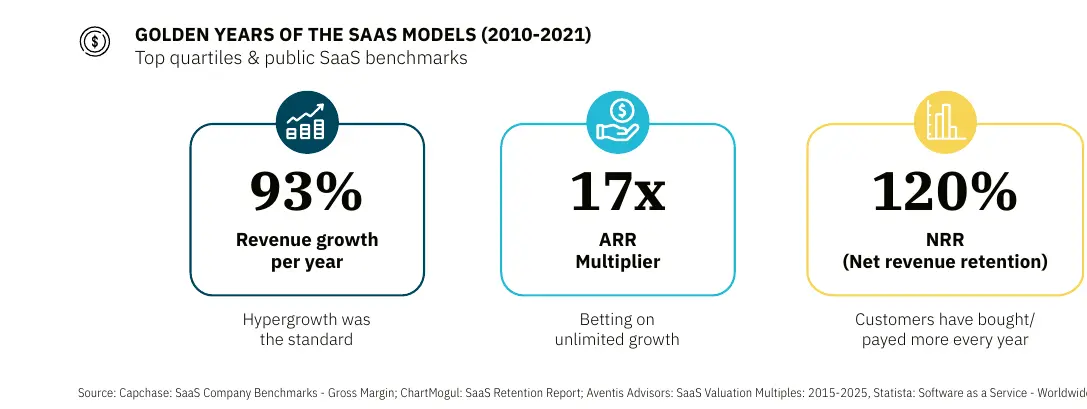
Net revenue retention (NRR) shows how much recurring revenue from the customers you had on a given date is left one year later, after cancellations, downgrades, upgrades and price adjustments. If it's above 100%, your customer base grows without a single new customer. In the SaaS benchmarks we compiled for our SaaS & AI Pricing Report 2026, NRR in the top quartile during the strong SaaS years was 120%. Guests on our podcast report 110 to 140% for their companies. Pricing is one of the most direct levers to get there, because it decides whether a customer who uses more also pays more.
This article is for executives, CFOs and revenue leaders at SaaS companies, and for investors who want to assess the NRR of a portfolio company.
How to calculate NRR
Take the recurring revenue of all customers who were customers at the start of the period, and look at what those same customers pay 12 months later. New customers won during the period don't count.
NRR = (starting revenue + expansion + price increases − downgrades − cancellations) ÷ starting revenue
NRR's sibling is gross revenue retention (GRR). It counts only the losses, that is, cancellations and downgrades, so it can never exceed 100%. GRR shows how tight your customer base is. NRR shows whether it grows.
With published figures, check the definition. Figma reports net dollar retention of 136% for the end of June 2026, calculated only over paying customers with more than $10,000 in ARR. Smaller customers aren't in that number. According to CFO Praveer Melwani, customers bought both additional seats and additional AI credits.
Worked example:
| Item | Amount |
|---|---|
| Recurring revenue at start | €1,000,000 |
| Cancellations | −€80,000 |
| Downgrades | −€20,000 |
| Upgrades, more users, new modules | €120,000 |
| Price increase for existing customers | €40,000 |
| Revenue from the same customers after 12 months | €1,060,000 |
| NRR | 106% |
| GRR | 90% |
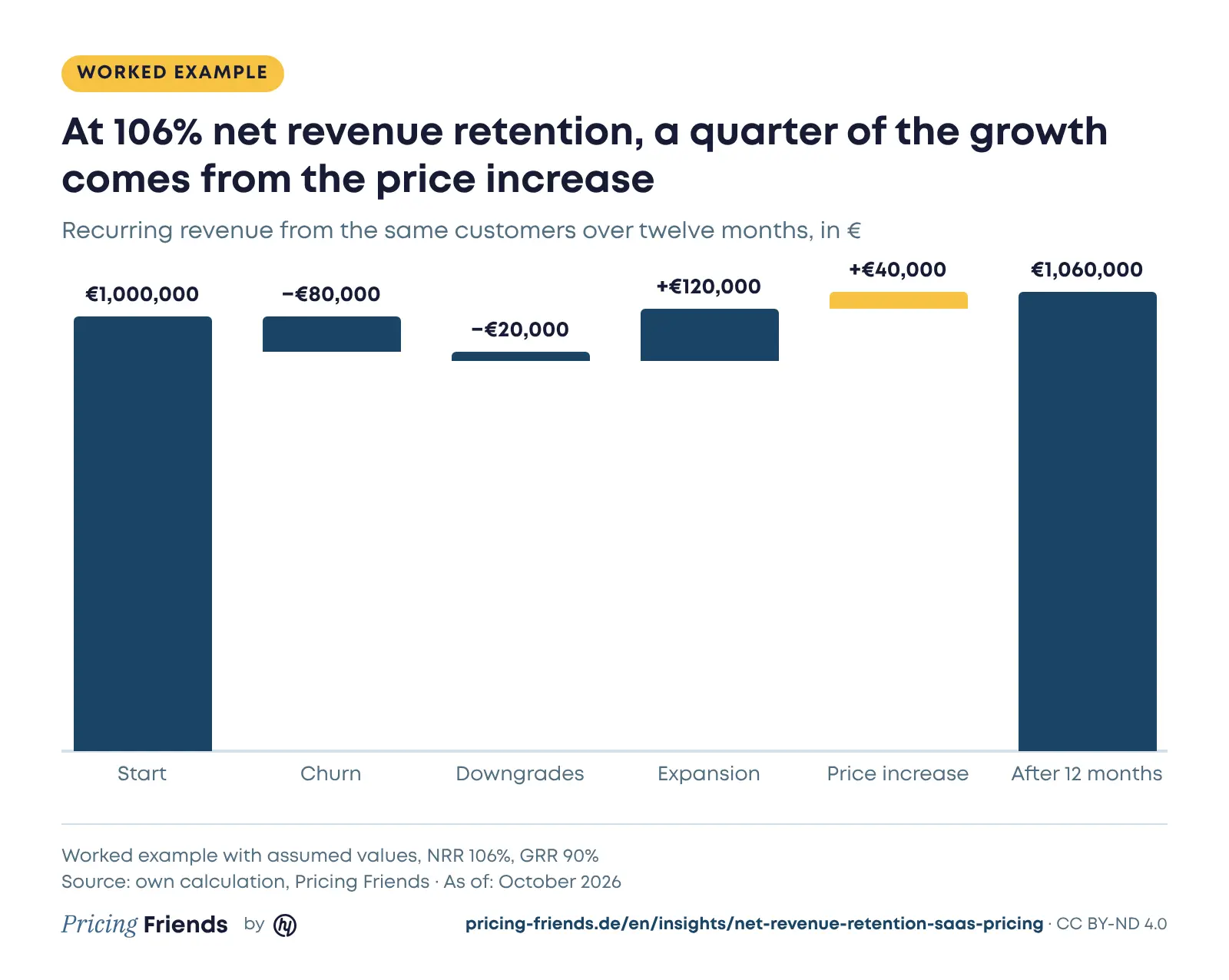
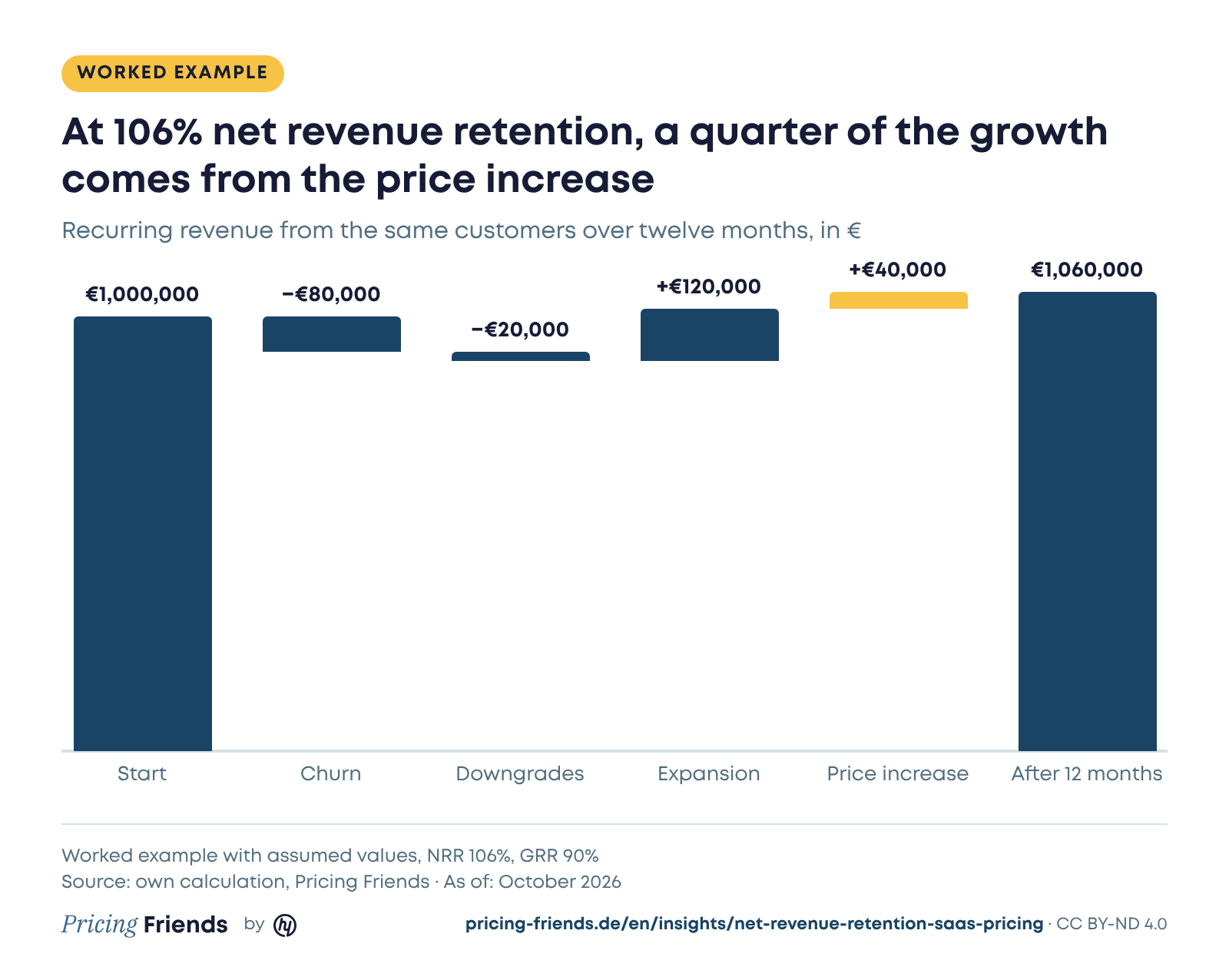
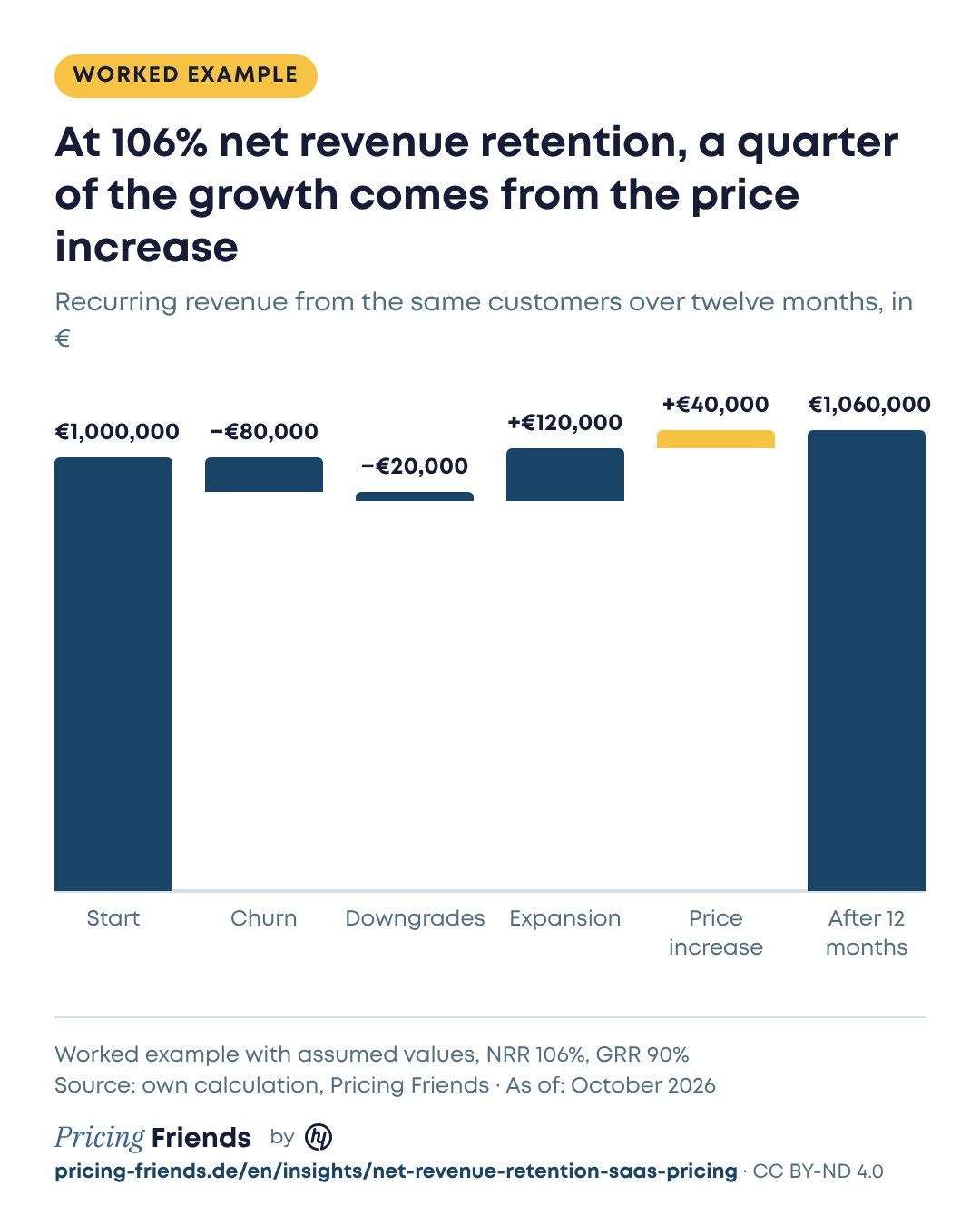
In this example, a quarter of the €160,000 gain comes from the price increase. The rest comes from expansion, and that depends on pricing too.
What good NRR looks like
The benchmarks come from sources including ChartMogul and Benchmarkit. In the strong SaaS years from 2010 to 2021, NRR in the top quartile and among publicly listed SaaS vendors was 120%, so customers bought more every year. Then the picture turned: NRR in the top decile fell 19 percentage points from 2022 to 2024. If you measure yourself today against the numbers from the boom years, you set the bar too high.
What guests on our podcast have shared about their own numbers falls in a similar range:
| Source | Value | Driver according to guest or report |
|---|---|---|
| Nikolai Skatchkov, spend management | 110% NRR, just under 96% logo retention | Billing for overusage, additional entities |
| Fabian Heinrich, procurement software | 130 to 140% NRR | New modules |
| Figma | 136% net dollar retention | AI credits per seat, additional purchases |
| Oliver Pabst, investor | 120 to 140% as a hallmark of valuable companies | Keeping and expanding customers |
Oliver Pabst put it this way: Companies that keep and expand customers, “meaning they have net retention rates of 120, 130, 140%. And if you have that, then you also have an extremely valuable company.” Our view: For most B2B software vendors, NRR above 100% is the first goal, above 110% is a good value and above 120% is a strong one. Small customers cancel more easily because, as Timo Müller says in episode 7, they have “much lower opportunity costs.” So compare yourself with vendors that serve customers of a similar size.
Four pricing levers for NRR
A pricing metric that grows with the customer
If your price is tied to a unit that grows on the customer's side, your revenue grows along with it, without a new sales conversation. That's one criterion of a good pricing metric: Revenue grows automatically as the customer grows. In episode 113, Nikolai Skatchkov describes one variant: “So we have overusage licenses.” Peaks such as interns or a company party are billed separately.
A clear path to the next tier
Three tiers make the upgrade the natural next step. That makes it easy to move existing customers into higher tiers. The prerequisite is that the middle tier gives customers a reason to switch that they feel in their daily work, and that the price gaps between the tiers are right.
Modules and add-ons customers can buy later
In episode 93, Fabian Heinrich explained where his 130 to 140% comes from. More users, countries and business units play a smaller role: “The growth driver is mostly new modules.” A product that exists in only one plan doesn't have this lever. For it to work, it has to be clear what belongs in the plan and what costs extra as an add-on.
Regular price adjustments for existing customers
An increase of a few percent a year raises NRR directly, as long as it doesn't lower GRR by more. After price increases, we very often see retention above 90 to 95% in software. To keep cancellations in check, plan the increase by customer segment.
Why investors look at NRR
For buyers of software companies, NRR is a measure of revenue quality. Mark Miller, who advises software companies on their sale, said in episode 123: “And of course other metrics like gross revenue retention, net revenue retention. People look closely at the cohorts, and if those are good, then valuations stay good.” Dr. Stephan Schmid of Bregal added in episode 129 that good pricing works twice: “Successful pricing of course feeds one-to-one into the first metric, into profit.” It also improves growth, profitability and risk profile, the three drivers of the valuation multiple. NRR is one of several pricing metrics investors review.
For many software vendors, an unused NRR lever currently sits in AI. An AI feature can take a lot of work off the customer's hands and bring the vendor not a single extra euro. In our survey of 153 SaaS and AI vendors for the SaaS & AI Pricing Report 2027, 50% build AI into the core product at no extra charge, and 22% don't monetize it at all yet. That can protect GRR, because the product gets better. It doesn't bring expansion. If you offer AI as a tier, an add-on or credits, you give customers a reason to pay more.
What you can do on Monday
- Calculate NRR and GRR for the last 12 months, split by customer size.
- Break the change down into cancellations, downgrades, expansion and price increases.
- Check whether your pricing metric grows with the customer or stays at a fixed number.
- Count how many existing customers moved to a higher tier or bought an additional module last year.
- Decide when the next price adjustment for existing customers will happen.
Bottom line: NRR is built into the pricing model
NRR above 100% means your customer base grows on its own, and values above 110 to 120% are strong. Much of that is decided in pricing: in the metric that grows with the customer, the path to the next tier, add-on modules and regular price adjustments. If you don't build these levers, expansion depends on sales alone.
Whether your plans show a path upward starts on your pricing page. You'll get a first read in about a minute with the free pricing audit on pricing-friends.de. It reads your pricing page live, checks pricing model, packaging, price points and entry offer, and gives a score from 0 to 100 with findings. The review follows the method hy Consulting Group developed in more than 600 pricing projects.
Sources
- SaaS & AI Pricing Report 2027 by hy, pp. 19, 21, 33, 41
- SaaS & AI Pricing Report 2026 by hy, pp. 12, 14
- Figma: Figma Announces Second Quarter 2026 Financial Results, press release of August 5, 2026 (SEC, Form 8-K), net dollar retention and its definition
- Pricing Friends, episode 5: Private Equity und Pricing mit Andreas Spiegel: Wie revolutioniert effektives Pricing den Wert von Softwareunternehmen?
- Pricing Friends, episode 7: Softwarelizenzen und Pricing mit Timo Müller: Wie beeinflusst die Preisgestaltung das Softwaregeschäft?
- Pricing Friends, episode 84: KI und Pricing mit Dr. Oliver Pabst: Warum gelingt echtes Value-Based Pricing nur 5 % der Softwareanbieter?
- Pricing Friends, episode 93: ProcurementTech und Pricing mit Fabian Heinrich: Wie werden Einkauf und KI zusammen zum Werttreiber?
- Pricing Friends, episode 113: Spend Management-Software und Pricing mit Nikolai Skatchkov: Wie skaliert man profitabel in einem Markt, der noch kaum digitalisiert ist?
- Pricing Friends, episode 123: Software-M&A und Pricing mit Mark Miller: Was entscheidet über den Preis einer SaaS-Company beim Exit?
- Pricing Friends, episode 129: Private Equity und Pricing mit Dr. Stephan Schmid
Quotes are translated from German. The podcast episodes are in German.