
Pricing strategy · 7 min read
Software pricing models: which ones exist and when each fits

Key points
- A software pricing model involves two decisions: how the customer pays, such as by subscription or consumption, and what they pay for, which is the pricing metric. The metric comes first.
- The right pricing model for your software depends on whether costs and customer value grow with usage and how much predictability customers need.
- A hybrid pricing model of base fee plus consumption splits the usage risk. 63% of the SaaS and AI vendors surveyed expect it to lead in two years.
- Per-user pricing stays common in software because it gives budget certainty. When AI drives ongoing costs, a second, usage-based metric is often added.
If you sell software, your pricing model comes down to two decisions: how the customer pays and what they pay for. For the how, there are four basic forms: one-time purchase, subscription, hybrid and pure usage-based. For the what, you choose the pricing metric, such as per user, per transaction, per credit or per outcome. Which combination fits depends on whether costs and customer value grow with usage and how much predictability your customers need. This article is for founders, CEOs and product leaders who want to choose or review their model.
Pricing model and pricing metric are two decisions
The pricing model describes how you bill: once, as a subscription, by consumption or as a mix. The pricing metric is the unit the customer pays for. It defines what gets paid for; the amount comes later: per user, per message, per processed document or per completed task. The metric decides two things the price alone can't control: whether revenue grows with customer value and whether it grows with variable costs.
The order matters. First the unit, then the number. I see three basic forms of metrics. Here's how I put it on the podcast: “The big variants are still user-based, transactional, meaning usage-based, or outcome-based. I think those are the three basics, and then there are variations of them.”
The four billing models compared
| Model | How the customer pays | Predictability for vendor / customer | Cost risk for vendor / customer | Main model 2026 | Expected in two years |
|---|---|---|---|---|---|
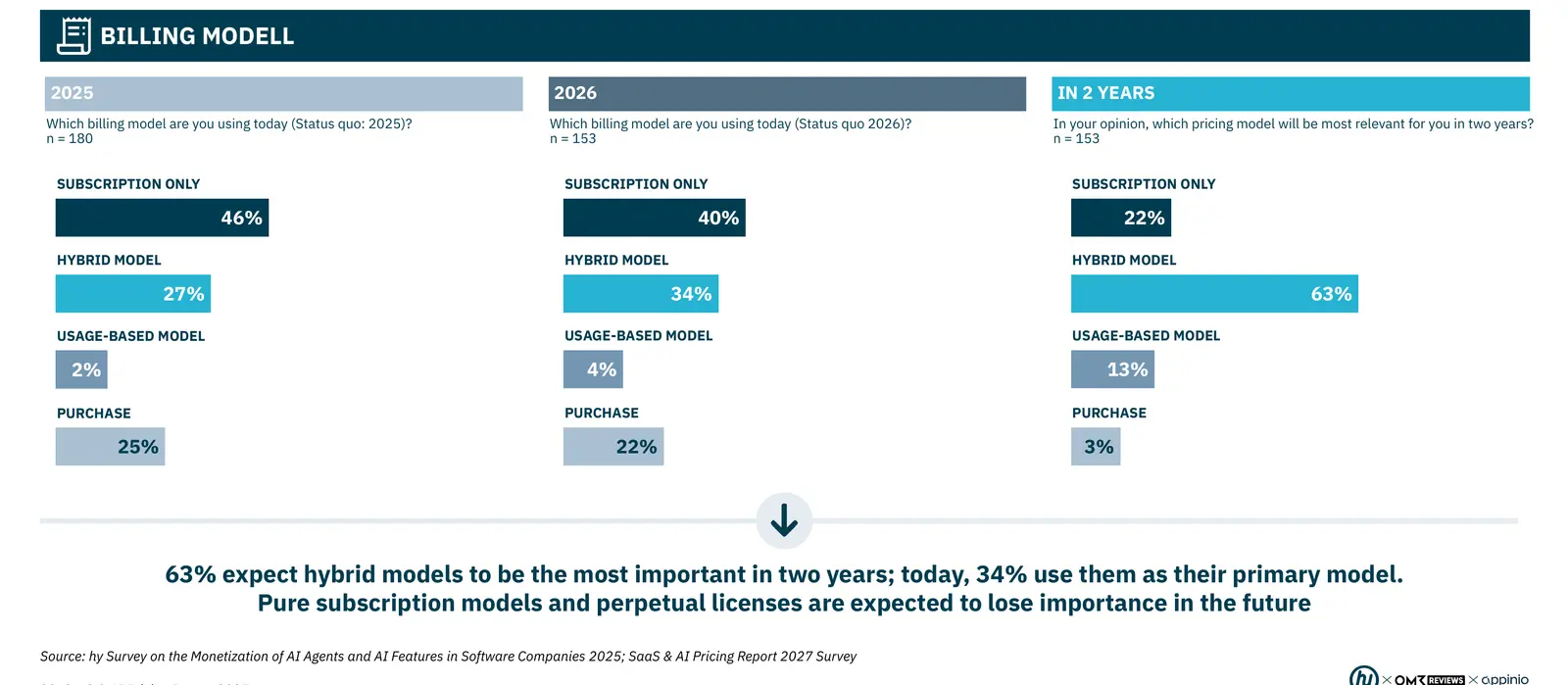
| Purchase | One-time payment, regardless of usage | low / high | low / low | 22% | 3% |
| Subscription | Fixed fee per period | high / high | high for heavy users / low | 40% | 22% |
| Hybrid | Base fee plus consumption | medium / medium | medium / medium | 34% | 63% |
| Usage-based | Consumption only | low / low | low / high | 4% | 13% |
Source: SaaS & AI Pricing Report 2027, p. 29 (assessment) and p. 30 (survey of 153 companies).
The table shows the core of the choice: Someone carries the risk of fluctuating usage. With a subscription, the vendor carries it when individual customers use a lot. With a pure usage-based model, the customer carries it and has a hard time budgeting costs. The hybrid model splits the risk. That's why 63% of the 153 SaaS and AI vendors in our survey expect it to be their most important model in two years.
Common pricing metrics
For the SaaS & AI Pricing Report 2026, we asked 180 software companies how they bill. Multiple answers were allowed.
| Pricing metric | Share of vendors |
|---|---|
| Per user (seat) | 54% |
| Per feature package | 41% |
| Flat fee | 32% |
| Per transaction | 19% |
| Per API call | 8% |
| Per compute unit | 4% |
| Several metrics combined | 59% |
Source: SaaS & AI Pricing Report 2026, p. 19.
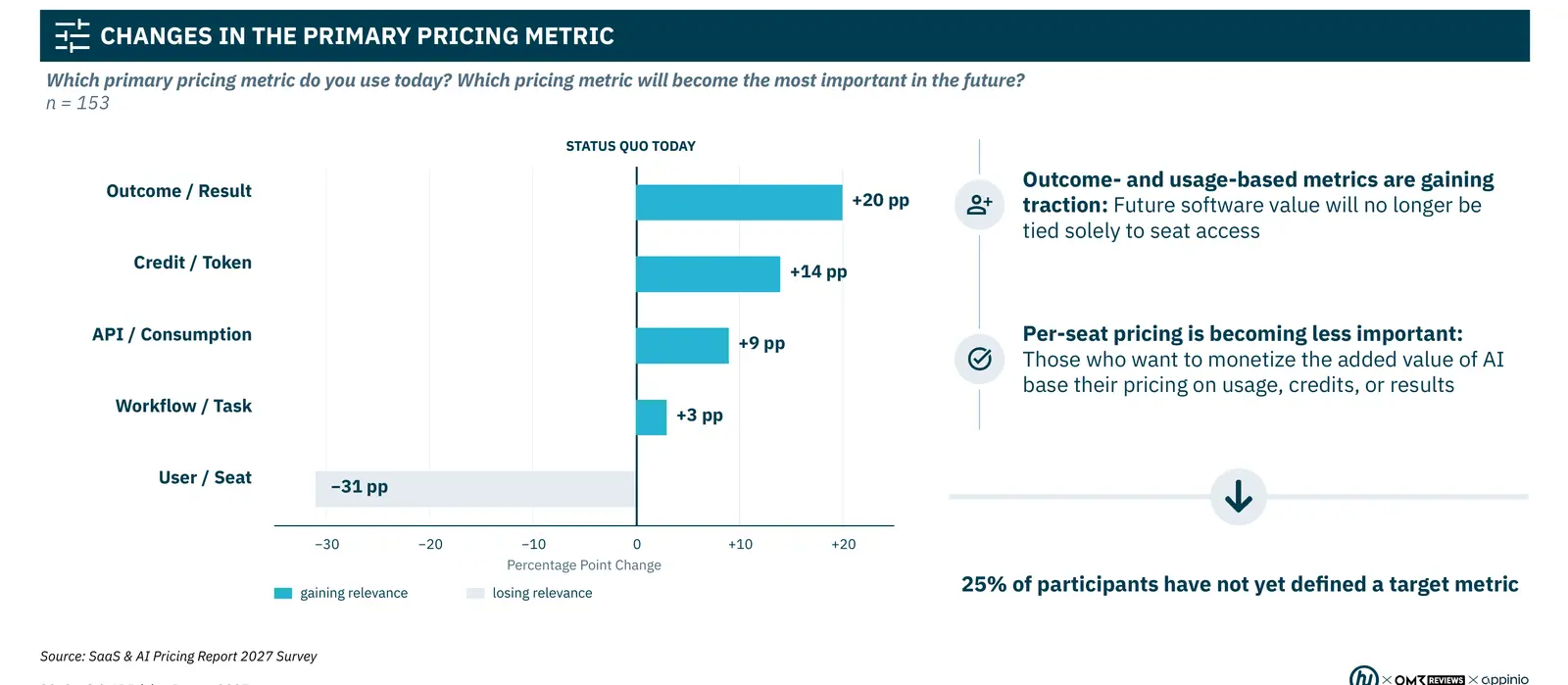
In our SaaS & AI Pricing Report 2027, respondents see a clear shift ahead. As the main metric, the seat loses 31 percentage points. Outcomes gain 20, credits or tokens 14 and API consumption 9 percentage points. 25% haven't set their future metric at all yet.
Which model fits when
| If … | the better fit tends to be … | Example or evidence |
|---|---|---|
| value grows with the number of people working in the tool, and each extra license costs you almost nothing | Subscription per user | CRM, a case where per user makes sense, according to Timo Müller |
| customers want budget certainty but usage fluctuates | Hybrid: base fee plus consumption | 63% expect this to be the most important model |
| usage and cost per customer fluctuate strongly, such as with compute-heavy AI tasks | Usage-based or credits | Video creation, data analysis, occasional batch processes |
| the outcome is clearly measurable and can be attributed unambiguously to your product | Price per outcome | Three conditions must be met |
| you deliver once and customers run it on-premises | Purchase with maintenance | Only 3% still expect this to be the most important model |
Why per user stays so common even though it often reflects value poorly: It gives budget certainty. Buyers don't have to ask three times whether they'll get more money. I once said on the podcast: “There are so many reasons why per-user pricing works and why fixed pricing works too.”
I'm cautious about price per outcome. It needs a very narrow, repeatable use case that's fully measurable. Otherwise you end up arguing about whether the outcome was achieved. Intercom shows what such a price looks like: its AI agent Fin costs $0.99 per outcome. Billing covers the conversations Fin resolves on its own. Investor Oliver Pabst gave an order of magnitude: about 5% of AI companies will adopt outcome-based pricing, meaning a price per outcome.
Why AI changes the choice
Classic SaaS products scaled at almost no additional cost. With AI, every interaction costs real money. At the same time, fewer people often work in the software, because agents take over tasks. Julius Göllner of ARRtist summed it up this way: when AI drives ongoing costs and fewer people use the software, a pure per-user model hits its limits.
I expect many vendors to solve this with a second, transactional metric next to the seat. I like to compare it with the phone plans of the past: “You pay €25 a month and 3 cents per minute of calls, roughly.” Later I went further: “I have a strong hypothesis that AI pricing, meaning token pricing, will develop exactly the way telecom pricing has over the last 30 years.” Whether the switch pays off for you is shown in the comparison of seat and usage pricing. How you combine a base fee and usage is the second question.
What you can check on Monday
- Write your current metric in one sentence: “Our customers pay per …”
- Put revenue and variable costs per customer side by side. Do both grow with usage, or does margin drop with your most active customers?
- Ask five existing customers how they measure the value of your product. Does that match your metric?
- Check whether your customers can budget for a variable bill at all.
At hy, billing model and pricing metric are two separate steps in our approach to pricing models, before the price level.
Bottom line: First the metric, then the model, the price last
There are four billing models and a handful of common metrics. The right model follows from how costs and value grow with usage for your customers and how much predictability they need. The market is moving toward the hybrid model: 34% use it as their main model today, and 63% expect it to lead in two years.
The free pricing audit on pricing-friends.de shows where your own model stands today in about a minute. It reads your pricing page live, checks pricing model, packaging and price points, and gives a score from 0 to 100 with findings. It checks against the approach hy Consulting Group developed in more than 600 pricing projects.
Sources
- SaaS & AI Pricing Report 2027 by hy, pp. 12, 29, 30, 31, 32, 38, 57
- SaaS & AI Pricing Report 2026 by hy, pp. 17, 19
- Intercom: Pricing, price of Fin per outcome, accessed October 17, 2026
- Pricing Friends, episode 7: Softwarelizenzen und Pricing mit Timo Müller: Wie beeinflusst die Preisgestaltung das Softwaregeschäft?
- Pricing Friends, episode 84: KI und Pricing mit Dr. Oliver Pabst: Warum gelingt echtes Value-Based Pricing nur 5 % der Softwareanbieter?
- Pricing Friends, episode 99: Sonderfolge: SaaS-Pricing, AI und die Zukunft der Preismodelle
- Pricing Friends, episode 147: AI Value Creation im Private Equity: Wie wird aus KI-Effizienz echter Umsatz?
Quotes are translated from German. The podcast episodes are in German.