
Pricing strategy · 7 min read
How a SaaS pricing project works and how long it takes

Key points
- A SaaS pricing project runs in five phases: goals and data, analysis, concept, rollout preparation and rollout.
- Analysis and concept in a SaaS pricing project take 10 to 16 weeks. If revenue, discount and contract data isn't prepared, add two to three months.
- A SaaS pricing project involves sales from the start. Salespeople who helped build the solution are the ones who later put the new prices in front of customers.
- After a SaaS pricing project, existing customers usually move to the new pricing on a rolling basis as their contracts end. For major changes, the migration takes up to two years.
If you sell software and want to rebuild your pricing, the project runs in five phases: goals and data, analysis, concept, rollout preparation and rollout. The concept is ready after about 10 to 16 weeks. Rolling it out to existing customers takes much longer after that, up to two years for a major change. This article is for CEOs, CROs and product leaders who are planning such a project and want to know what's coming.
Why so many projects are starting now
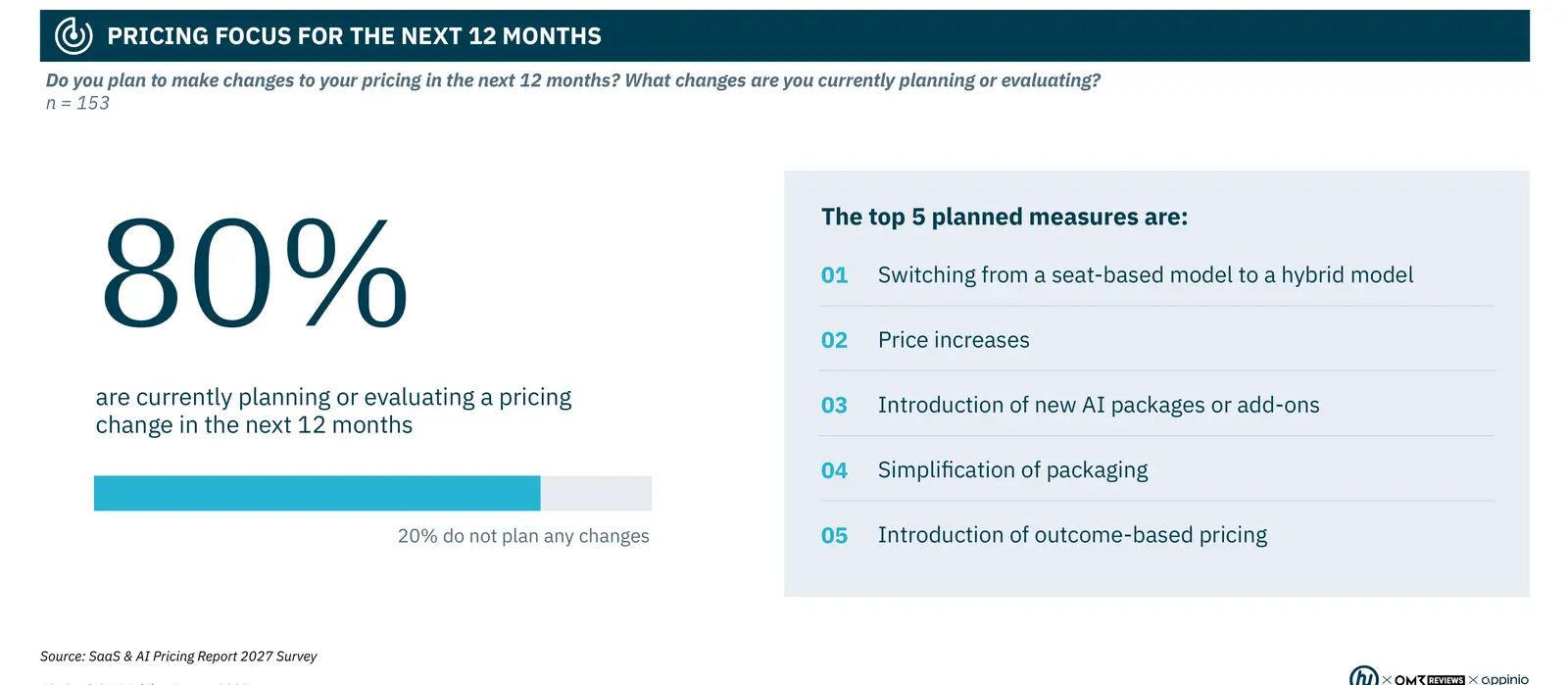
In our SaaS & AI Pricing Report 2027, 80% of the 153 SaaS and AI companies surveyed are planning or considering a pricing change in the next 12 months. The five most common plans are moving from a seat model to a hybrid model, price increases, new AI plans or add-ons, simpler plans and outcome-based pricing. At software companies, many projects come from one of two directions: new plans for new customers or a price increase plan for existing customers. The process is similar in both cases. Only the last phase differs sharply.
The five phases at a glance
The phases follow our eight-step approach. How long they take depends mainly on the quality of your data and how many customers you need to migrate.
| Phase | Steps in our approach | Typical duration | Result |
|---|---|---|---|
| 1. Goals and data | I. Goals and guardrails | 1 to 2 weeks, 2 to 3 months with data preparation | Aligned goals, clean data foundation |
| 2. Analysis | II. Competitive position | together with phase 3: 10 to 16 weeks | Competition, customer view, willingness to pay |
| 3. Concept | III. to VII. Packaging to price differentiation | see phase 2 | Plans, metric, prices, business case |
| 4. Prepare rollout | VIII. Price enforcement | a few weeks | Rules, contracts, training, migration plan |
| 5. Rollout and adjustment | VIII. Price enforcement | 18 to 24 months for major changes | New prices in the market, ongoing corrections |
Sources: Timo Müller in episode 7 (data, concept), episode 21 (transformation).
Phase 1: Goals and data
The first question is what the new pricing should achieve: more revenue per customer, more new customers at entry level, a margin that holds up even with AI costs. For AI, this includes deciding whether it should strengthen usage and differentiation or generate revenue on its own.
Then comes the data. Timo Müller, who has guided many migrations from licenses to subscriptions, budgets two to three months for this if the data first has to be prepared. At larger, well-structured companies, one to two weeks is enough. His reason for this order: “What makes no sense is to jump into a core concept project and then have to keep pulling the data again and again.”
Phases 2 and 3: Analysis and concept
In the analysis, we look at the competition, your customers and their willingness to pay. Competition today also includes the question of which vendors AI search puts on the list. Which method for measuring willingness to pay fits depends on the question you want to answer.
The concept then produces plans, billing model, pricing metric, price level and price differentiation, in exactly that order. The metric comes before the price: only once it's clear what a customer pays for can you have a useful conversation about how much. For the billing model, there are four basic forms, from purchase to usage.
Timo Müller puts analysis and concept together at 10 to 16 weeks. The length depends on three things: how intensively you work on it, whether a consultant is involved and how complex your product and portfolio are. His example: “If I only have a single product, always just one line item and only 100 customers, that's different from 10,000 software customers.” In my experience, a typical consulting project for a switch from licenses to subscriptions tends to take 12 weeks.
Involve sales from the start
If you want pricing to create value, you have to think about sales from the start. A new price list alone won't convince a single customer. My fellow partner Amadeus Petzke considers it a fallacy that “you do a pricing project in the pricing team and then announce the results at the end of the pricing project.” He would start with the questions from sales: What works well in pricing today, and what would help people in customer conversations? People who were part of the solution are the ones who later put it into practice.
Phase 4: Prepare the rollout
Between the concept and the first customer conversation is a phase of its own. Felix Krohn listed what belongs in it:
- Check all new price points once more before they go to customers.
- Update terms and conditions and service descriptions so future annual price increases are possible too.
- Plan the migration of existing customers, including the winners and losers of the change.
- Train sales: why prices are changing and how to explain that to the customer.
- Set up tracking that shows whether the business case is materializing.
The law sets a limit for the second point. Under German law (§ 307 BGB), provisions in standard terms and conditions are invalid if they unreasonably disadvantage the other party. That can follow simply from a provision not being clear and understandable. So word a price adjustment clause so the customer can see when and on what basis their price changes.
This also includes clear rules for approvals and discounts, so sales doesn't water down the new pricing logic right away.
Phase 5: Rollout and adjustment
Timo Müller says: “Very few companies these days prefer a big-bang migration.” A rolling approach along contract end dates is the norm. That has one advantage: After the first 50, 100 or 200 customers, you see which groups over- or underperform. After two to three months, a review with adjustments pays off.
Boy Hengstmann, CEO of evasys, described what such a cadence can look like: weekly team meetings, monthly retrospectives and a quarterly session to adjust the strategy. Felix Krohn expects the whole transformation to take 18 to 24 months. For a change of this size, which affects contracts, sales and existing customers at the same time, a specialized pricing consultancy like hy can help coordinate the phases.
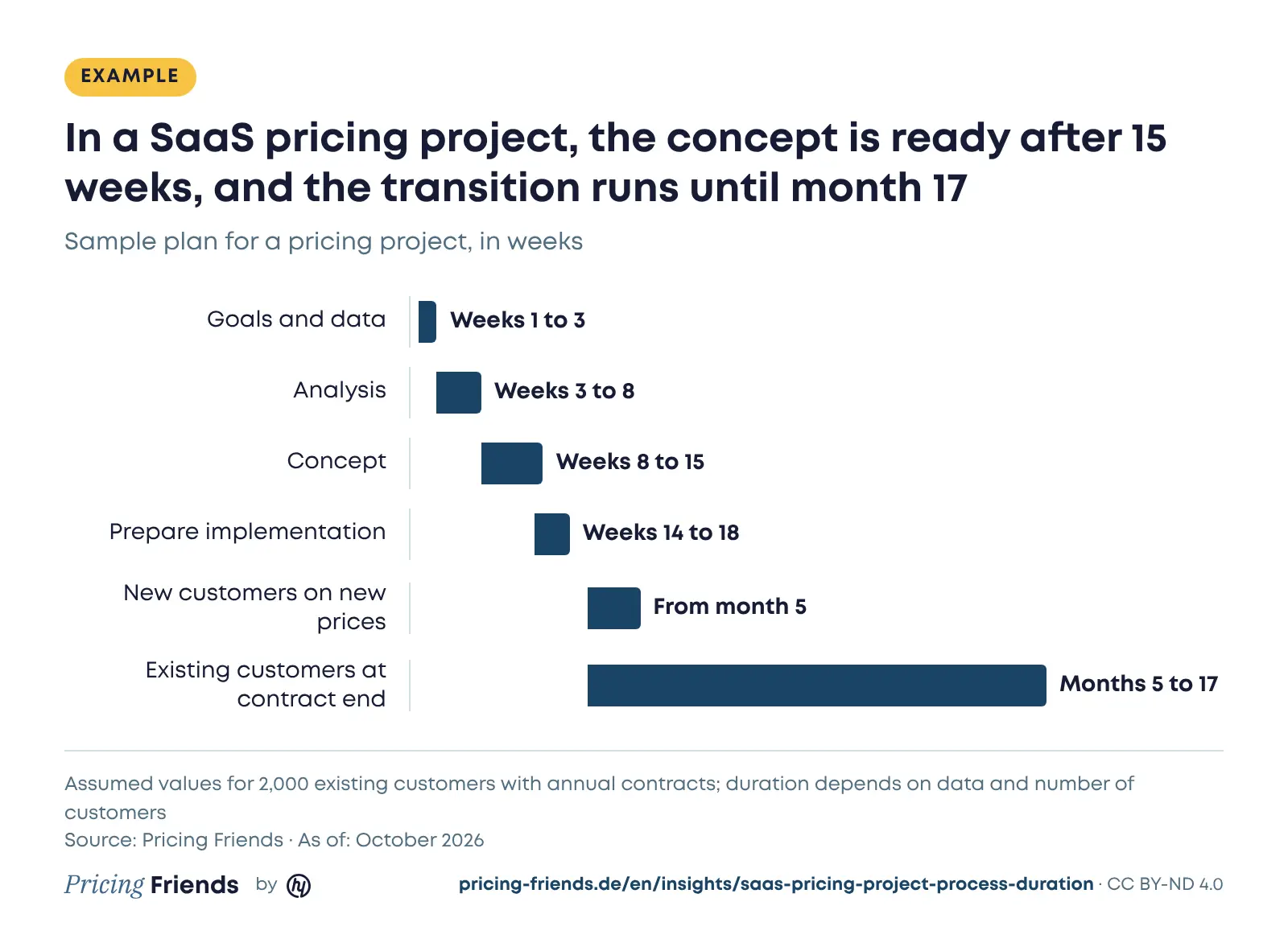
Sample plan (assumed values for a SaaS company with 2,000 existing customers on annual contracts):
| Period | What happens |
|---|---|
| Weeks 1 to 3 | Clarify goals, pull and check data |
| Weeks 3 to 8 | Competition, customer interviews, willingness to pay |
| Weeks 8 to 15 | Plans, metric, prices, business case |
| Weeks 14 to 18 | Terms and conditions, training, migration plan, approval rules |
| From month 5 | New customers on new prices, existing customers at contract end |
| After another 12 months | All annual contracts migrated once |
What you can prepare on Monday
You save the most time by having your data ready before the start:
- Revenue per customer and plan over the last 12 months.
- Discounts granted, by customer and by sales rep.
- Contract terms, notice periods and price adjustment clauses.
- How new customers are distributed across your plans.
- Usage data per customer, especially for AI features.
- A list of lost deals with the stated reason.
Bottom line: The concept takes weeks, the rollout takes months
A SaaS pricing project needs 10 to 16 weeks for analysis and concept, and two to three months more with poorly prepared data. Then the real work begins: contracts, training and a rolling migration of existing customers over one to two years. If you involve sales early and prepare your data in advance, you shorten both.
An outside view gives you a first read on where you stand today. You get it in about a minute with the free pricing audit on pricing-friends.de. It reads your pricing page live, checks pricing model, packaging and price points, and gives you a score from 0 to 100 with findings. It applies the approach hy Consulting Group developed in more than 600 pricing projects.
Sources
- SaaS & AI Pricing Report 2027 by hy, pp. 13, 84
- Pricing Friends, episode 7: Softwarelizenzen und Pricing mit Timo Müller: Wie beeinflusst die Preisgestaltung das Softwaregeschäft?
- Pricing Friends, episode 21: Change Management und Pricing mit Felix Krohn: Wie stelle ich sicher, dass Organisationen neue Pricing-Konzepte erfolgreich umsetzen?
- Pricing Friends, episode 99: Sonderfolge: SaaS-Pricing, AI und die Zukunft der Preismodelle, Dr. Sebastian Voigt bei Julius Göllner
- Pricing Friends, episode 102: Software-Abos und Pricing mit Boy Hengstmann: Wie verbindet evasys Kundentreue und Transformation?
- Pricing Friends, episode 128: Industrie-Pricing und Transformation mit Dr. Amadeus Petzke: Wie bringt man 25 Jahre Industrieexpertise und digitale DNA zusammen?
- § 307 BGB, fairness review of standard terms, on gesetze-im-internet.de
Quotes are translated from German. The podcast episodes are in German.