
Report 2027 · 5 min read
SaaS & AI Pricing Report 2027: four findings for your pricing

Key points
- According to the SaaS & AI Pricing Report 2027 by hy, 80% of the SaaS and AI vendors surveyed are planning or considering a pricing change within 12 months.
- Software pricing is going hybrid: A base fee gives predictability, and a variable component covers AI costs. 63% of the software vendors surveyed expect this model to lead in two years.
- Most software vendors include AI agents in the plan at no extra charge. But an AI agent competes with labor costs, and if you price it as a feature, it gets compared with software.
- The software shortlist is increasingly built in AI systems such as ChatGPT. Vendors that don't show their prices get compared there using someone else's price data.
If you sell software or AI products and you're working on your prices this year, this piece is for you. I've worked on software pricing for 20 years. It started with perpetual licenses, then came subscriptions and per-user pricing, and today we talk about credits, agents, workflows and outcomes. The fundamentals have rarely changed this fast.
For the SaaS & AI Pricing Report 2027, we at hy worked with the German software review platform OMR Reviews and Appinio to analyze 4,400 software profiles on OMR Reviews, survey 153 SaaS and AI companies and conduct 24 expert interviews. Here are four of the findings.
The key figures from all seven chapters are also summarized on eight pages, each with its sample and source: Download the Executive Summary (PDF), or the German Management Summary as a PDF.
1. Four in five companies are changing their pricing
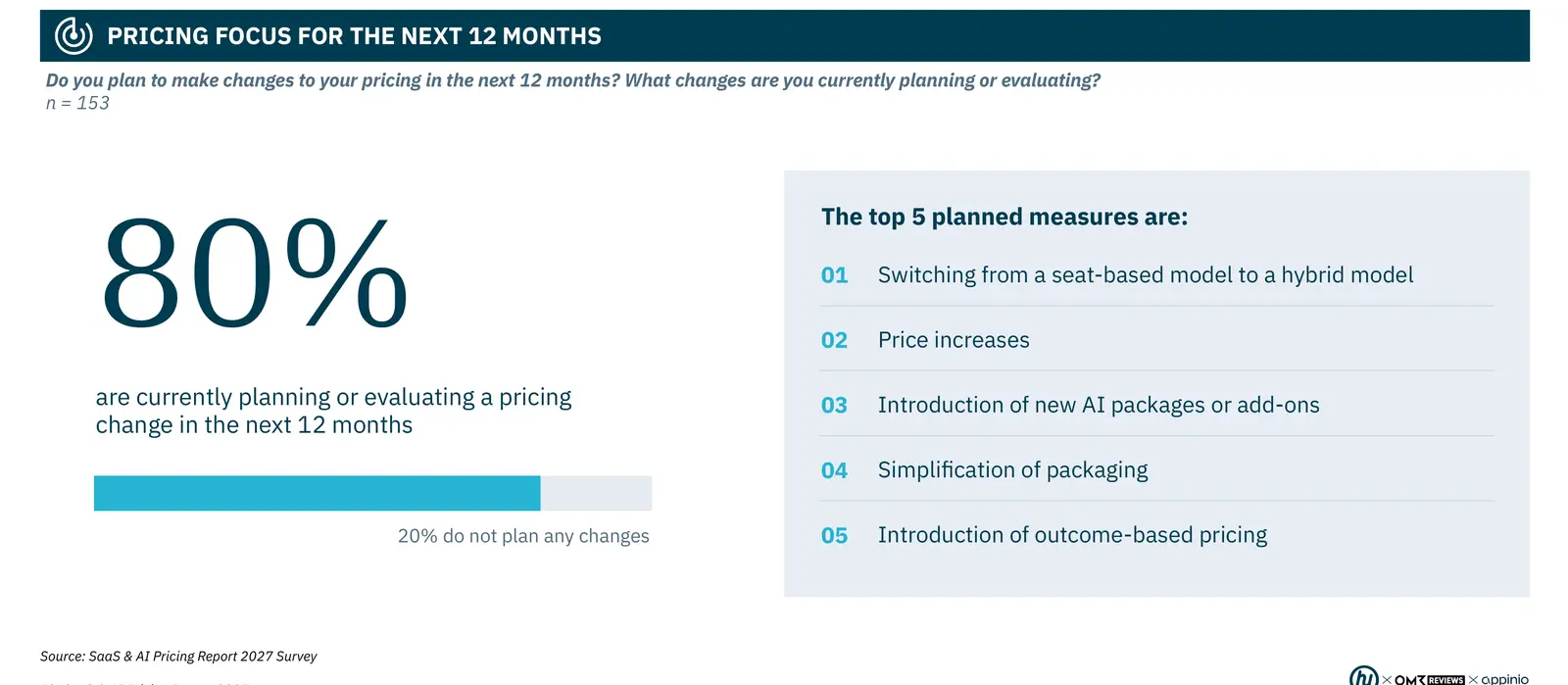
80% of the companies surveyed are planning or considering a change to their pricing in the next 12 months. The most common planned move is switching from a seat model to a hybrid model. Next come price increases, new AI plans or add-ons, simpler plans and outcome-based pricing.
That matches my experience as a consultant. A company used to call me about every three years. Now it's every year. If you leave your model unchanged in 2027, your customers will compare it with offers that are being rebuilt right now.
2. Billing goes hybrid, and the seat loses ground
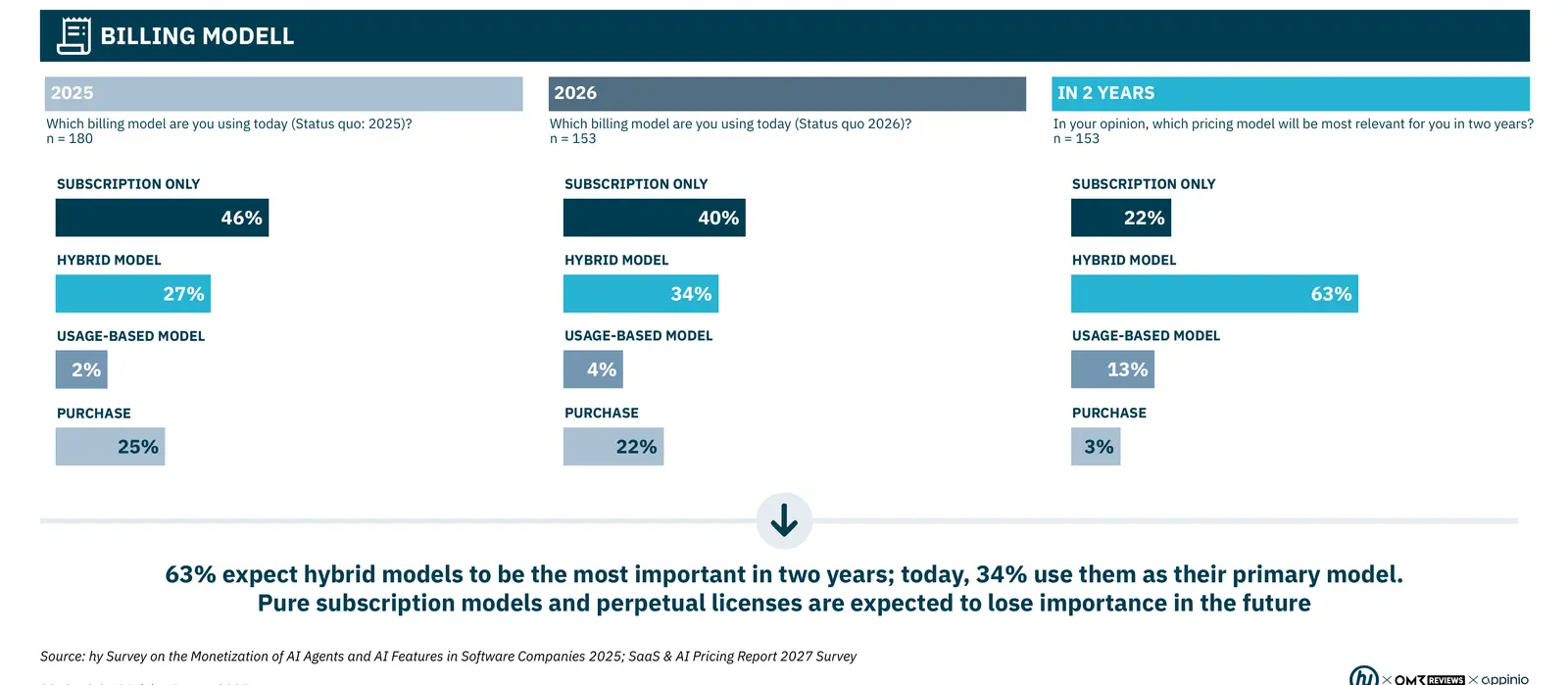
Pure subscription is still the most common primary model, at 40%. But only 22% of respondents expect it to be the most important model two years from now. By then, 63% expect to rely on hybrid models that combine a fixed base fee with variable usage, up from 34% today. As the future primary pricing metric, the seat drops 31 percentage points.
The reason is cost. Classic SaaS products could scale with almost no added cost, but with AI every interaction costs real money. According to its price list, OpenAI charges $2 per million input tokens and $10 per million output tokens for its gpt-6.1-sol model (as of October 2026). A fixed base fee gives the customer predictability, and the variable part covers your AI costs. A quarter of respondents, however, haven't yet settled on a target metric.
3. AI and agents mostly still sit inside the existing plan
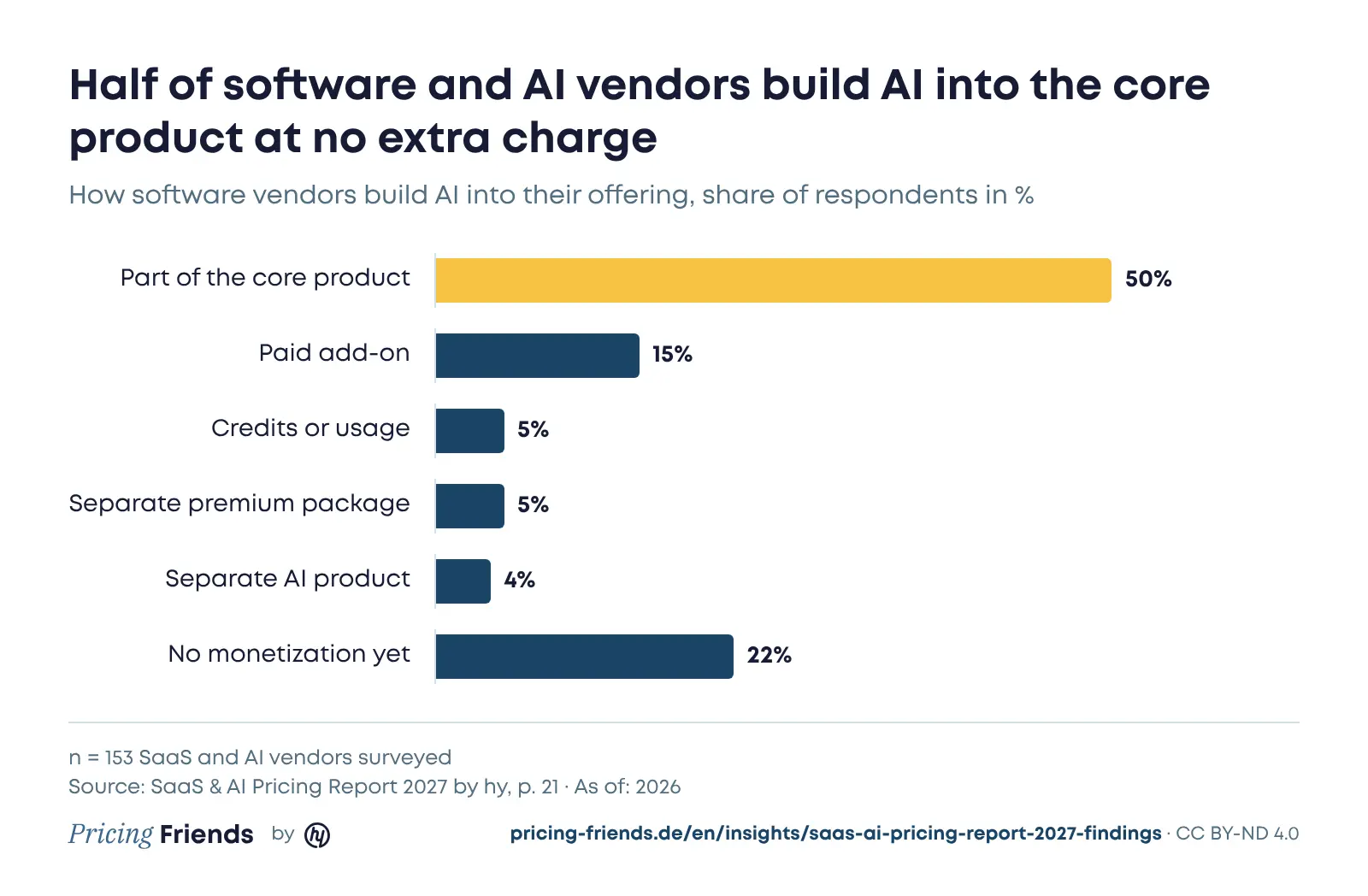
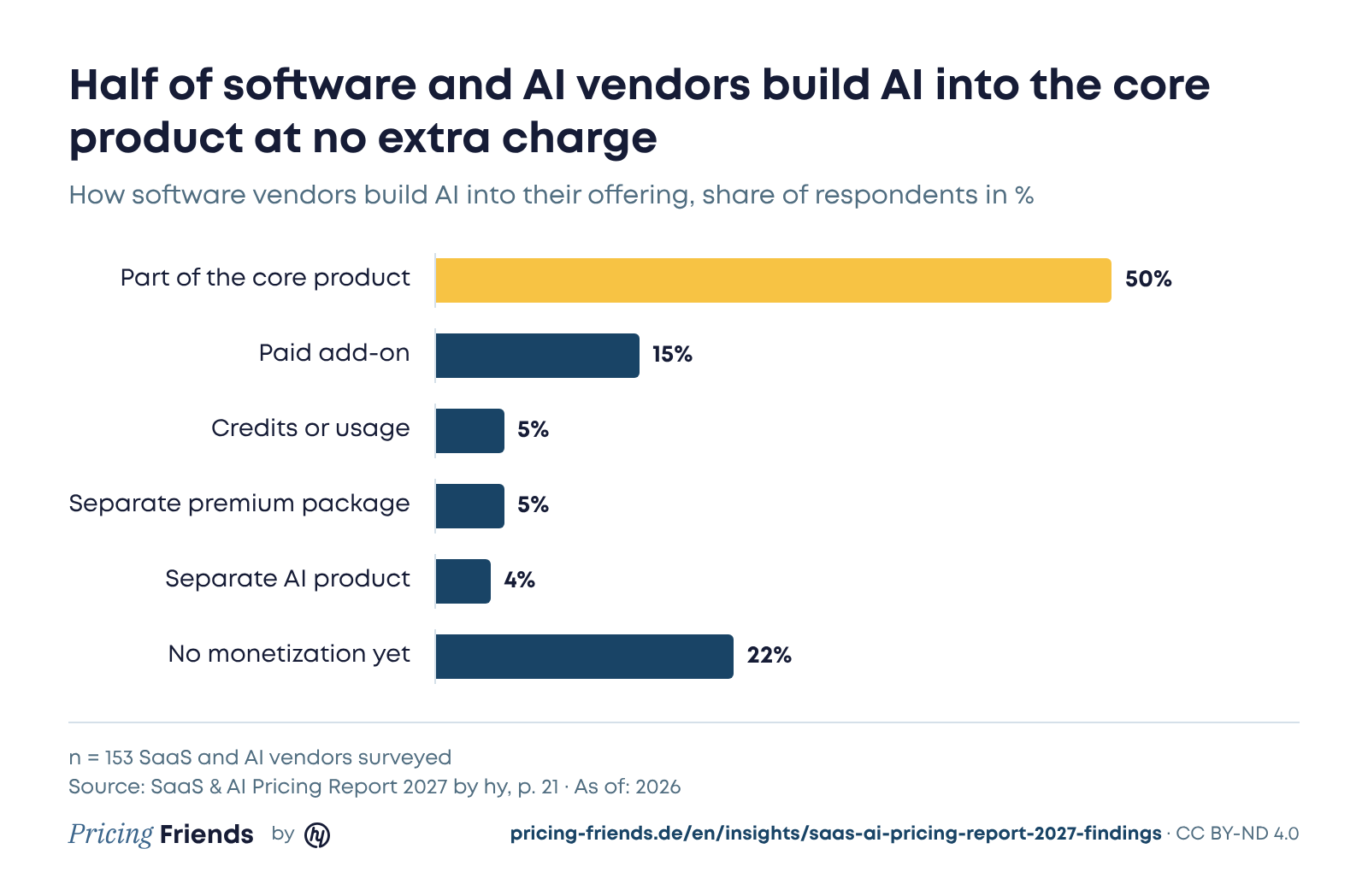
50% of respondents build AI into the core product at no extra charge. 22% don't monetize AI at all yet. Agents look similar: 62% include them in existing plans or don't have a strategy yet.
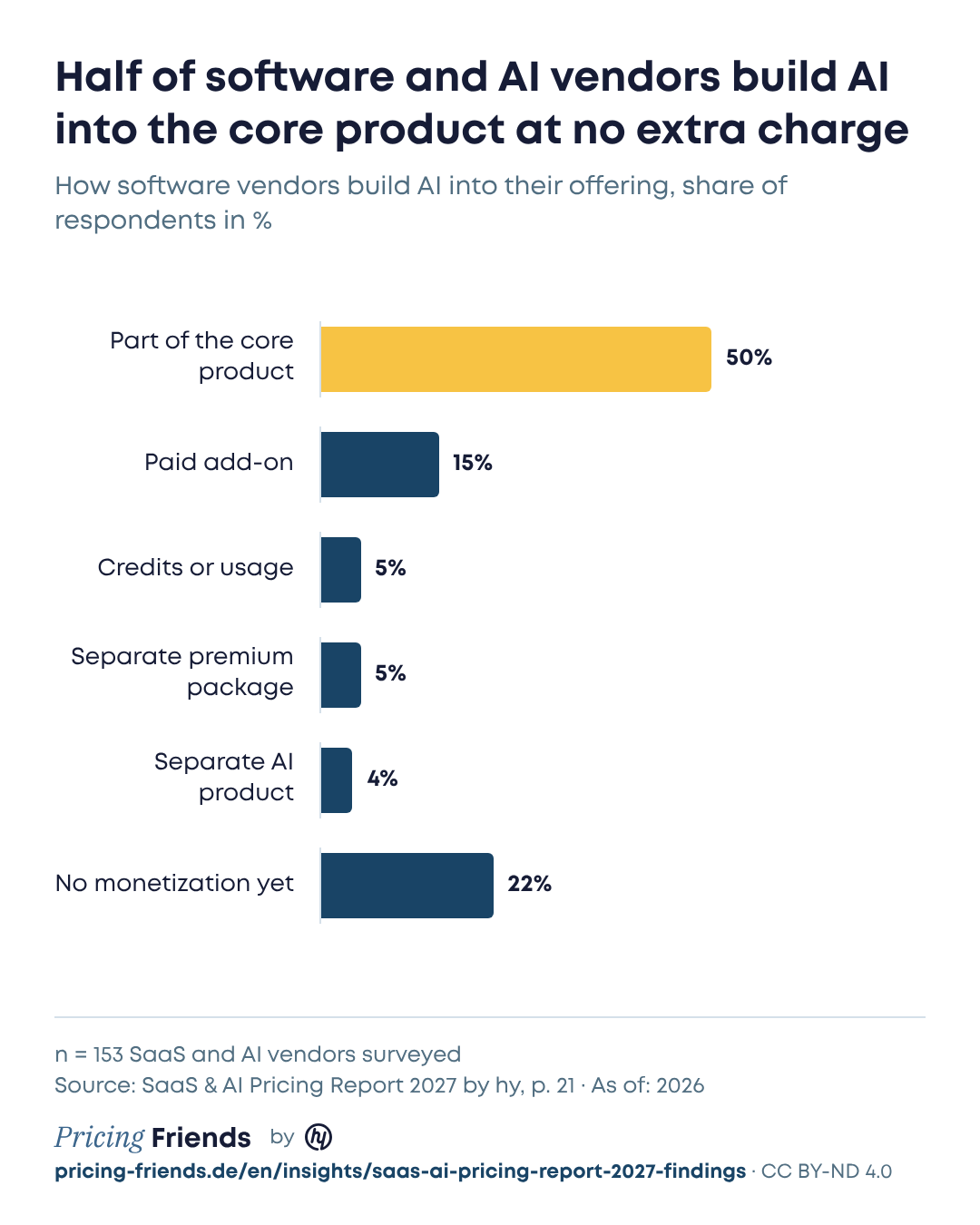
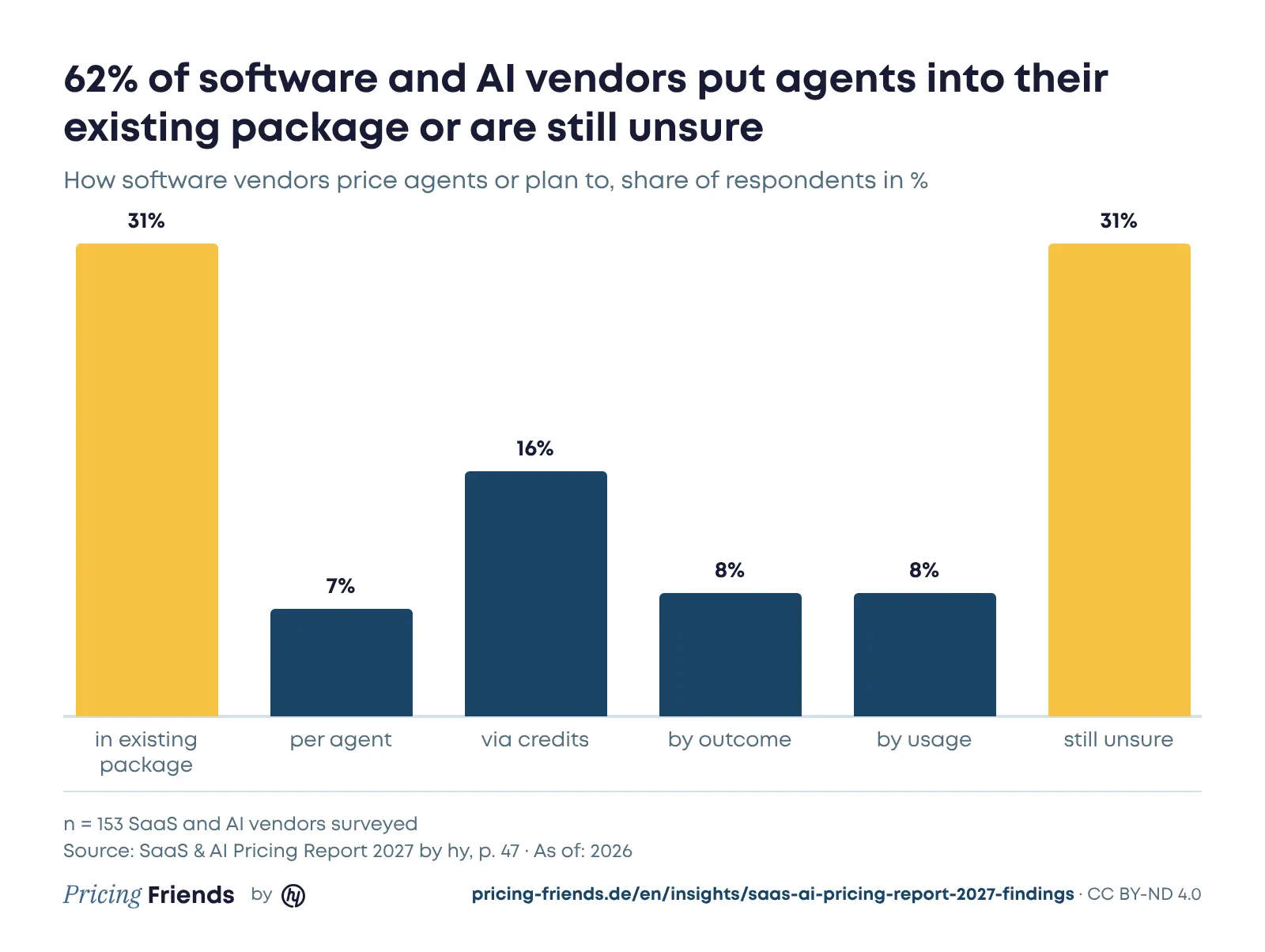
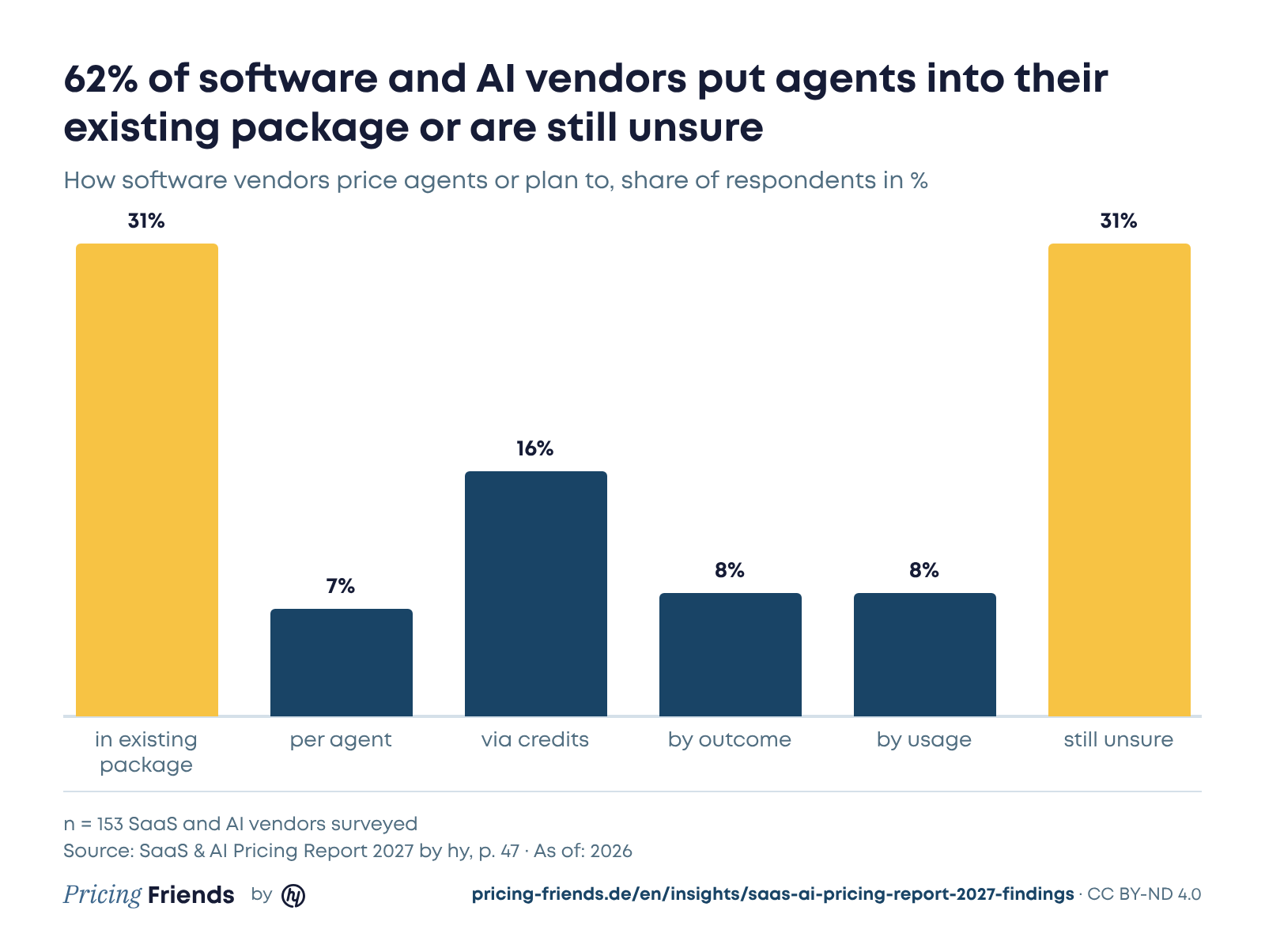
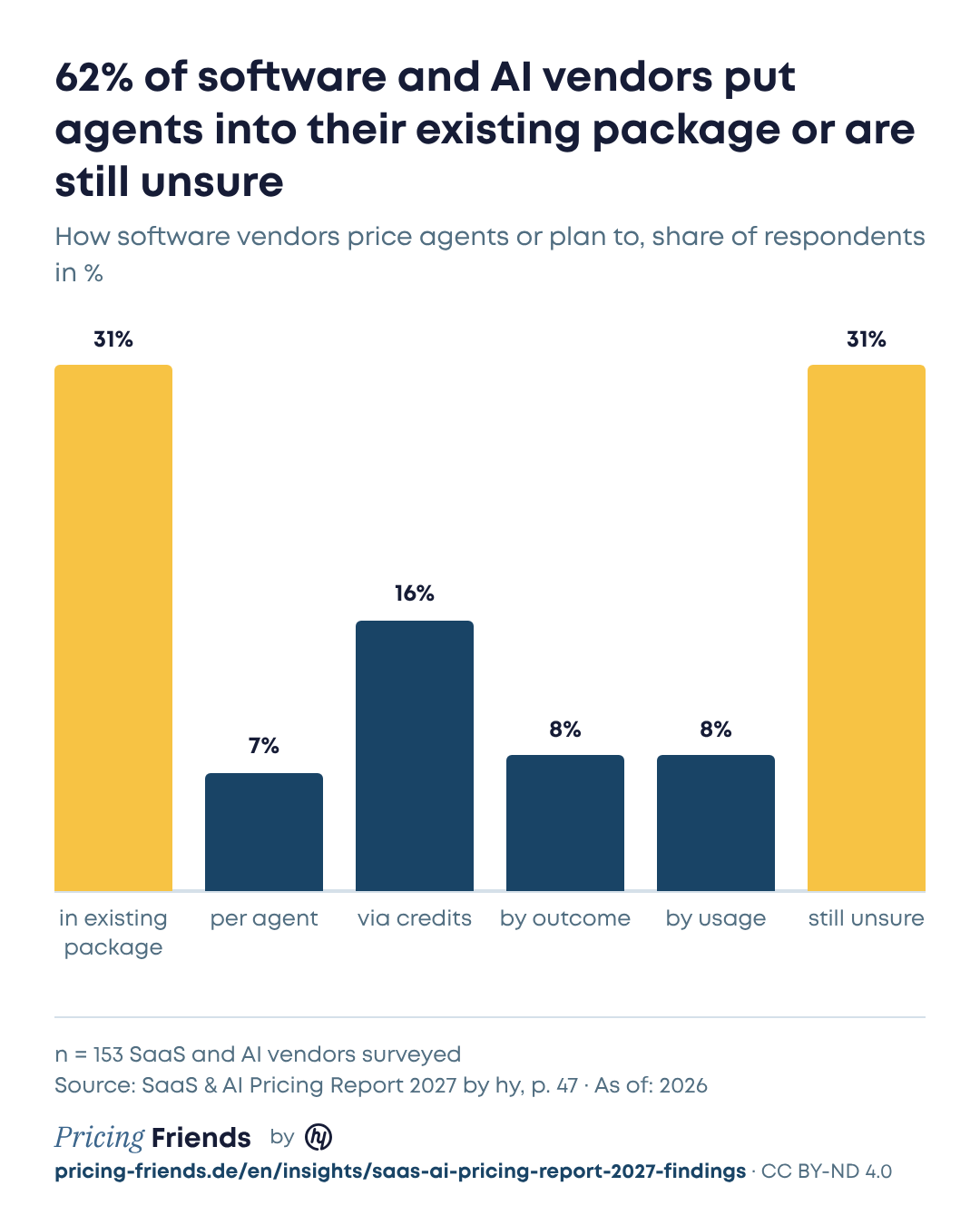
My hypothesis: With AI, the efficiency logic is far ahead of the monetization logic. An AI feature can take a lot of work off the customer's plate and still not bring the vendor a single extra euro. For agents, distinguishing by budget helps. Features compete for the customer's software budget, agents for their personnel budget. If you price an agent like a feature, it gets compared with software, even though it does work.
4. The shortlist is increasingly built in an AI system
Many software buyers in Germany, Austria and Switzerland now start their research in an AI system. A survey by the German digital industry association Bitkom shows how fast AI is spreading in companies: In 2026, 57% of German companies with 20 or more employees use AI, up from 20% two years earlier. 92% of B2B buyers end up buying a product that was already on their first list, according to a study by Google and Bain. If you're not on that list, you don't even make it into the price negotiation.
On prices, it's in your hands. Hiding your prices doesn't take you out of the comparison. You only lose control over the price you're compared on. The free pricing audit on pricing-friends.de shows you in about a minute whether ChatGPT, Claude and Gemini get your prices right. It reads your pricing page live, asks the three systems about your prices and gives you a score from 0 to 100. The check follows the approach hy Consulting Group developed in more than 600 pricing projects.
Bottom line: First the unit, then the number
Successful AI pricing doesn't start with a number. It starts with the question of what value your product creates and which unit best reflects that value. That's why product, packaging and price belong in one system.
In the full report, you'll find data on plans, billing models and pricing metrics, chapters on AI features, agents, workflows and AI infrastructure, case studies such as Figma, Microsoft and Intercom, and an eight-step approach for building your own pricing model. Download the SaaS & AI Pricing Report 2027 here.
Sources
- SaaS & AI Pricing Report 2027 by hy, pp. 3, 7, 12, 13, 21, 30, 32, 46, 47, 74, 76, 80, 84
- Bitkom: Erstmals nutzt die Mehrheit der Unternehmen KI (For the first time, most companies use AI), Sept. 14, 2026
- OpenAI: API pricing, accessed Oct. 17, 2026
- Pricing Friends, episode 142: SaaS- und AI-Pricing mit Mariella Knospe und Felix Rahlmeyer: Wie bepreist man Software und AI im Jahr 2027?
The podcast episodes are in German.