
Pricing strategy · 7 min read
Pricing consultancy or head of pricing: what pays off when
hy pricing teamReviewed by experts at hy
- Published
- Updated
Key points
- If a company has a pricing initiative with a clear end, such as new plans, external pricing consulting pays off. If pricing decisions come up every week, a head of pricing pays off.
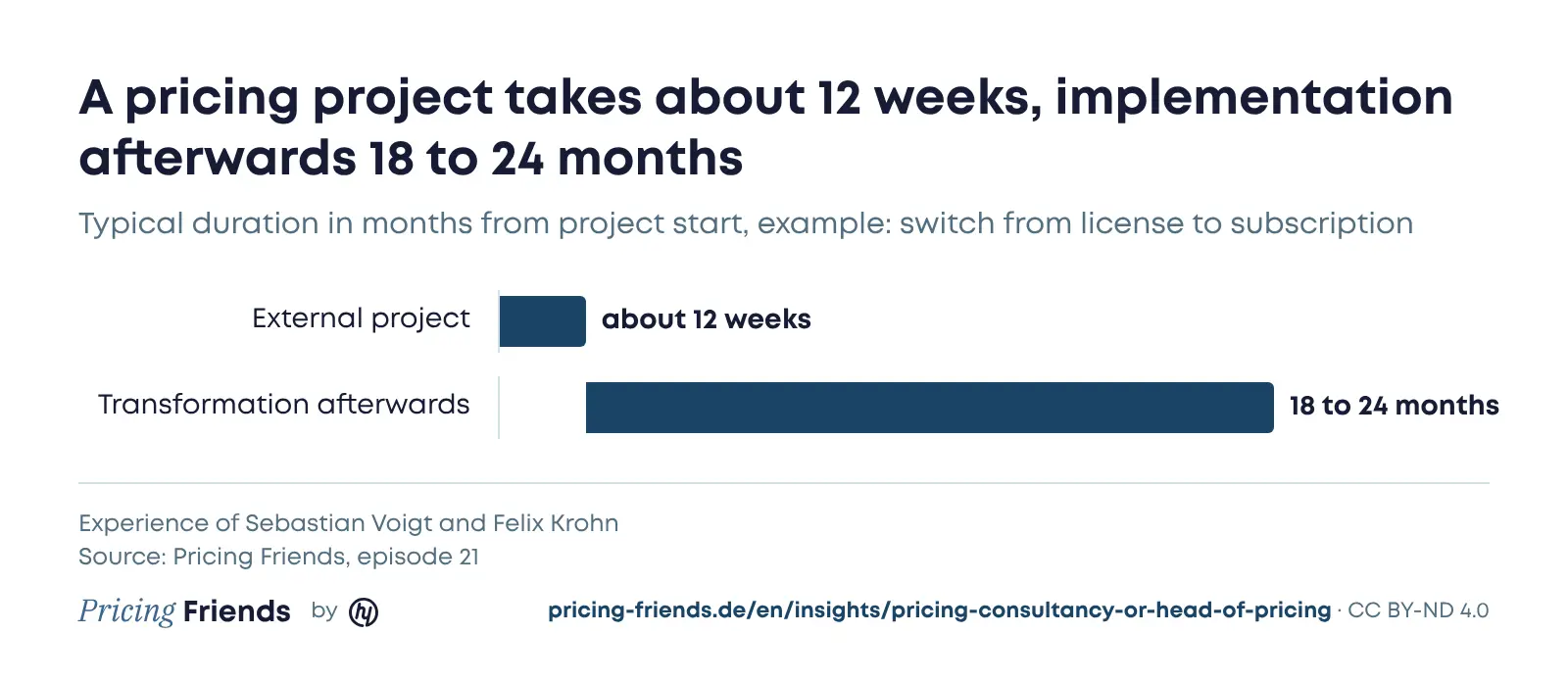
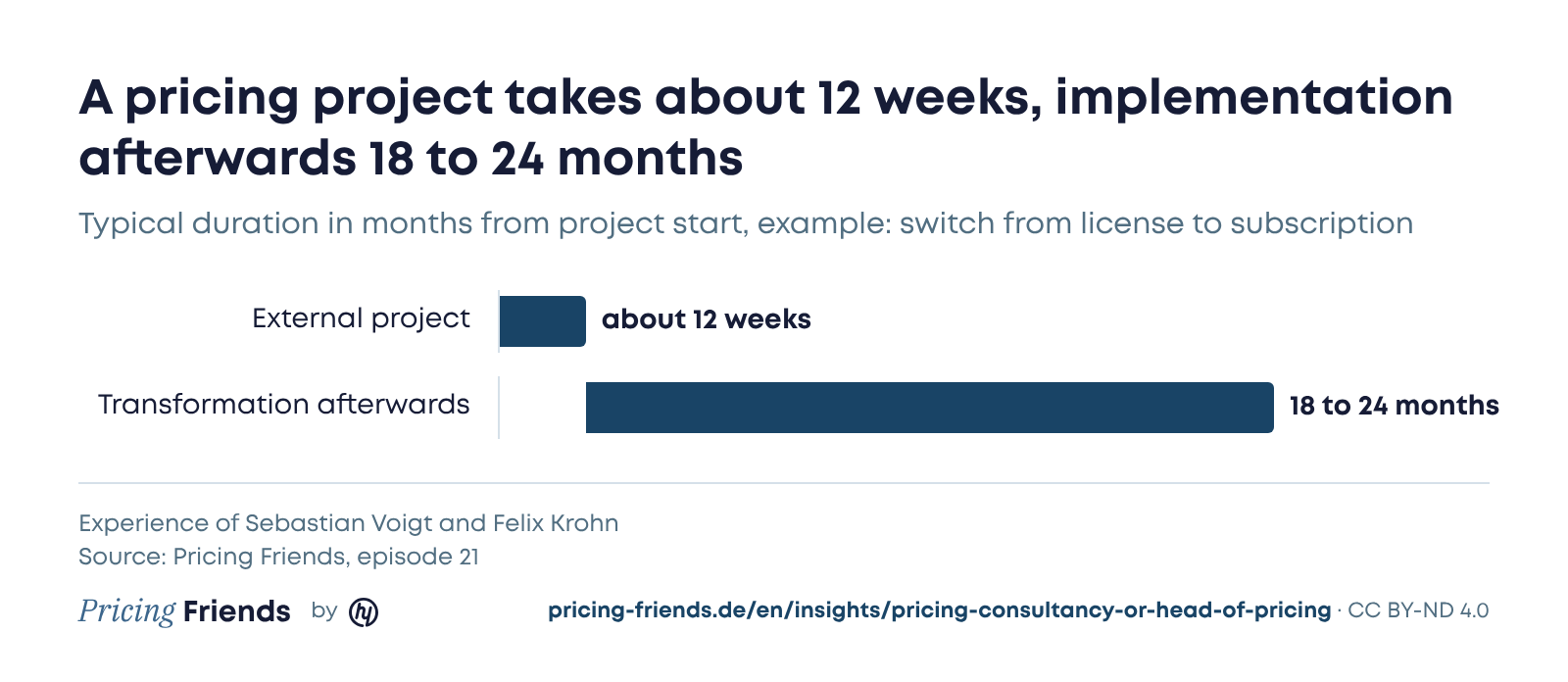
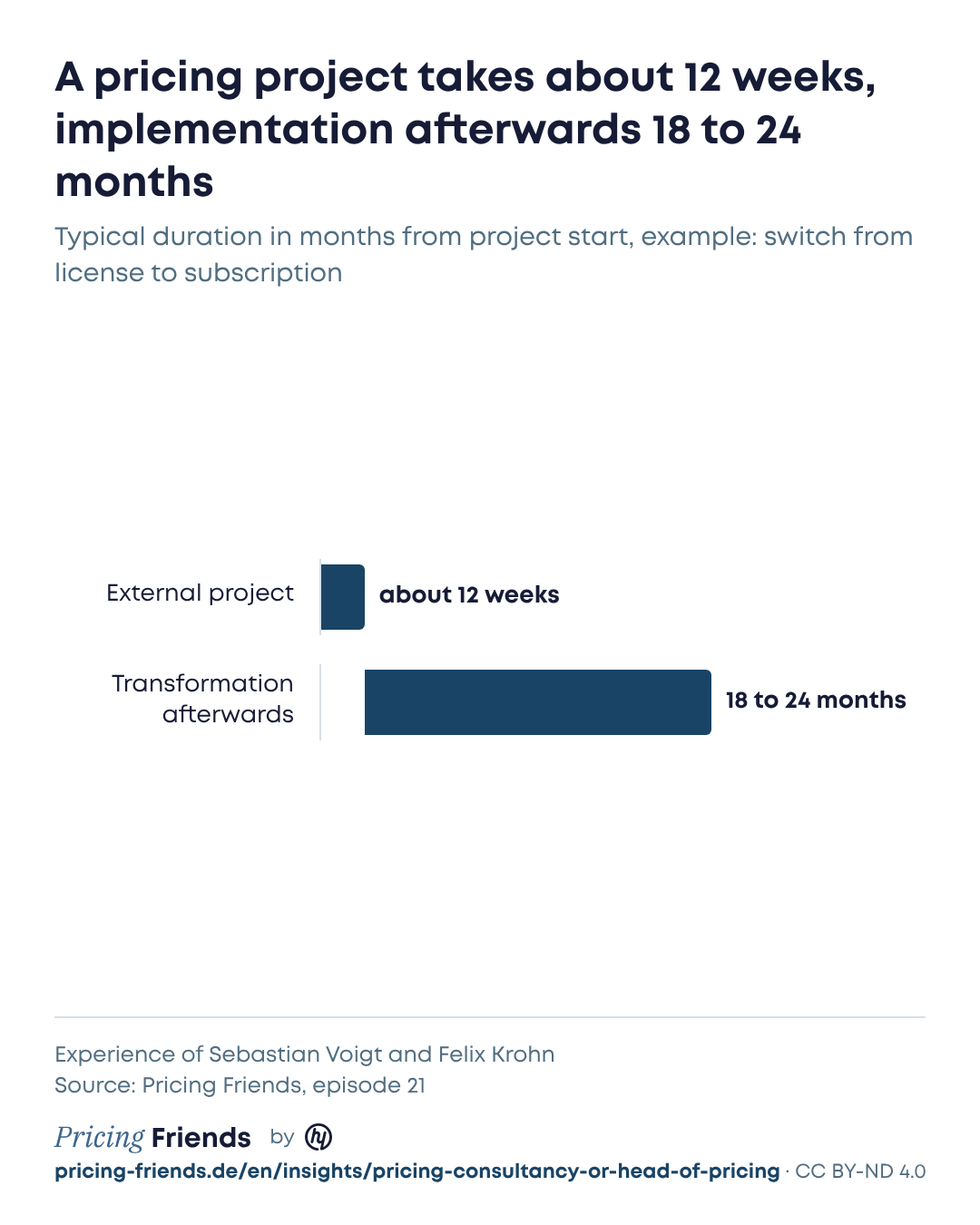
- A project with an external pricing consultancy takes about twelve weeks. Implementation inside the company then takes 18 to 24 months. Without an internal owner, the results stall.
- By one rule of thumb, a full-time pricing role only pays for itself at around €110–170 million in company revenue. Below that, an external pricing project is usually enough.
- If a company creates its own pricing role, it's better to start with an analytical role that first brings transparency to pricing data.
If you run a software company and pricing comes up, the question of who should own it comes up fast. Our short answer: For an initiative with a clear end, such as new plans, a new pricing model or monetizing AI features, an external project pays off. A head of pricing pays off when pricing decisions come up every week and someone has to own them permanently. Often the right answer is both, in a specific order.
This article is for CEOs, CROs and CFOs facing this decision right now. We know both sides: Sebastian Voigt, partner at hy, started as head of pricing at Axel Springer in 2016. Today we advise software and tech companies.
What an external project delivers
A project brings two things above all: speed and comparison. Someone who has seen many pricing models from the inside spots faster where yours gets stuck. They also know which solution worked in a similar situation. Sebastian Voigt has worked on more than 100 pricing projects. In his experience, a classic consulting project, such as moving from licenses to subscriptions, takes about twelve weeks.
But a project won't enforce the new prices for you month after month. According to Felix Krohn, the transformation that follows takes 18 to 24 months. Krohn guides companies through these changes, and in the same conversation he described what a good client makes sure of at the end of a project: “First: a good handover. It's a huge mistake if that doesn't happen.” If nobody inside takes over the results, they stall.
That's why we focus on the handover instead of a big final presentation. As Sebastian Voigt puts it: “We rarely do final presentations, we always do implementation kick-offs, because of course we want to set up the handover properly.” That only works if there's someone on your side to hand over to.
What a head of pricing delivers
An internal role pays off for the decisions that come up all the time. These include discount approvals, offers outside the price list and the annual price adjustment for existing customers. They also include deciding which plan a new feature belongs in. This work is more likely to grow. For our SaaS & AI Pricing Report 2027, we surveyed 153 SaaS and AI companies. 80% of them are planning or considering a change to their pricing in the next twelve months. The report expects pricing to become a core competency, for pricing teams but also for product management, sales and leadership.
Kevin Mitchell, president of the Professional Pricing Society, has explained how big such a team should be. In his experience, companies that do pricing very well have six to nine full-time pricing staff per billion euros or dollars of revenue. He also described when many companies actually start: usually only when results fall short. Then someone from finance or sales is declared the new pricing department and has to learn the craft on the side.
Worked example: Applying Mitchell's rule of thumb to a software company gives the following picture.
| Annual revenue | Pricing capacity by the rule of thumb |
|---|---|
| €20 million | 0.12 to 0.18 full-time roles |
| €50 million | 0.3 to 0.45 full-time roles |
| €150 million | 0.9 to 1.35 full-time roles |
| €500 million | 3 to 4.5 full-time roles |
Our own calculation based on episode 78. The rule of thumb comes from companies across all industries, not specifically software.
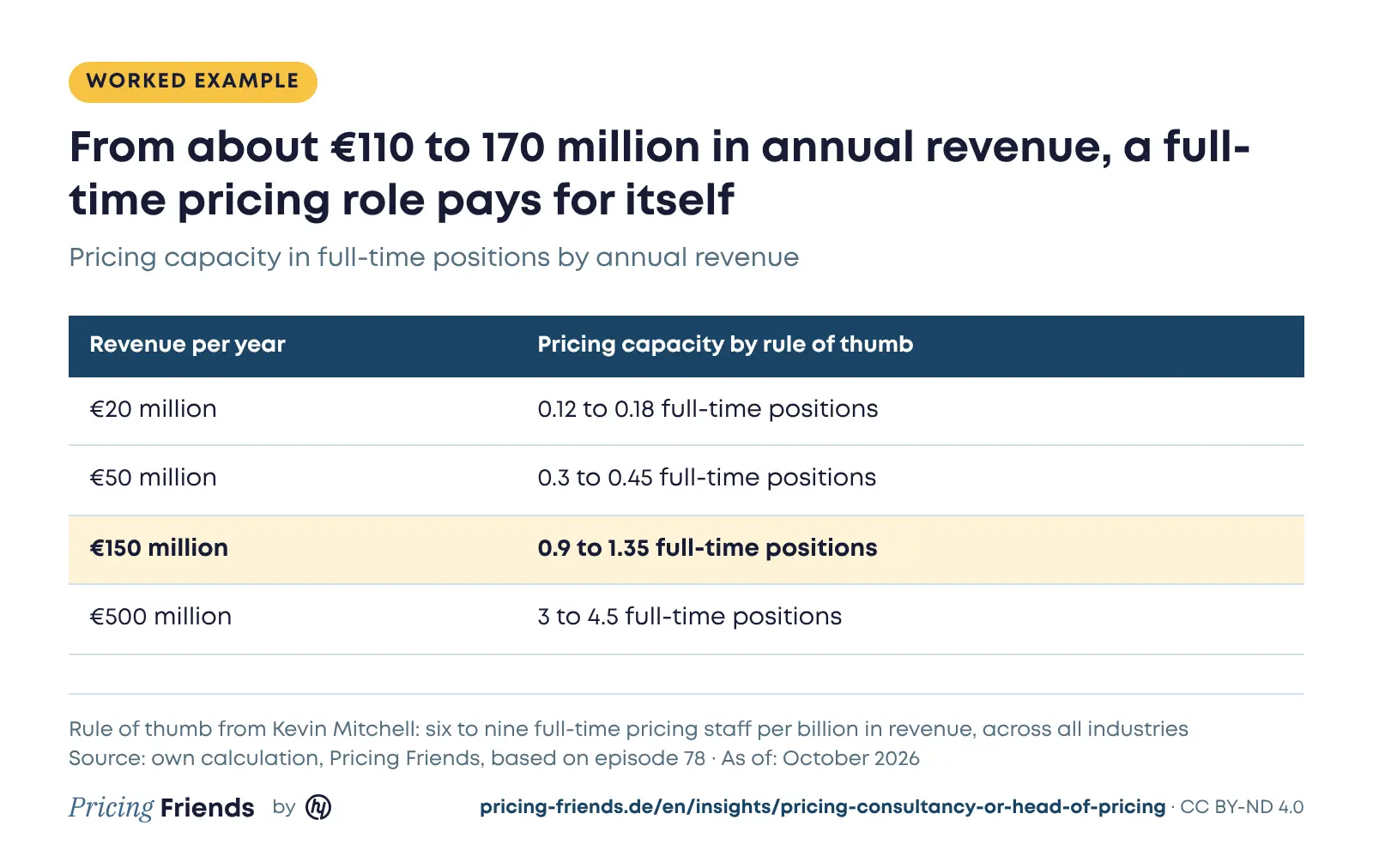
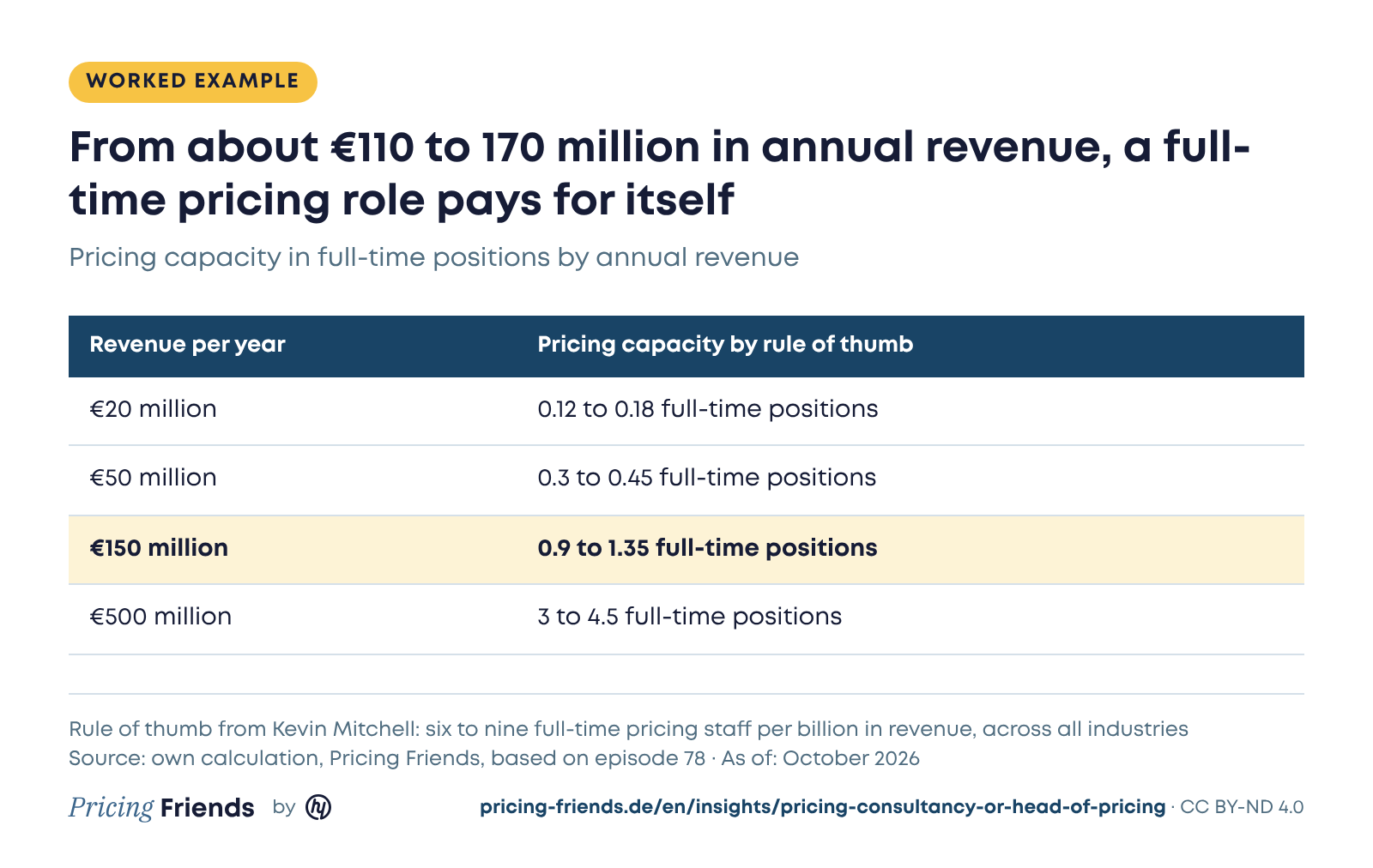
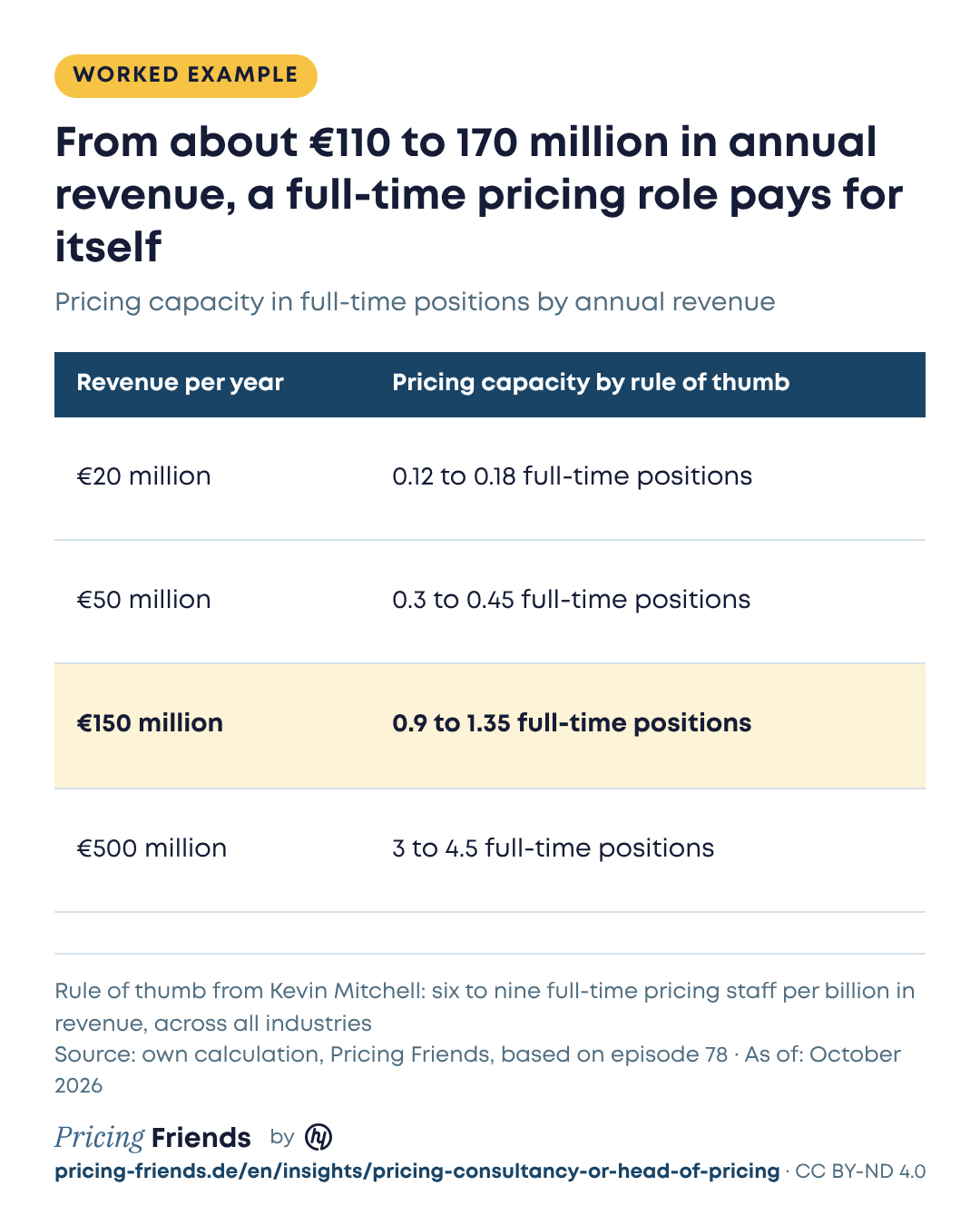
By this calculation, a full-time role pays for itself from about €110–170 million in revenue. Below that, a full-time head of pricing would be overstaffing by the rule of thumb. The exception is businesses with an unusually high number of pricing decisions, for example due to many products, several countries or individually negotiated deals. The figure is a rough starting point. We expect AI features, credits and hybrid models to increase the number of pricing decisions per euro of revenue. That would also lower the threshold for a dedicated role.
Whom to hire first
If you create a role, the next question is: analyst or director? Diana Coelho, chair of the pricing community EPP, would start with an analytical role. Her argument: A strong leader first needs transparency into data and processes. Only then can they build credibility inside the company. She has also observed that many companies still treat pricing as a project and hire consultants instead of building their own capabilities.
A pricing role is half analysis and half persuasion, and Coelho draws a clear line between the two. Getting list prices into the ERP without errors takes different skills than explaining new rules to sales.
Decision table
| Your situation | Our recommendation |
|---|---|
| Plans or the pricing model are being rebuilt from the ground up, once | External project with a named internal owner |
| AI features are supposed to bring revenue, the pricing metric is open | External project, since 25% of respondents don't yet have a target metric |
| Existing customers are to get higher prices in a one-off move | External project, then an annual routine in-house |
| Sales negotiates almost every deal individually with a discount | Internal role with approval rules |
| Several products, countries and an annual pricing round | Internal role, a full-time position from about €110 million in revenue |
| Unclear where the problem lies | Short external check, then decide |
We describe separately how such a project runs, phase by phase. For the work that stays in-house afterward, you need firm rules for discounts and someone who enforces the pricing logic in sales, deal by deal.
The combination we recommend
In our view, the order matters most. First a project for the big change, with one person on your side from day one who takes it over. That can be a CRO, a product manager or someone from RevOps. As the work grows, it becomes a dedicated role.
Amadeus Petzke, partner at hy, put it this way: “What I really want to have in the company, what then truly sets me apart from my competitors in the market, is the ability to always find the best price for the product at launch, but also across the life cycle.” A project lays the foundation. The capability is built inside the company. Research sees it similarly: In 2003, Shantanu Dutta, Mark Zbaracki and Mark Bergen studied the pricing process of a large U.S. manufacturer and describe pricing as a capability in its own right. If you want to set the right prices, you have to invest in resources and routines.
For Monday, three questions to your leadership team are enough:
- How many pricing decisions outside the price list do you make each month?
- Who owns them today, and how much time does that cost this person?
- Is a change with a clear end coming up in the next twelve months, such as new plans or a new billing model?
Many ongoing decisions point to a role, a big change to a project. Our eight-step approach shows how we structure pricing.
Bottom line: First the change, then the routine
An external project pays off for the big change, a head of pricing for the ongoing decisions after it. By Kevin Mitchell's rule of thumb, a full-time role pays for itself from about €110–170 million in revenue. Below that, we consider a project with a clear internal owner the better choice than a role without a mandate.
You can get a first outside look at your pricing in about a minute with the free pricing audit on pricing-friends.de. It reads your pricing page live, checks pricing model, packaging and price points, and gives a score from 0 to 100 with findings. It checks against the approach hy Consulting Group developed in more than 600 pricing projects.
Sources
- SaaS & AI Pricing Report 2027 by hy, pp. 13, 32, 82
- SaaS & AI Pricing Report 2026 by hy, p. 4
- Shantanu Dutta, Mark J. Zbaracki and Mark Bergen: Pricing Process as a Capability: A Resource-Based Perspective, Strategic Management Journal 24 (7), 2003
- Pricing Friends, episode 21: Change Management und Pricing mit Felix Krohn: Wie stelle ich sicher, dass Organisationen neue Pricing-Konzepte erfolgreich umsetzen?
- Pricing Friends, episode 78: PPS and Pricing with Kevin Mitchell: What makes a strong pricing leader today?
- Pricing Friends, episode 128: Industrie-Pricing und Transformation mit Dr. Amadeus Petzke: Wie bringt man 25 Jahre Industrieexpertise und digitale DNA zusammen?
- Pricing Friends, episode 146: Pricing Enablement with Diana Coelho: How is EPP shaping the next generation of pricing professionals?
Quotes are translated from German. The podcast episodes are in German.